Loading...
Done
A sea otter in the Great Bear Rainforest, off the Pacific coast of British Columbia, Canada in the second decade of December 2024, appeared to be enjoying a relaxing swim as it preened its fur, the densest of any mammal. (Photo by Max Waugh/Solent News & Photo Agency)

A sea otter in the Great Bear Rainforest, off the Pacific coast of British Columbia, Canada in the second decade of December 2024, appeared to be enjoying a relaxing swim as it preened its fur, the densest of any mammal. (Photo by Max Waugh/Solent News & Photo Agency)
Details
29 Dec 2024 01:48:00
A woman poses by “Leaf Spirit” by Simon Gudgeon at the FORM 24 show at Sculpture by the Lakes, on April 02, 2024 in Dorchester, England. The award-winning sculpture show runs from April 2 to June 1, with works by more than 35 leading contemporary sculptors exhibited throughout 26-acres of lakes, rivers, gardens, and woodlands as well as in the Gallery and The Retreat. FORM includes a series of talks and events to accompany the exhibition, including “Meet the Artist” Q&A sessions with exhibiting sculptors, workshops and demonstrations. (Photo by Finnbarr Webster/Getty Images)

A woman poses by “Leaf Spirit” by Simon Gudgeon at the FORM 24 show at Sculpture by the Lakes, on April 02, 2024 in Dorchester, England. The award-winning sculpture show runs from April 2 to June 1, with works by more than 35 leading contemporary sculptors exhibited throughout 26-acres of lakes, rivers, gardens, and woodlands as well as in the Gallery and The Retreat. FORM includes a series of talks and events to accompany the exhibition, including “Meet the Artist” Q&A sessions with exhibiting sculptors, workshops and demonstrations. (Photo by Finnbarr Webster/Getty Images)
Details
30 Apr 2024 04:56:00
A rose chafer in Oxfordshire, UK on July 8, 2024. The beetles are often seen on flowers in the garden and are sometimes maligned for munching their way through these plants. However, they are an important detritivore as they feed on dead and decaying matter and recycle its nutrients, which makes a helpful addition to any compost. (Photo by Geoffrey Swaine/Rex Features/Shutterstock)

A rose chafer in Oxfordshire, UK on July 8, 2024. The beetles are often seen on flowers in the garden and are sometimes maligned for munching their way through these plants. However, they are an important detritivore as they feed on dead and decaying matter and recycle its nutrients, which makes a helpful addition to any compost. (Photo by Geoffrey Swaine/Rex Features/Shutterstock)
Details
21 Jul 2024 05:04:00
Kawakanih Yawalapiti, 9, Upper Xingu region of Mato Grosso, Brazil, 2018: Kawakanih lives with her tribe, the Yawalapiti, in Xingu national park, a preserve in the Amazon basin of Brazil. The Yawalapiti collect seeds to preserve species unique to their ecosystem, which lies between the rain forest and savannah. Kawakanih’s diet is simple, consisting mainly of fish, cassava, porridge, fruit and nuts. “It takes five minutes to catch dinner”, says Kawakanih. “When you’re hungry, you just go to the river with your net”. (Photo by Gregg Segal/The Guardian)

Photographer Gregg Segal travelled the world to document children and the food they eat in a week. Partly inspired by the increasing problems of childhood obesity, he tracked traditional regional diets as yet unaffected by globalisation, and ironically, found that the healthiest diets were often eaten by the least well off. (Photo by Gregg Segal/The Guardian)
Details
03 Jul 2019 00:03:00
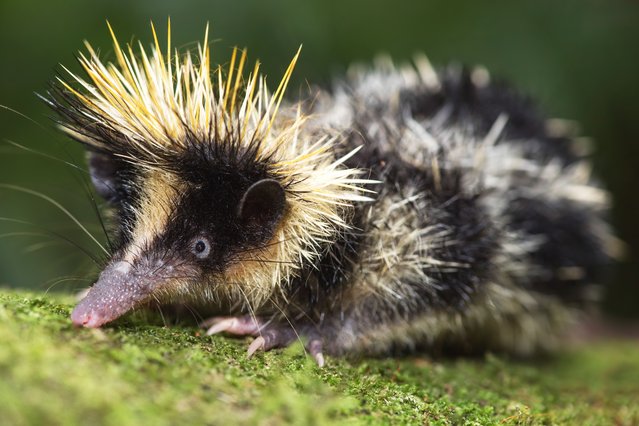
This spiky tenrec was spotted in Madagascar’s Mantadia National Park in the last decade of September 2025. Mostly nocturnal and rarely seen, it puffs out its spines when threatened. Spiky tenrecs are excellent swimmers — unlike most spiny mammals, some species of tenrec can forage in streams and rivers, using their spines for protection while hunting aquatic insects and small prey. (Photo by Dale Morris/Solent News & Photo Agency)

This spiky tenrec was spotted in Madagascar’s Mantadia National Park in the last decade of September 2025. Mostly nocturnal and rarely seen, it puffs out its spines when threatened. Spiky tenrecs are excellent swimmers — unlike most spiny mammals, some species of tenrec can forage in streams and rivers, using their spines for protection while hunting aquatic insects and small prey. (Photo by Dale Morris/Solent News & Photo Agency)
Details
05 Oct 2025 04:02:00
A woman walks past debris as Super Typhoon Ragasa hits the Central district in Hong Kong on September 24, 2025. Hong Kong's weather service issued the highest level of typhoon warning in the early hours, as Super Typhoon Ragasa brought powerful winds and lashing rain to the southern Chinese coast. (Photo by Peter Parks/AFP Photo)

A woman walks past debris as Super Typhoon Ragasa hits the Central district in Hong Kong on September 24, 2025. Hong Kong's weather service issued the highest level of typhoon warning in the early hours, as Super Typhoon Ragasa brought powerful winds and lashing rain to the southern Chinese coast. (Photo by Peter Parks/AFP Photo)
Details
07 Oct 2025 04:26:00
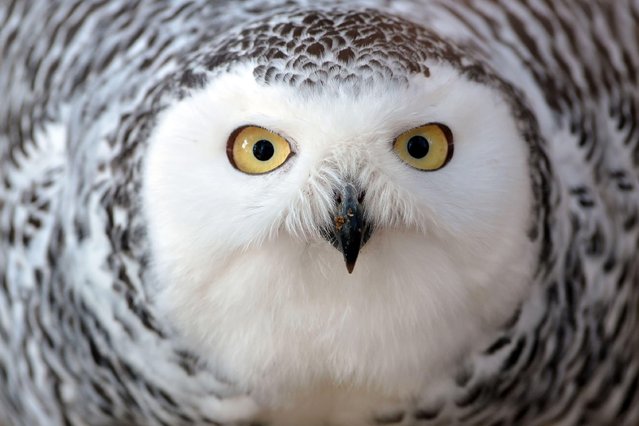
A snowy owl (Bubo scandiacus) raised by a falconer as part of a captive-breeding program, pictured in its enclosure in Vysocina, Czech Republic on October 22, 2025. (Photo by Slavek Ruta/ZUMA Press Wire via Alamy Live News)

A snowy owl (Bubo scandiacus) raised by a falconer as part of a captive-breeding program, pictured in its enclosure in Vysocina, Czech Republic on October 22, 2025. (Photo by Slavek Ruta/ZUMA Press Wire via Alamy Live News)
Details
02 Nov 2025 05:16:00
Highly commended birds : Crested guan by Tim Hunt (UK). ‘This photo shows a crested guan in the cloud forests of Costa Rica as it pauses while foraging on a lone branch. Due to the clouds that are so typical for this habitat, I could often only photograph the bird’s silhouette against a grey sky. (Photo by Tim Hunt/GDT European Wildlife Photographer of the Year 2015)

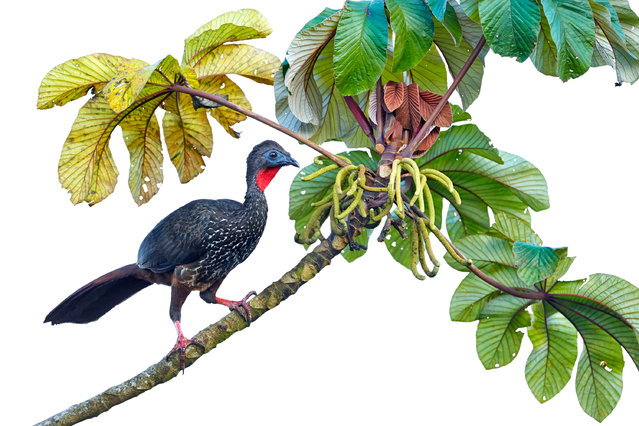
Highly commended birds : Crested guan by Tim Hunt (UK). ‘This photo shows a crested guan in the cloud forests of Costa Rica as it pauses while foraging on a lone branch. Due to the clouds that are so typical for this habitat, I could often only photograph the bird’s silhouette against a grey sky. But then, for a short moment only, the sun broke through the clouds, and I overexposed the image by over two stops in order to blow out the background and allow this beautifully marked bird to stand out’. (Photo by Tim Hunt/GDT European Wildlife Photographer of the Year 2015)
Details
24 Nov 2015 08:01:00