A market trader in Gaibandha in Bangladesh on September 25, 2019, surrounded by bottle gourd vegetables, which sell for around 3p ($ 0.04) each. (Photo by Solent News)
People carry lychee for sale on a motorbike on a street in Luc Ngan, Bac Giang province, Vietnam, 22 June 2016. Lychee output in Bac Giang province is expected to reach 130,000 tonnes this year. China is still Vietnam's main lychee export market so far, buying around 60 percent of the annual crop, according to official reports. (Photo by Luong Thai Linh/EPA)
A man helps a woman with blood on her face after security guards saw her looting in a hotel during a protest demanding the resignation of Haiti's Prime Minister Ariel Henry after weeks of shortages, in Port-au-Prince, Haiti on October 10, 2022. (Photo by Ralph Tedy Erol/Reuters)
Thousands of bright Red Potatoes are washed and sorted at a vegetable market. Workers hose down tons of the vegetables before packing them into sacks at the market in Shibganj Upazila, Bogura, Bangladesh on February 19, 2023. The Red La Soda spuds are then taken to the country's capital Dhaka. (Photo by Mustasinur Rahman Alvi/Rex Features/Shutterstock)
Filipino students performs during the parade at the 125th Philippine’s Independence Day at Dubai World Trade Centre on June 10, 2023. (Photo by Leslie Pableo for The National)
American model Emily Ratajkowski, 30, appeared in perfect shape from the front and back in a teeny hot pink bikini and high heels in Los Angeles on September 4, 2021. The beauty was in LA for a fashion show organised by singer Rihanna. (Photo by Backgrid USA)
“The Northrop Grumman (formerly Ryan Aeronautical) RQ-4 Global Hawk (known as Tier II+ during development) is an unmanned aerial vehicle (UAV) used by the United States Air Force and Navy as a surveillance aircraft”. – Wikipedia
Photo: A full-scale model of The RQ-4 Global Hawk unmanned plane is displayed during a presentation at PiO Exhibition Center on March 24, 2010 in Tokyo, Japan. (Photo by Koichi Kamoshida/Getty Images)
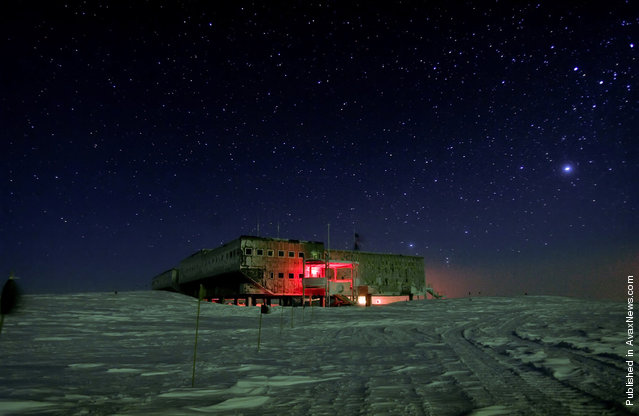
Amundsen-Scott South Pole Station experiences months of darkness. The sun dips below the horizon on March 21, after which follows several weeks of twilight before complete darkness results. Photo taken on June 25, 2009. (National Science Foundation/Jeremy Johnson)