Loading...
Done
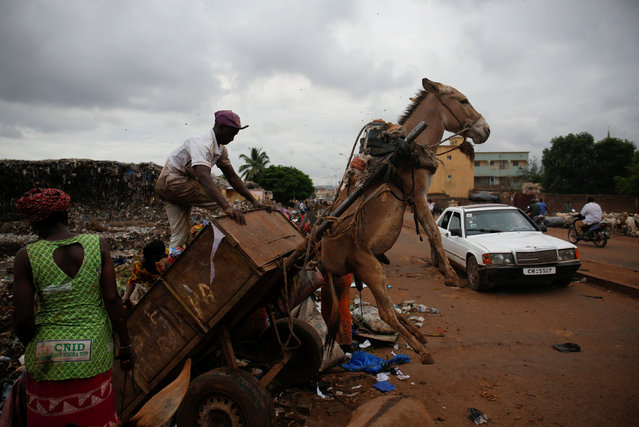
A waste picker unloads garbage at a waste transfer station in Bamako, Mali, August 19, 2018. In the Malian capital of Bamako, donkey carts driven by young men like 19-year-old Arouna Diabate play a vital role battling the fast-growing city's waste problem. Every morning before dawn, Diabate hitches his donkey to a cart and sets off on his rounds, going door-to-door to collect household garbage which he delivers to a local waste transfer station for a monthly salary of around $35. “I won't be picking up trash with a donkey cart for the rest of my life, but for now people appreciate us because we help clean up the homes of Bamako”, Diabate said. (Photo by Luc Gnago/Reuters)

A waste picker unloads garbage at a waste transfer station in Bamako, Mali, August 19, 2018. In the Malian capital of Bamako, donkey carts driven by young men like 19-year-old Arouna Diabate play a vital role battling the fast-growing city's waste problem. Every morning before dawn, Diabate hitches his donkey to a cart and sets off on his rounds, going door-to-door to collect household garbage which he delivers to a local waste transfer station for a monthly salary of around $35. “I won't be picking up trash with a donkey cart for the rest of my life, but for now people appreciate us because we help clean up the homes of Bamako”, Diabate said. (Photo by Luc Gnago/Reuters)
Details
18 Sep 2018 00:01:00
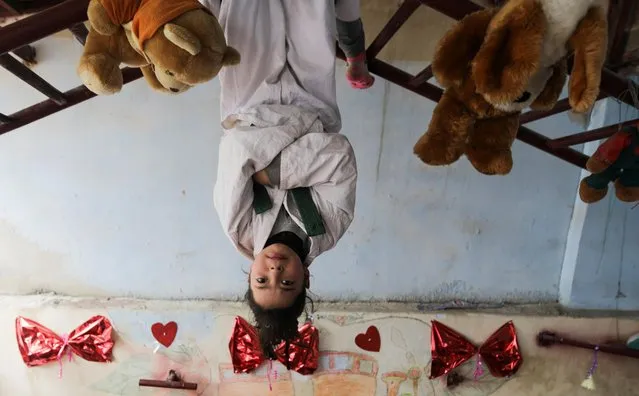
A girl practices martial arts during a training at a school in Syrian opposition-held village of al-Jeineh, Syria on April 11, 2021. (Photo by Khalil Ashawi/Reuters)

A girl practices martial arts during a training at a school in Syrian opposition-held village of al-Jeineh, Syria on April 11, 2021. (Photo by Khalil Ashawi/Reuters)
Details
12 May 2021 08:49:00
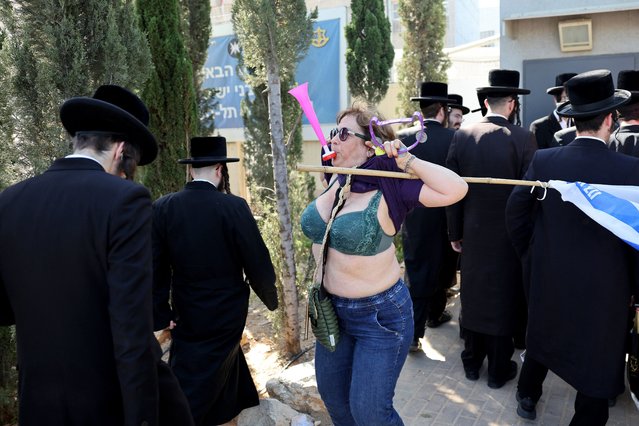
An Israeli protester lifts her T-shirt next to Ultra-Orthodox Jewish men outside an army recruiting office in the town of Kiryat Ono near Tel Aviv on March 5, 2024, during a demonstration against their exemption from serving in the army. Since the October 7 attack by Palestinian militants, the question surrounding whether the insular community, whose members see army service as conflicting with their religious duties, should be obligated to serve has sparked debate and led to protests against their decades-long exemptions. (Photo by Jack Guez/AFP Photo)

An Israeli protester lifts her T-shirt next to Ultra-Orthodox Jewish men outside an army recruiting office in the town of Kiryat Ono near Tel Aviv on March 5, 2024, during a demonstration against their exemption from serving in the army. Since the October 7 attack by Palestinian militants, the question surrounding whether the insular community, whose members see army service as conflicting with their religious duties, should be obligated to serve has sparked debate and led to protests against their decades-long exemptions. (Photo by Jack Guez/AFP Photo)
Details
16 Jul 2025 04:12:00
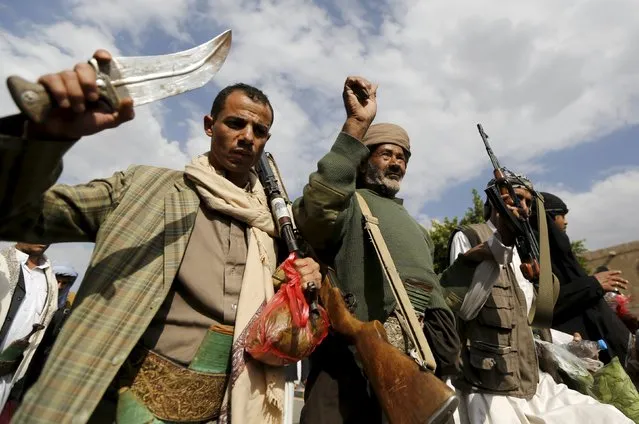
Houthi followers perform the traditional Baraa dance ahead of a demonstration against the Saudi-led air strikes in Yemen's capital Sanaa August 24, 2015. (Photo by Khaled Abdullah/Reuters)

Houthi followers perform the traditional Baraa dance ahead of a demonstration against the Saudi-led air strikes in Yemen's capital Sanaa August 24, 2015. The nothern-based Houthis, a Shi'ite Muslim group, took control of Sanaa last September. Arab countries intervened in the conflict in March to halt a Houthi advance into the south which caused the Saudi-backed government to flee to Riyadh from its refuge in the southern port of Aden. (Photo by Khaled Abdullah/Reuters)
Details
25 Aug 2015 10:19:00
Women dressed in folk costumes take part in a traditional wedding ceremony in the village of Galicnik, west of Macedonia's capital Skopje, July 12, 2014. The Galicnik Wedding, a three-day traditional Macedonian wedding celebration held each “Petrovden” or St. Peter's Day, involves traditional customs, costumes, and rituals and dances that have been passed down over the centuries. (Photo by Ognen Teofilovski/Reuters)

Women dressed in folk costumes take part in a traditional wedding ceremony in the village of Galicnik, west of Macedonia's capital Skopje, July 12, 2014. The Galicnik Wedding, a three-day traditional Macedonian wedding celebration held each “Petrovden” or St. Peter's Day, involves traditional customs, costumes, and rituals and dances that have been passed down over the centuries. (Photo by Ognen Teofilovski/Reuters)
Details
19 Jul 2014 10:11:00
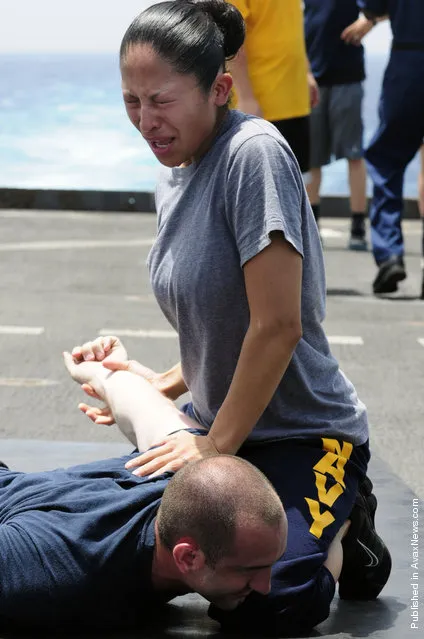
Culinary Specialist 2nd Class Jaqueline Rodriguez subdues a simulated suspect after being sprayed with oleoresin capsicum (OC) spray during security training aboard the amphibious dock landing ship USS Comstock (LSD 45)

Culinary Specialist 2nd Class Jaqueline Rodriguez subdues a simulated suspect after being sprayed with oleoresin capsicum (OC) spray during security training aboard the amphibious dock landing ship USS Comstock (LSD 45). (U.S. Navy photo by Mass Communication Specialist 2nd Class Joseph M. Buliavac/Released). May 10, 2011
Details
10 Apr 2012 14:56:00


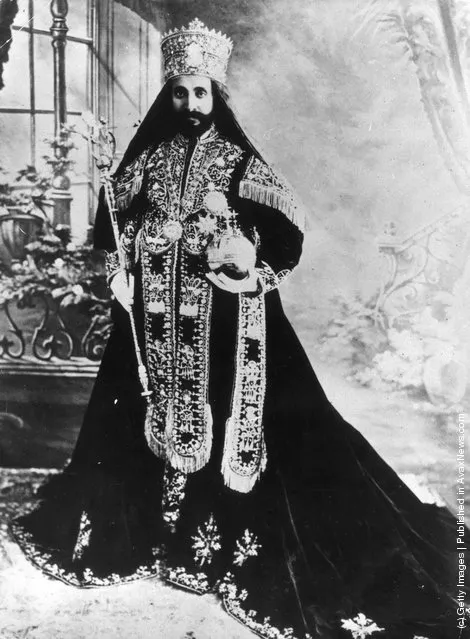
“Haile Selassie I (23 July 1892 – 27 August 1975), born Tafari Makonnen, was Ethiopia's regent from 1916 to 1930 and Emperor of Ethiopia from 1930 to 1974. The heir to a dynasty that traced its origins to the 13th century, and from there by tradition back to King Solomon and Queen Makeda, Empress of Axum, known in the Abrahamic tradition as the Queen of Sheba. Haile Selassie is a defining figure in both Ethiopian and African history.

Haile Selassie is revered as the returned Messiah of the Bible, God incarnate, among the Rastafari movement, the number of followers of which is estimated between 200,000 and 800,000. Begun in Jamaica in the 1930s, the Rastafari movement perceives Haile Selassie as a messianic figure who will lead a future golden age of eternal peace, righteousness, and prosperity. He himself remained an Ethiopian Orthodox Christian throughout his life”. – Wikipedia

Photo: Negusa Negasti, Emperor of Ethiopia Haile Selassie I, known as “Lord of Lords”, “The Conquering Lion of the tribe of Judah”, “Light of the world”, “Elect of God”, in full ceremonial regalia following his coronation. (Photo by Hulton Archive/Getty Images)
Details
21 Jun 2011 11:04:00
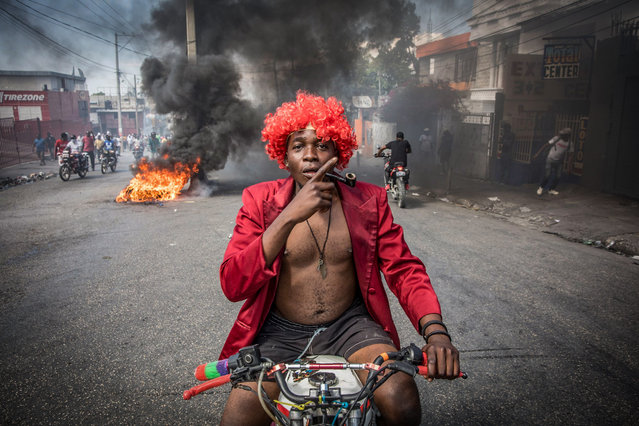
Demonstrators march in Port-au-Prince on February 14, 2021, to protest against the government of President Jovenel Moise. Several thousand people demonstrated Sunday in the Haitian capital Port-au-Prince, saying the government was trying to establish a new dictatorship and denouncing international support for President Jovenel Moise. The protests were mostly peaceful, although a few clashes broke out between some demonstrators and police, who fired tear gas and rubber bullets. (Photo by Valerie Baeriswyl/AFP Photo)

Demonstrators march in Port-au-Prince on February 14, 2021, to protest against the government of President Jovenel Moise. Several thousand people demonstrated Sunday in the Haitian capital Port-au-Prince, saying the government was trying to establish a new dictatorship and denouncing international support for President Jovenel Moise. The protests were mostly peaceful, although a few clashes broke out between some demonstrators and police, who fired tear gas and rubber bullets. (Photo by Valerie Baeriswyl/AFP Photo)
Details
22 May 2021 08:42:00