Loading...
Done
Political Art By Nadia Khuzina

Russian political artist Nadezhda Khuzina was born December 12, 1982 in the city of Serpukhov, Russia. In 2001 she graduated from Moscow Region Pedagogical College, in 2008 – St. Petersburg Art and Industry Academy. Now Nadezhda Khuzina is living in San Diego, CA. Nadezhda Khuzina “Nadia” has devoted her last paintings to Winter Olympics in Sochi, featuring Russian president Putin in different roles. Vladimir Putin is able to perform any sport – skater and skier, hockey player and snowboarder, such James Bond of Olympics, able to cope with any task. The creative artist is inspired by the image of Russian president, a charismatic man Vladimir Putin
Details
13 Feb 2014 13:31:00
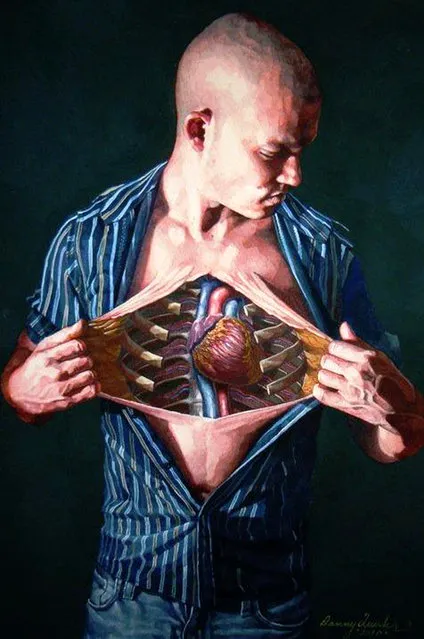
Anatomical Self Dissections By Danny Quirk

"I'm an artist, recent graduate, specializing in photo realistic watercolors, painting what the camera can't capture. My work is perceivably on the darker side, but the actually is, it's about exploration.
My anatomical works combine classic poses, in dramatic chiaroscuro lighting, with a very contemporary twist... illustrating what's underneath the skin, and the portrayed figure dissects a region of their body to show the structures that lay beneath."

Danny Quirk
Details
25 Jun 2013 10:56:00
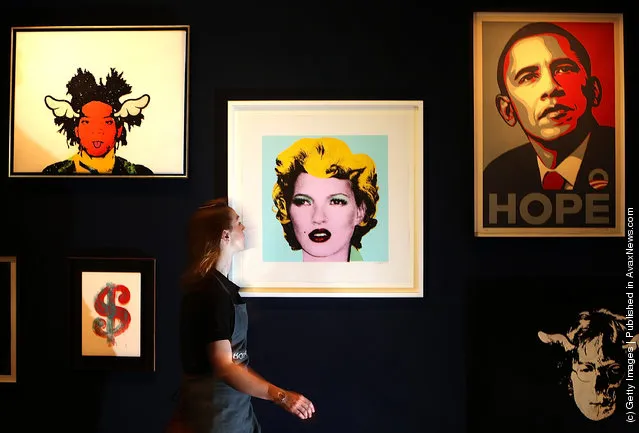
Employee Victoria Livesey walks past Banksy's 'Kate Moss 2005' on display at Bonhams

Employee Victoria Livesey walks past Banksy's “Kate Moss 2005” on display at Bonhams on March 23, 2012 in London, England. The painting, estimated at GBP 30,000 – 50,000, USD 48,000 – 79,000 and 35,000 – 59,000 euros forms part of the Urban Art Sale, which takes place at Bonhams on March 29, 2012. (Photo by Peter Macdiarmid/Getty Images)
Details
24 Mar 2012 11:00:00
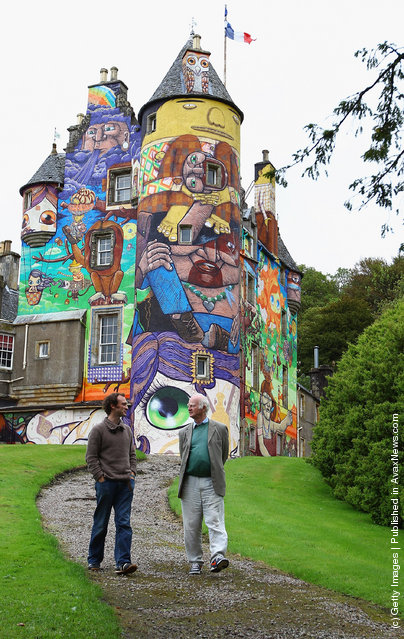
Graffiti At Kelburn Castle

Patrick Boyle, The Earl of Glasgow and his son David, Viscount Kelburn pose at their home Kelburn Castle on August 30, 2011 in Largs, Scotland. The Earl of Glasgow has asked Historic Scotland if the graffiti can remain as a permanent feature of the Castle. The local council allowed the mural to be painted on the wall by Brazilian artists in 2007, with a three year limit put on the graffiti pending the start of rendering work at the castle.(Photo by Jeff J Mitchell/Getty Images)
Details
31 Aug 2011 10:56:00
A bullied student with vitiligo is celebrating learning to love her skin by turning it into art  making a world map, flowers and even a Van Gogh painting. Ashley Soto, 21, from Orlando in Florida, USA, has found turning her white patches of skin into art has empowered her and helped her to embrace her vitiligo. Here are some of the art pieces Ashleys made to celebrate and embrace her vitiligo from a world map to simply tracing her vitiligo and also Van Goghs Starry Night. (Photo by Ashley Soto/Caters News Agency)

A bullied student with vitiligo is celebrating learning to love her skin by turning it into art making a world map, flowers and even a Van Gogh painting. Ashley Soto, 21, from Orlando in Florida, USA, has found turning her white patches of skin into art has empowered her and helped her to embrace her vitiligo. Here are some of the art pieces Ashleys made to celebrate and embrace her vitiligo from a world map to simply tracing her vitiligo and also Van Goghs Starry Night. (Photo by Ashley Soto/Caters News Agency)
Details
16 Mar 2017 00:02:00


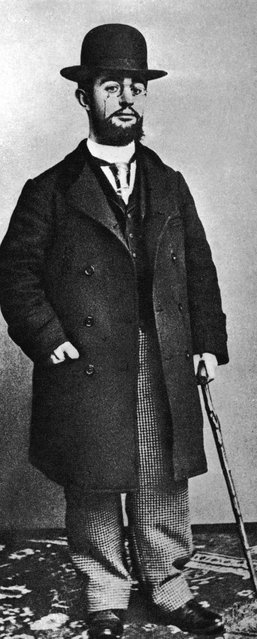
“Henri Marie Raymond de Toulouse-Lautrec-Monfa or simply Henri de Toulouse-Lautrec (24 November 1864 – 9 September 1901) was a French painter, printmaker, draughtsman, and illustrator, whose immersion in the colourful and theatrical life of fin de siècle Paris yielded an œuvre of exciting, elegant and provocative images of the modern and sometimes decadent life of those times. Toulouse-Lautrec is known along with Cézanne, Van Gogh, and Gauguin as one of the greatest painters of the Post-Impressionist period. In a 2005 auction at Christie's auction house a new record was set when “La blanchisseuse”, an early painting of a young laundress, sold for $22.4 million U.S” – Wikipedia.

Photo: Full-length portrait of French artist Henri Toulouse-Lautrec wearing an overcoat, a bowler hat, and pince-nez eyeglasses while holding a cane. (Photo by Hulton Archive/Getty Images). Circa 1895
Details
20 Mar 2011 09:28:00
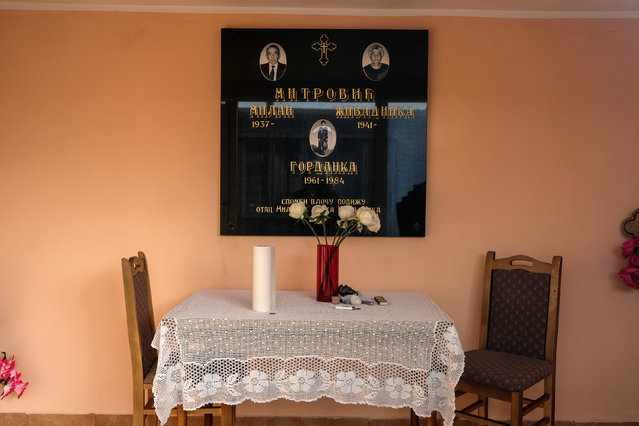
Pictures of deceased people are seen inside a chapel at a cemetery in the village of Smoljinac, Serbia, October 25, 2016. (Photo by Marko Djurica/Reuters)

Pictures of deceased people are seen inside a chapel at a cemetery in the village of Smoljinac, Serbia, October 25, 2016. From a distance, the cemetery in the eastern Serbian village of Smoljinac looks like a residential neighbourhood eerily placed among graves. But once inside the grounds, after passing a section with the usual stone slabs, visitors find rows of small bungalows painted in pastel colours. They have one or two rooms, large windows and ornate plaques – some inside, some outside – memorialising the deceased. These are the burial chapels of Smoljinac, cosy cabins with a furnished room inside, a storage place for wreaths and funeral paraphernalia, and the family crypt below. Some even have electric power inside. (Photo by Marko Djurica/Reuters)
Details
12 Nov 2016 10:37:00
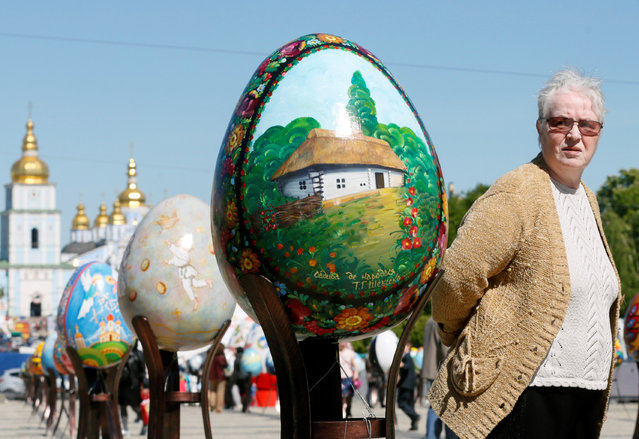
A woman looks at traditional Ukrainian Easter eggs “Pysanka”, installed as part of the upcoming celebrations of Easter, in central Kiev, Ukraine, April 29, 2016. A pysanka is a Ukrainian Easter egg, decorated with traditional Ukrainian folk designs using a wax-resist (batik) method. The word pysanka comes from the verb pysaty, “to write”, as the designs are not painted on, but written with beeswax. Many other eastern European ethnic groups decorate eggs using wax resist for Easter. These include the Belarusians, Bulgarians, Croats, Czechs, Hungarians, Lithuanians, Poles, Romanians, Serbs, Slovaks, Slovenes and Sorbs. (Photo by Valentyn Ogirenko/Reuters)

A woman looks at traditional Ukrainian Easter eggs “Pysanka”, installed as part of the upcoming celebrations of Easter, in central Kiev, Ukraine, April 29, 2016. A pysanka is a Ukrainian Easter egg, decorated with traditional Ukrainian folk designs using a wax-resist (batik) method. The word pysanka comes from the verb pysaty, “to write”, as the designs are not painted on, but written with beeswax. Many other eastern European ethnic groups decorate eggs using wax resist for Easter. These include the Belarusians, Bulgarians, Croats, Czechs, Hungarians, Lithuanians, Poles, Romanians, Serbs, Slovaks, Slovenes and Sorbs. (Photo by Valentyn Ogirenko/Reuters)
Details
30 Apr 2016 09:00:00