Loading...
Done
U.S. President Donald Trump holds news conference on the coronavirus outbreak at the White House in Washington, U.S., February 26, 2020. (Photo by Carlos Barria/Reuters)

U.S. President Donald Trump holds news conference on the coronavirus outbreak at the White House in Washington, U.S., February 26, 2020. (Photo by Carlos Barria/Reuters)
Details
28 Feb 2020 00:07:00
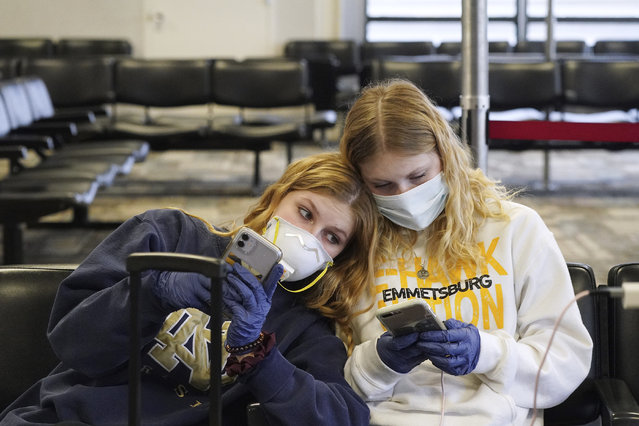
Rachel Miner, 15, left, of Emmetsburg, Iowa, sits with Carlotta Haas, 15, a foreign exchange student from Duesseldorf, Germany, who had been living with Miner and her family but was called home, as they waited for her flight Wednesday, March 25, 2020, in at Minneapolis-St. Paul International Airport in Minneapolis. (Photo by Anthony Souffle/Star Tribune via AP Photo)

Rachel Miner, 15, left, of Emmetsburg, Iowa, sits with Carlotta Haas, 15, a foreign exchange student from Duesseldorf, Germany, who had been living with Miner and her family but was called home, as they waited for her flight Wednesday, March 25, 2020, in at Minneapolis-St. Paul International Airport in Minneapolis. (Photo by Anthony Souffle/Star Tribune via AP Photo)
Details
09 Apr 2020 00:05:00
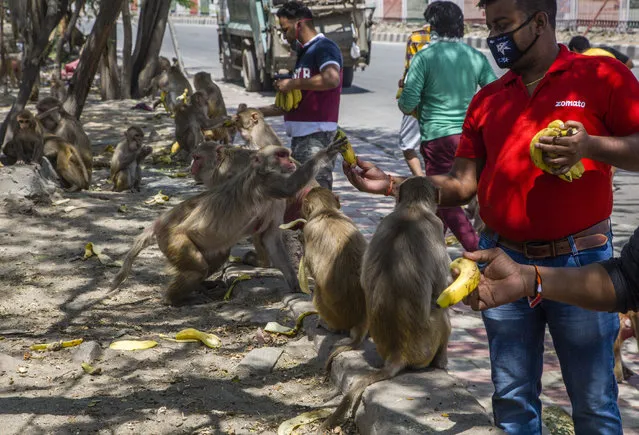
Men give bananas to monkeys gathered on the side of the road as India remains under an unprecedented lockdown over the highly contagious coronavirus (COVID-19) on April 08, 2020 in New Delhi, India. Wild animals, including monkeys, are roaming human settlements in India as people are staying indoors due to the 21-day lockdown. With India's 1.3 billion population and tens of millions of cars off the roads, wildlife is moving towards areas inhabited by humans. Wild animals in many countries have been seen roaming streets. A study says some 60 percent of the new diseases found around the globe every year are zoonotic, meaning they originate in animals and are passed on to humans. COVID-19 is a zoonotic disease that is suspected to have come from the wet markets of Wuhan, China. (Photo by Yawar Nazir/Getty Images)

Men give bananas to monkeys gathered on the side of the road as India remains under an unprecedented lockdown over the highly contagious coronavirus (COVID-19) on April 08, 2020 in New Delhi, India. Wild animals, including monkeys, are roaming human settlements in India as people are staying indoors due to the 21-day lockdown. (Photo by Yawar Nazir/Getty Images)
Details
12 Apr 2020 00:05:00
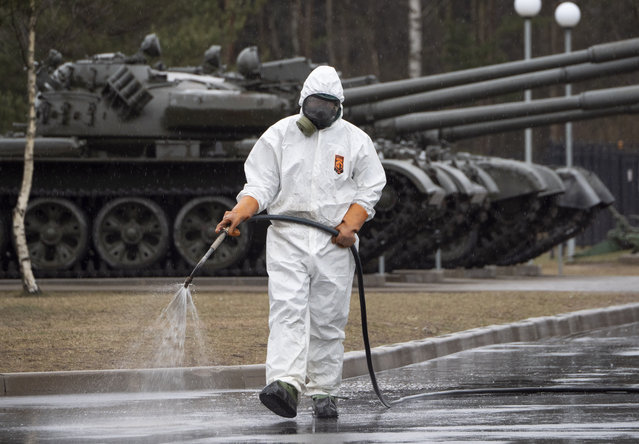
A specialist from a local veterinary service wears a protective suit as sprays disinfectant near Russian tanks displayed at area near Proryv (The Breakthrough) museum dedicated to the breakthrough of the Siege of Leningrad during World WarII near Kirovsk, about 30 kilometres (19 miles) east of St.Petersburg, Russia, Thursday, April 2, 2020. (Photo by Dmitri Lovetsky/AP Photo)

A specialist from a local veterinary service wears a protective suit as sprays disinfectant near Russian tanks displayed at area near Proryv (The Breakthrough) museum dedicated to the breakthrough of the Siege of Leningrad during World WarII near Kirovsk, about 30 kilometres (19 miles) east of St.Petersburg, Russia, Thursday, April 2, 2020. (Photo by Dmitri Lovetsky/AP Photo)
Details
13 Apr 2020 00:01:00
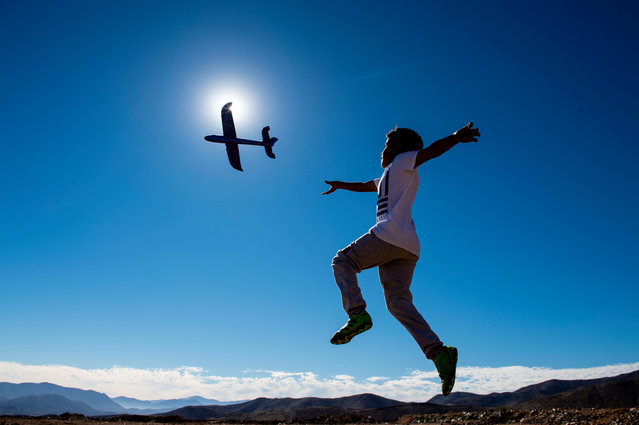
A boy plays with a toy plane on the eve of a solar eclipse, in La Higuera, Coquimbo Region, in the Atacama desert about 580 km north of Santiago, on July 1, 2019. A total solar eclipse will be visible from small parts of Chile and Argentina on July 2. (Photo by Martin Bernetti/AFP Photo)

A boy plays with a toy plane on the eve of a solar eclipse, in La Higuera, Coquimbo Region, in the Atacama desert about 580 km north of Santiago, on July 1, 2019. A total solar eclipse will be visible from small parts of Chile and Argentina on July 2. (Photo by Martin Bernetti/AFP Photo)
Details
14 May 2020 00:03:00
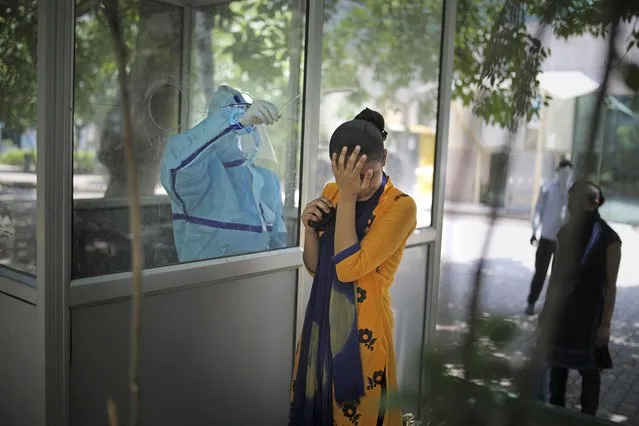
A woman reacts after getting a nasal swab taken to test for the coronavirus in Noida, on the outskirts of New Delhi, India, Tuesday, June 16, 2020. India is the fourth hardest-hit country by the COVID-19 pandemic in the world after the U.S., Russia and Brazil. (Photo by Altaf Qadri/AP Photo)

A woman reacts after getting a nasal swab taken to test for the coronavirus in Noida, on the outskirts of New Delhi, India, Tuesday, June 16, 2020. India is the fourth hardest-hit country by the COVID-19 pandemic in the world after the U.S., Russia and Brazil. (Photo by Altaf Qadri/AP Photo)
Details
18 Jun 2020 00:07:00
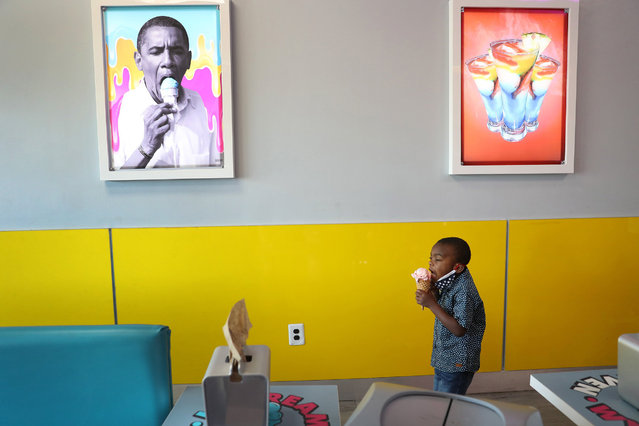
Charistan Hood, 4, eats an ice cream near a picture of former President Barack Obama at the Black-owned Ice Cream Heaven store on Blackout Day 2020 on July 07, 2020 in Miami Gardens, Florida. Supporters of Blackout Day have committed to only spending money at Black-owned businesses to showcase the economic power of the Black community. (Photo by Joe Raedle/Getty Images)

Charistan Hood, 4, eats an ice cream near a picture of former President Barack Obama at the Black-owned Ice Cream Heaven store on Blackout Day 2020 on July 07, 2020 in Miami Gardens, Florida. Supporters of Blackout Day have committed to only spending money at Black-owned businesses to showcase the economic power of the Black community. (Photo by Joe Raedle/Getty Images)
Details
12 Jul 2020 00:03:00
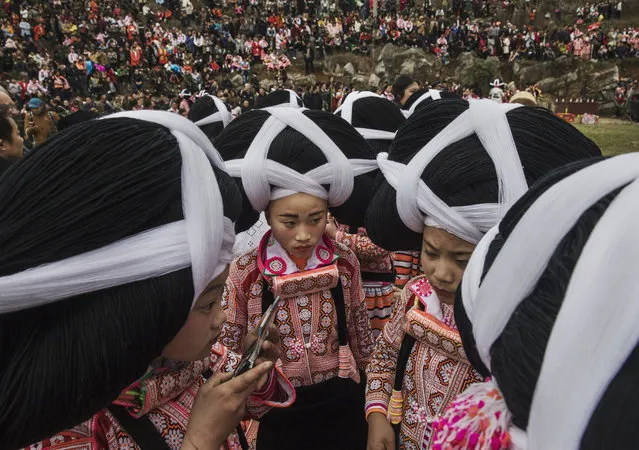
Girls of the Long Horn Miao ethnic minority group wear headdresses as they prepare gather for Tiaohua or Flower Festival as part of the Lunar New Year on February 6, 2017 in Longga village, Guizhou province, southern China. The Long Horn Miao are recognized for their declining practice of wrapping a blend of linen, wool, and the hair of their ancestors around animal horns or a wooden clip to make headdresses. Many young women say they now wear the headdresses only for special occasions and festivals, as the ornaments, which are attached by the horns to their real hair, have proved impractical for modern daily life in a fast changing world. China officially recognizes 56 different ethnic minorities, and statistics show over 7 million Chinese identifying themselves as Miao. But the small Long Horn Miao community counts only around 5000 people living in 12 villages, whose age-old traditions, language, and culture are fading. It is increasingly difficult in a modernizing China, as young people are drawn from remote rural villages to opportunities in bigger cities amongst wide-scale urbanization. Farming and labour remain the mainstays of life for the Long Horn Miao, leaving the area relatively poor in comparison with many parts of China. The government has invested significant amounts into local infrastructure and the tourism industry to try to bolster the local economy. (Photo by Kevin Frayer/Getty Images)

Girls of the Long Horn Miao ethnic minority group wear headdresses as they prepare gather for Tiaohua or Flower Festival as part of the Lunar New Year on February 6, 2017 in Longga village, Guizhou province, southern China. (Photo by Kevin Frayer/Getty Images)

Details
13 Feb 2017 00:01:00