Loading...
Done
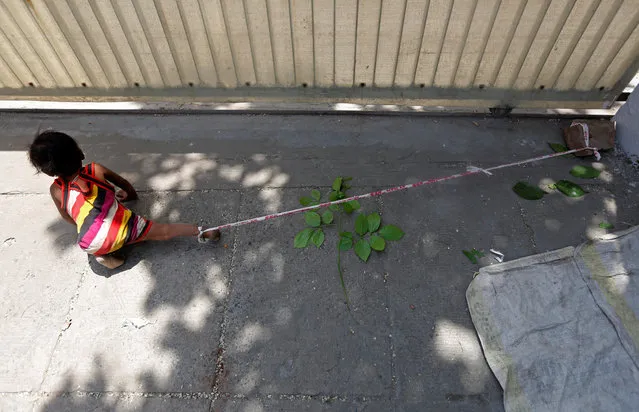
Barrier tape is tied around 15-month-old Shivani's ankle to prevent her from running away, while her mother Sarta Kalara works at a construction site nearby, in Ahmedabad, India, April 19, 2016. Kalara says she has no option but to tether her daughter Shivani to a stone despite her crying, while she and her husband work for 250 rupees ($3.8) each a shift digging holes for electricity cables in the city of Ahmedabad. There are about 40 million construction workers in India, at least one in five of them women, and the majority poor migrants who shift from site to site, building infrastructure for India's booming cities. Across the country it is not uncommon to see young children rolling in the sand and mud as their parents carry bricks or dig for new roads or luxury houses. (Photo by Amit Dave/Reuters)

Barrier tape is tied around 15-month-old Shivani's ankle to prevent her from running away, while her mother Sarta Kalara works at a construction site nearby, in Ahmedabad, India, April 19, 2016. Kalara says she has no option but to tether her daughter Shivani to a stone despite her crying, while she and her husband work for 250 rupees ($3.8) each a shift digging holes for electricity cables in the city of Ahmedabad. There are about 40 million construction workers in India, at least one in five of them women, and the majority poor migrants who shift from site to site, building infrastructure for India's booming cities. Across the country it is not uncommon to see young children rolling in the sand and mud as their parents carry bricks or dig for new roads or luxury houses. (Photo by Amit Dave/Reuters)
Details
14 Dec 2016 07:39:00
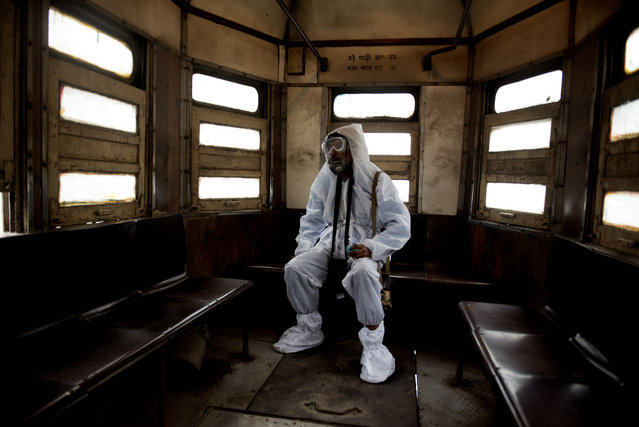
Fighting Infections (single image) | Fighting Pandemic by Sudipto Das. “It’s exhausting. A tram conductor in Kolkata, India, wears protective clothing from head to toe even in the heat of a summer afternoon. This was when restrictions were easing after India’s first Covid-19 lockdown – public transport was running, but staff were advised to suit up like this. We’ve all grown used to saluting the efforts of healthcare workers, but plenty of other people in public-facing jobs have performed gruelling duties too to keep people safe”. (Photo by Sudipto Das/Wellcome Photography Prize 2021)

Fighting Infections (single image) | Fighting Pandemic by Sudipto Das. “It’s exhausting. A tram conductor in Kolkata, India, wears protective clothing from head to toe even in the heat of a summer afternoon. This was when restrictions were easing after India’s first Covid-19 lockdown – public transport was running, but staff were advised to suit up like this. We’ve all grown used to saluting the efforts of healthcare workers, but plenty of other people in public-facing jobs have performed gruelling duties too to keep people safe”. (Photo by Sudipto Das/Wellcome Photography Prize 2021)
Details
29 Jun 2021 09:49:00
An Indian lift operator stands inside a dedicated lift for people suspected to be infected with the new corona virus at the Government Gandhi Hospital in Hyderabad, India, Monday, March 2, 2020. Coronavirus has spread to more than 60 countries, and more than 3,000 people have died from the COVID-19 illness it causes. (Photo by Mahesh Kumar A./AP Photo)

An Indian lift operator stands inside a dedicated lift for people suspected to be infected with the new corona virus at the Government Gandhi Hospital in Hyderabad, India, Monday, March 2, 2020. Coronavirus has spread to more than 60 countries, and more than 3,000 people have died from the COVID-19 illness it causes. (Photo by Mahesh Kumar A./AP Photo)
Details
04 Mar 2020 00:07:00
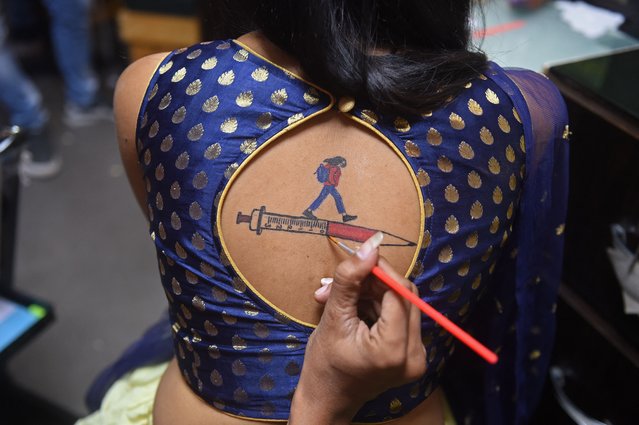
A Garba (folk dance) participant gets her back painted with an awareness message on vaccination against the Covid-19 coronavirus during the ongoing Navratri festival in Ahmedabad on October 8, 2021. (Photo by Sam Panthaky/AFP Photo)

A Garba (folk dance) participant gets her back painted with an awareness message on vaccination against the Covid-19 coronavirus during the ongoing Navratri festival in Ahmedabad in western India on October 8, 2021. (Photo by Sam Panthaky/AFP Photo)
Details
09 Oct 2021 08:10:00
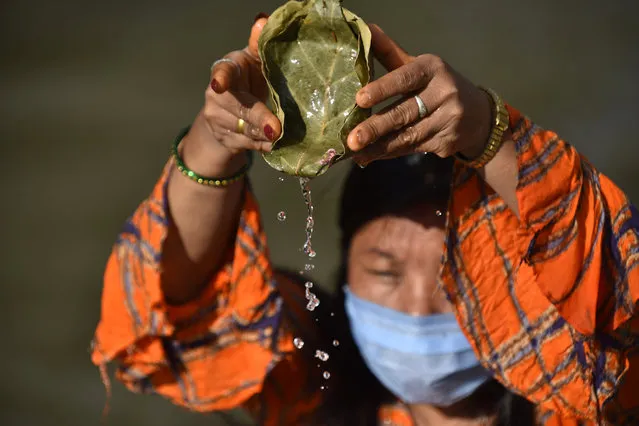
A Nepalese devotee offers ritual prayer at the Bank of Bagmati River of Pashupatinath Temple during Rishi Panchami Festival celebrations at Kathmandu, Nepal on Sunday, August 23, 2020. Rishi Panchami festival is  celebrated as the last day of three-day long Teej Festival. The Teej festival is celebrated by Hindu women in Nepal as well as in some parts of India. During the three-day long festival, women observe a day-long fast and pray for the long life of their husbands as well as for a happy family. Those who are unmarried pray for a good husband and a long life. Due to prohibitory order lockdown in Kathmandu valley for a week-long, as rapid increase in the number of COVID-19 cases. (Photo by Narayan Maharjan/NurPhoto via Getty Images)

A Nepalese devotee offers ritual prayer at the Bank of Bagmati River of Pashupatinath Temple during Rishi Panchami Festival celebrations at Kathmandu, Nepal on Sunday, August 23, 2020. Rishi Panchami festival is celebrated as the last day of three-day long Teej Festival. The Teej festival is celebrated by Hindu women in Nepal as well as in some parts of India. (Photo by Narayan Maharjan/NurPhoto via Getty Images)
Details
20 Sep 2020 00:01:00


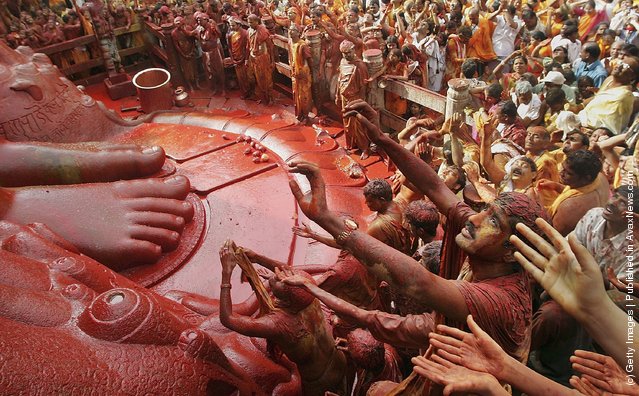
“The Mahamasthakabhisheka (or Mahamasthak Abhishek) is an important Jain festival held once every twelve years in the town of Shravanabelagola in Karnataka state, India. The festival is held in veneration of an immense 18 meter high statue of the Bhagwan (or Saint) Gomateshwara Bahubali. The anointing last took place in February 2006, and the next ceremony will occur in 2018”. – Wikipedia

Photo: A Jain Sadhu (2nd L) and devotees gather and pray at the feet of the monolithic statue of Jain sage Gomateswara during preparations for the Mahamastak Abhisheka ceremony February 7, 2006 in Shravanabelagola, India. The Mahamastak Abhisheka ceremony is held just once every twelve years where the statue will be bathed with milk, yogurt, saffron, gold coins and other religious items. The statue is said to be the world's largest monolith. The ceremony officially runs February 8-19. (Photo by Mario Tama/Getty Images)
Details
21 Jun 2011 12:27:00
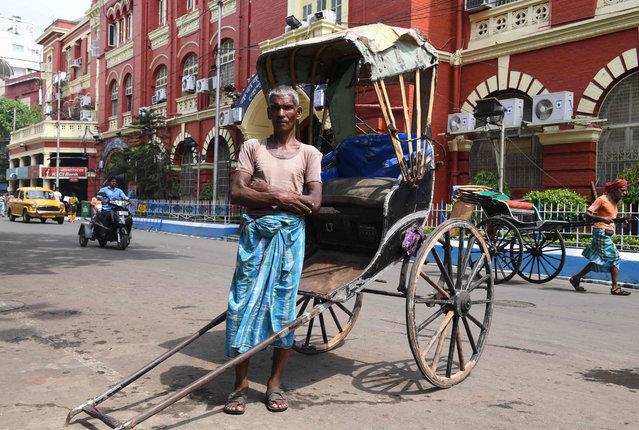
Mohammad Ashgar, 65, an Indian rickshaw puller, poses for a photograph next to his rickshaw in Kolkata on April 21, 2018. A mainstay of 19 th century transportation options, the hand- pulled rickshaw survives in India only in Kolkata after being outlawed elsewhere. The local puller's union puts the number of pullers in the city at 3,000. The union has resisted all previous attempts to ban their livelihood, previously organising mass protests of their members against moves to stamp out the practice. (Photo by Dibyangshu Sarkar/AFP Photo)

Ahead of May Day, AFP' s video and photo teams spoke to men and women around the globe whose jobs are becoming increasingly rare, particularly as technology transforms societies. Here: Mohammad Ashgar, 65, an Indian rickshaw puller, poses for a photograph next to his rickshaw in Kolkata on April 21, 2018. (Photo by Dibyangshu Sarkar/AFP Photo)
Details
02 May 2018 00:01:00
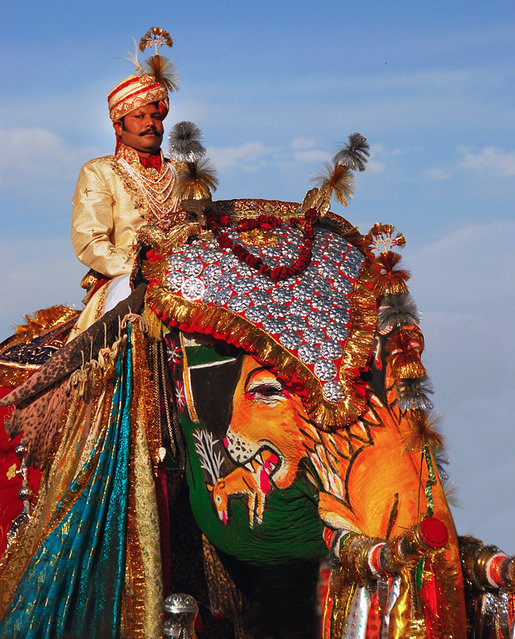
Elephant

Elephant Festival is a festival celebrated in Jaipur city in Rajasthan state in India. It is held on the day of Holi festival, usually in the month of March.The festival features Elephant polo and Elephant Dance. The Elephant Festival begins with a beautiful procession of bedecked elephants, camels, horses and folk dancers. The owners proudly embellish their elephants with vibrant colors, jhools (saddle cloth) and heavy jewellery. It is quite a treat to see female elephants wearing anklets, which tinkle as they walk. One can see people sprinkling 'gulaal' (colored powder) perched on top of the elephant. The most beautifully decorated elephant is awarded. Elephant polo, Elephant race, the tug-of-war between Elephant and 19 men and women are the featured events of the festival.
Details
30 Apr 2015 16:55:00