Loading...
Done
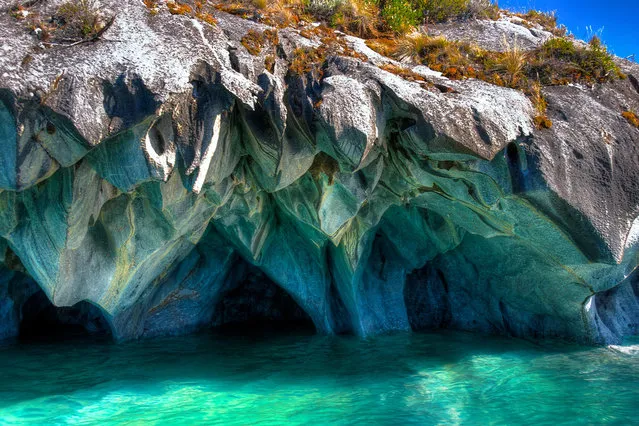
 Marble Caves, Patagonia, Chile

The Marble Caves of Patagonia, Chile, are beautiful vibrant blue caverns, partially submerged in the equally stunning turquoise waters of Carrera Lake. The lake itself is on the border of Argentina and Chile, with the caves located on the Chilean side. The caves are comprised of three main caverns: the Chapel (La Capilla), the Cathedral (El Catedral), and the Cave (La Cueva). Visitors to the caves can explore them in a small boat or kayak, but only when Carrera Lake’s waters are calm and gentle. A rare and invaluable natural wonder, the existence of these caves is currently threatened by plans to build five large dams in the area. If you visit these caves, please treat them with the utmost respect and care.
Details
15 Aug 2012 11:25:00
The Hot Tub Tug Boat

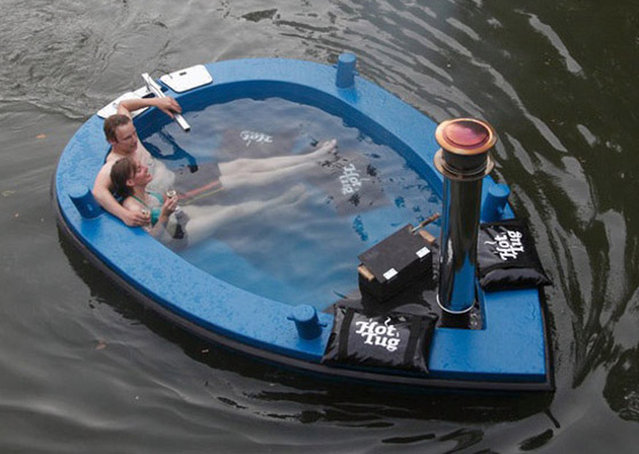
Slow walks along the river or lake in a small boat, meant for two passengers, this is a very nice and romantic. This game is very popular among honeymooners or couples who have recently together and have not lost to the heat and intensity of feelings that push young people to the incredible things. How to convert such travel in a more romantic, and healthy, invented Dutch designer Frank de Bruijn , “crossed” a boat and a bath-tub and calling a hybrid HotTug Boat.
Details
02 Nov 2012 11:56:00
A baby wallaby

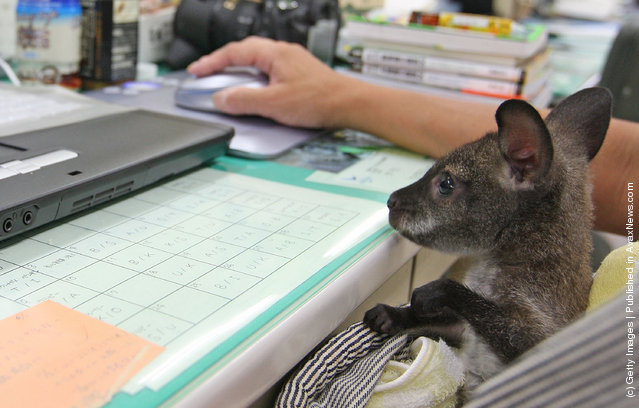
“Very small forest-dwelling wallabies are known as pademelons (genus Thylogale) and dorcopsises (genera Dorcopsis and Dorcopsulus). The name wallaby comes from the Eora Aboriginal tribe who were the original inhabitants of the Sydney area. Wallabies are herbivores whose diet consists of a wide range of grasses, vegetables, leaves, and other types of foliage”. – Wikipedia

Photo: A baby wallaby sits in a zoo attendant's lap at Edogawa Natural Zoo on August 4, 2009 in Tokyo, Japan. The staff of the zoo have raised the young wallaby after her mother neglected her. (Photo by Junko Kimura/Getty Images)
Details
07 Sep 2011 13:33:00
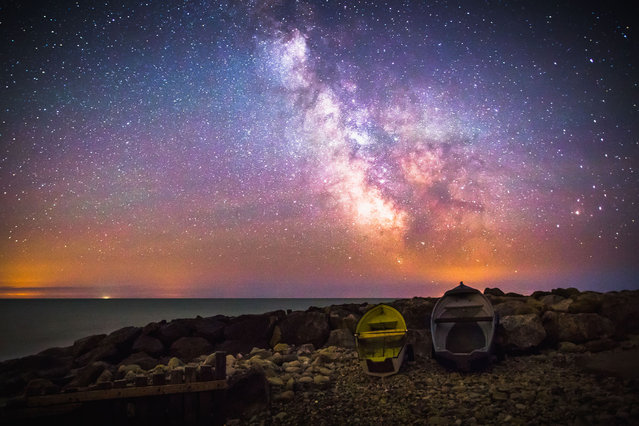
The galactic core of the milky way occupied by two small wooden boats on July 2, 2014, in Isle of Wight, UK. The Milky Way shines in mesmerizing colourful patterns above the Isle of Wight in stunning photographs. (Photo by Chad Powell/Barcroft Media)

The galactic core of the milky way occupied by two small wooden boats on July 2, 2014, in Isle of Wight, UK. The Milky Way shines in mesmerizing colourful patterns above the Isle of Wight in stunning photographs. Chad Powell used a DSLR camera to capture images of the spectacular constellation above the familiar beach scenes of England's largest island. The 22-year-old, who shot the pictures over a year of stargazing on the island, often stayed up until dawn to catch the most dramatic sky-scapes. Chad, a graphic designer from Ventnor, Isle of Wight, used foregrounds of abandoned theme parks, harbors and lighthouses against the illuminated sky. Minor adjustments were made to bring out the contrast and whites in the images. (Photo by Chad Powell/Barcroft Media)
Details
28 Jul 2014 11:31:00
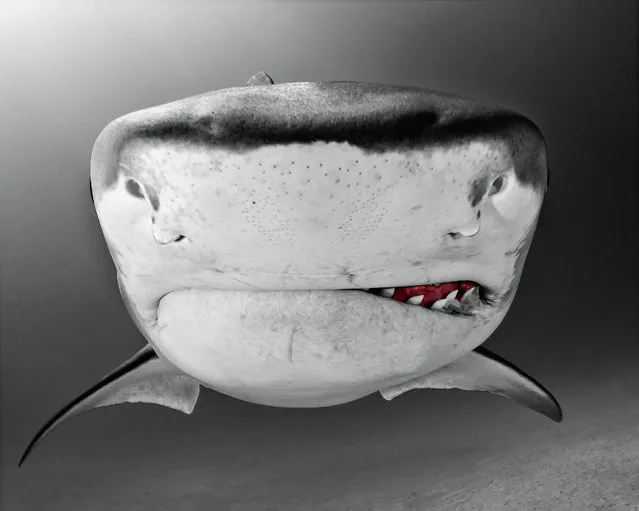
Todd Bretl specializes in underwater photography, and is able to capture striking photos of aquatic life big and small. His photos of sharks are particularly striking; though he rarely faces hostility from the animals, he tries not to spend too much time looking through his viewfinder and many shots are framed by educated guesses and impeccable timing. (Photo by Todd Bretl)

Todd Bretl specializes in underwater photography, and is able to capture striking photos of aquatic life big and small. His photos of sharks are particularly striking; though he rarely faces hostility from the animals, he tries not to spend too much time looking through his viewfinder and many shots are framed by educated guesses and impeccable timing. What follows are photographs taken over the past several years on trips to the Bahamas and Isla Guadalupe, an island off the coast of the Baja California peninsula in Mexico. (Photo by Todd Bretl)
Details
01 Aug 2014 12:35:00
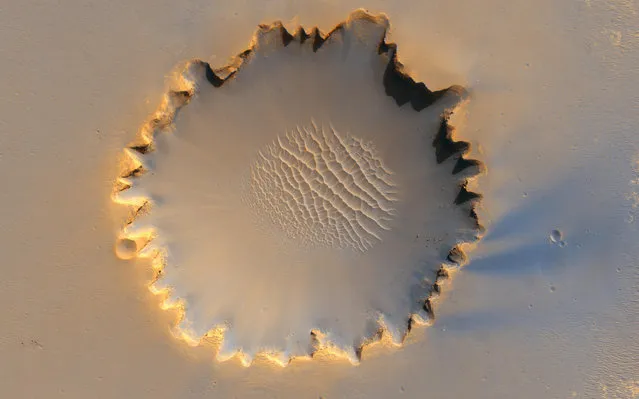
NASA's rover Opportunity visits Victoria Crater, viewed from orbit by the High Resolution Imaging Science Experiment on NASA's Mars Reconnaissance Orbiter in october of 2006. Opportunity is a small dot on the crater's lip, at top right. Opportunity first reached the crater's rim on September 27, 2006. (Photo by NASA/JPL-Caltech/University of Arizona/The Atlantic)

“NASA's Mars rover Opportunity just celebrated its ninth anniversary on Mars – a mission that was originally meant to last just 90 days...” – The Atlantic. Photo: NASA's rover Opportunity visits Victoria Crater, viewed from orbit by the High Resolution Imaging Science Experiment on NASA's Mars Reconnaissance Orbiter in october of 2006. Opportunity is a small dot on the crater's lip, at top right. Opportunity first reached the crater's rim on September 27, 2006. (Photo by NASA/JPL-Caltech/University of Arizona via The Atlantic)


Details
14 Feb 2013 10:58:00
In this February 5, 2014 photo, Divaldo Aguiar, who plays the part of Pachencho, is carried in a mock coffin during the Burial of Pachencho celebration, through a cemetery in Santiago de Las Vegas, Cuba. Cuban villagers stage a mock funeral and burial of Pachencho, with a living man playing the part of Pachencho, in a boozy festival that has become an annual tradition in this small town near Havana, held each February 5 for the last 30 years. (Photo by Enric Marti/AP Photo)

In this February 5, 2014 photo, Divaldo Aguiar, who plays the part of Pachencho, is carried in a mock coffin during the Burial of Pachencho celebration, through a cemetery in Santiago de Las Vegas, Cuba. Cuban villagers stage a mock funeral and burial of Pachencho, with a living man playing the part of Pachencho, in a boozy festival that has become an annual tradition in this small town near Havana, held each February 5 for the last 30 years. (Photo by Enric Marti/AP Photo)
Details
10 Feb 2014 09:24:00
Baby Fennec Fox

“The fennec fox is a small nocturnal fox found in the Sahara of North Africa. Its most distinctive feature is unusually large ears. The name “fennec” comes from the Arabic word for fox, and the species name zerda has a Greek origin that refers to its habitat. The fennec is the smallest species of canid in the world; coat, ears and kidney functions have adapted to a high-temperature, low-water, desert environment. In addition, its hearing is sensitive enough to hear prey moving underground”. – Wikipedia

Photo: A Baby Fennec is seen at Sunshine International Aquarium on June 24, 2009 in Tokyo, Japan. The small nocturnal fox babies were born on May 17 2009. (Photo by Junko Kimura/Getty Images)
Details
16 Sep 2011 12:02:00