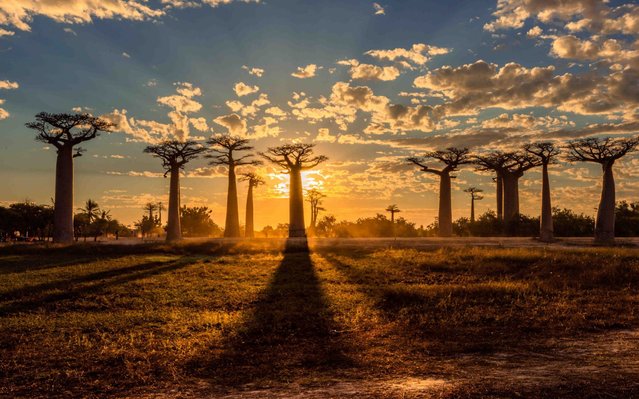
Madagascan sunset setting over the 98-foot-tall baobab trees of the Avenue of the Baobabs located in Menabe, Madagascar on August 2020. (Photo by Kim Paffen/MediaDrumImages)
A migrant worker wearing face masks to help curb the spread of the coronavirus walks up to a pedestrian bridge in Beijing, Sunday, December 6, 2020. Provincial governments across China are placing orders for experimental, domestically made coronavirus vaccines, though health officials have yet to say how well they work or how they may reach the country's 1.4 billion people. (Photo by Andy Wong/AP Photo)
A girl carries sorghum stalks during the sorghum harvest season in Amran province, Yemen, October 24, 2020. (Photo by Xinhua News Agency/Rex Features/Shutterstock)
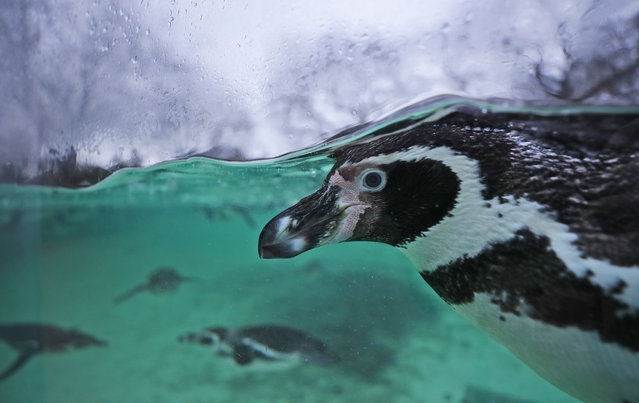
A Humboldt penguin swims in a pool during the annual stock take at ZSL London Zoo in London, Thursday, January 2, 2020. Caring for more than 500 different species, ZSL London Zoo's keepers face the challenging task of tallying up every animal large and small, every mammal, bird, reptile, fish and invertebrate at the Zoo. (Photo by Frank Augstein/AP Photo)
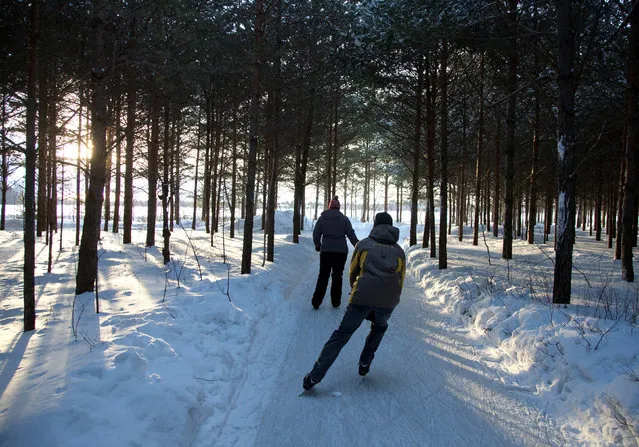
People skate through the forest at Domaine de la Foret Perdu or the Lost Forest, a 15km weaving and zambonied forest trail made for skating in Notre-Dame-du-Mont-Carmel, near Three Rivers, Quebec January 29, 2017. (Photo by Christinne Muschi/Reuters)
Nikolay Skidan, a hunter, carries the skin of a wolf in the village of Khrapkovo, Belarus February 1, 2017. Wolf fur grows thickest in winter, so Belarussian hunter Vladimir Krivenchik only sets his traps once snow is on the ground. He and his wife live on the edge of the Chernobyl exclusion zone – 2,600 square km of land on the Belarus-Ukraine border that was contaminated by a nuclear disaster in 1986. (Photo by Vasily Fedosenko/Reuters)
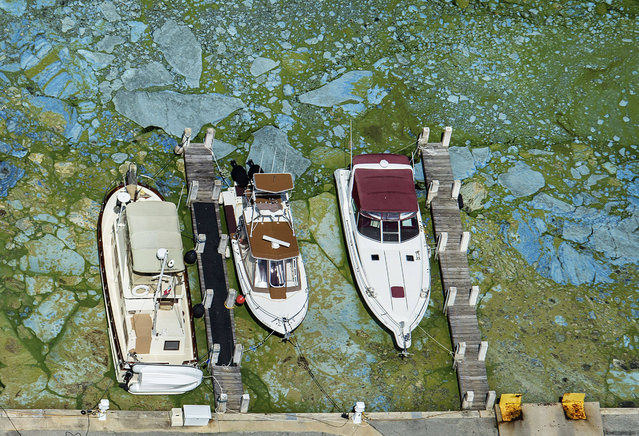
In this June 29, 2016 file photo, boats docked at Central Marine in Stuart, Fla., are surrounded by blue green algae. The 153-mile-long Indian River Lagoon has been plagued by harmful algae blooms. Water quality testing data analyzed by the AP showed the average phosphorous level – a byproduct of fertilizers and human waste that algae thrive on, rose nearly 75 percent between 2000 and 2016. (Photo by Greg Lovett/The Palm Beach Post via AP Photo)