Loading...
Done
An undated handout photo made available by the Zerynthia Association shows the pupa of an amicta moneiba, a recently discovered species of moth endemic to La Gomera and El Hierro islands in the Canary Islands, Spain (issued 01 July 2020), as those two islands pulled apart from the rest of the Canary Islands 2.5 million years ago. The Institute of Evolutionary Biology of the Spanish National Research Council (CSIC) and the Zerynthia Association have recently discovered two new moth species in El Hierro and La Gomera. (Photo by Yeray Monasterio/Zerynthia/EPA/EFE)

An undated handout photo made available by the Zerynthia Association shows the pupa of an amicta moneiba, a recently discovered species of moth endemic to La Gomera and El Hierro islands in the Canary Islands, Spain (issued 01 July 2020), as those two islands pulled apart from the rest of the Canary Islands 2.5 million years ago. The Institute of Evolutionary Biology of the Spanish National Research Council (CSIC) and the Zerynthia Association have recently discovered two new moth species in El Hierro and La Gomera. (Photo by Yeray Monasterio/Zerynthia/EPA/EFE)
Details
11 Oct 2020 00:01:00
A group of people perform yoga on the bank of the river amidst heavy fog on a cold winter morning in Narayanganj, Bangladesh on December 9, 2020. (Photo by Mushfiqul Alam/NurPhoto via Getty Images)

A group of people perform yoga on the bank of the river amidst heavy fog on a cold winter morning in Narayanganj, Bangladesh on December 9, 2020. (Photo by Mushfiqul Alam/NurPhoto via Getty Images)
Details
19 Dec 2020 00:01:00
British Holidaymakers seen partying partying in Punta Bella main Street in Magaluf, a major holiday resort on the Spanish island of Majorca this summer, July 2017. (Photo by Splash News and Pictures)

British Holidaymakers seen partying partying in Punta Bella main Street in Magaluf, a major holiday resort on the Spanish island of Majorca this summer, July 2017. (Photo by Splash News and Pictures)
Details
19 Jul 2017 08:34:00
A fado singer smokes a cigarrette outside a fado house at the Alfama neighborhood in Lisbon on May 8, 2019. From fado sounds to Cape Verde mornas or bossa nova: the Lisbon nights, where musicians from all over the world meet, have largely inspired Madonna's new album, who has been in the Portuguese capital since 2017. (Photo by Patrícia de Melo Moreira/AFP Photo)

A fado singer smokes a cigarrette outside a fado house at the Alfama neighborhood in Lisbon on May 8, 2019. From fado sounds to Cape Verde mornas or bossa nova: the Lisbon nights, where musicians from all over the world meet, have largely inspired Madonna's new album, who has been in the Portuguese capital since 2017. (Photo by Patrícia de Melo Moreira/AFP Photo)
Details
18 Oct 2019 00:05:00
In this  Saturday, March 21, 2015 photo, a porter rests carrying supplies for the upcoming climbing season, near the Everest Base camp, Nepal. (Photo by Tashi Sherpa/AP Photo)

In this Saturday, March 21, 2015 photo, a porter rests carrying supplies for the upcoming climbing season, near the Everest Base camp, Nepal. Nepal has cleared more than 300 mountaineers to climb Mount Everest after they had to abandon last year's efforts when an ice avalanche killed 16 guides in the mountain's deadliest disaster, an official said on March 20. The three-month climbing season for Everest, the world's tallest mountain, begins in March. (Photo by Tashi Sherpa/AP Photo)
Details
29 Mar 2015 12:16:00
A boy looks for scrap metal using an improvised magnetic tool near a construction site in New Delhi, India, March 21, 2016. (Photo by Cathal McNaughton/Reuters)

A boy looks for scrap metal using an improvised magnetic tool near a construction site in New Delhi, India, March 21, 2016. (Photo by Cathal McNaughton/Reuters)
Details
09 Jul 2016 09:50:00
A mudlark uses a torch to look for items on the bank of the River Thames in London, Britain June 06, 2016. Mudlarking is believed to trace its origins to the 18th and 19th century, when scavengers searched the Thames' shores for items to sell. These days, history and archaeology fans are the ones hoping to find old relics such as coins, ceramics, artifacts or everyday items from across centuries. They wait for the low tide and then scour specific areas of exposed shores. "If you're in a field you could be out all day long, with the river you're restricted to about two or three hours," mudlark Nick Stevens said. While many just use the naked eye for their searches, others rely on metal detectors for which a permit from the Port of London Authority is needed. Digging also requires consent. (Photo by Neil Hall/Reuters)

A mudlark uses a torch to look for items on the bank of the River Thames in London, Britain June 06, 2016. Mudlarking is believed to trace its origins to the 18th and 19th century, when scavengers searched the Thames' shores for items to sell. These days, history and archaeology fans are the ones hoping to find old relics such as coins, ceramics, artifacts or everyday items from across centuries. their finds with the Portable Antiquities Scheme. Any item over 300 years old must be recorded. (Photo by Neil Hall/Reuters)
Details
27 Aug 2016 10:43:00
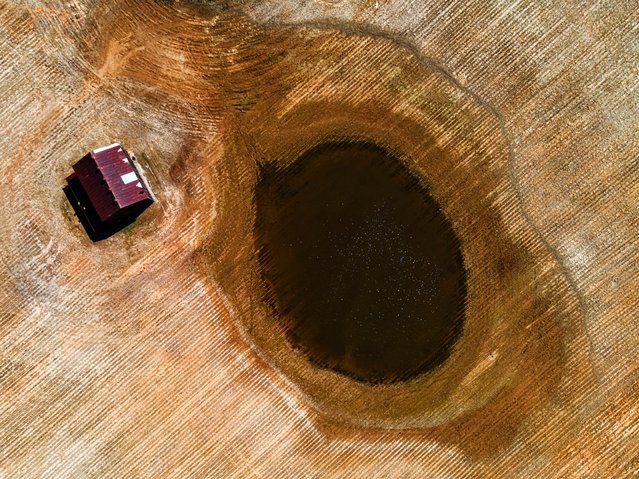
In an aerial view, a flooded section of farmland is seen next to a home in Cadiz, Kentucky, U.S. April 18, 2025. (Photo by Jon Cherry/Reuters)

In an aerial view, a flooded section of farmland is seen next to a home in Cadiz, Kentucky, U.S. April 18, 2025. (Photo by Jon Cherry/Reuters)
Details
07 May 2025 03:41:00