Loading...
Done
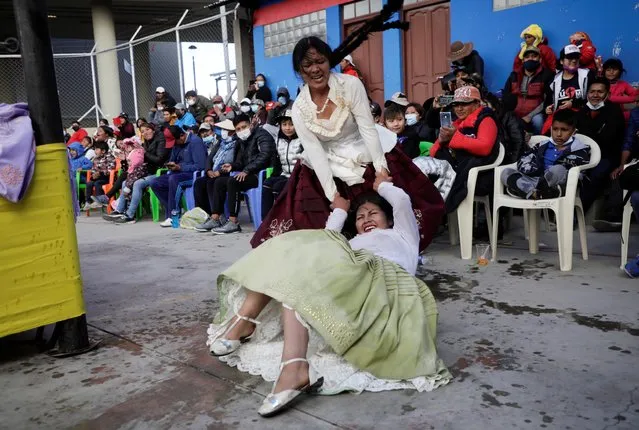
Barbara Quisbert and Susana La Bonita, cholitas wrestlers, fight during their return to the ring after the coronavirus disease (COVID-19) restrictions, in El Alto outskirts of La Paz, November 29, 2020. (Photo by David Mercado/Reuters)

The Fighting Cholitas are a group of female wrestlers who perform in El Alto, Bolivia. Tickets to the exhibitions cost $1. Like the general population of El Alto, which consists almost entirely of Aymara and Quechua residents, the Cholitas are indigenous. They wear braided hair, bowler hats and multilayered skirts in the ring. Here: Barbara Quisbert and Susana La Bonita, cholitas wrestlers, fight during their return to the ring after the coronavirus disease (COVID-19) restrictions, in El Alto outskirts of La Paz, November 29, 2020. (Photo by David Mercado/Reuters)
Details
12 Dec 2020 00:03:00
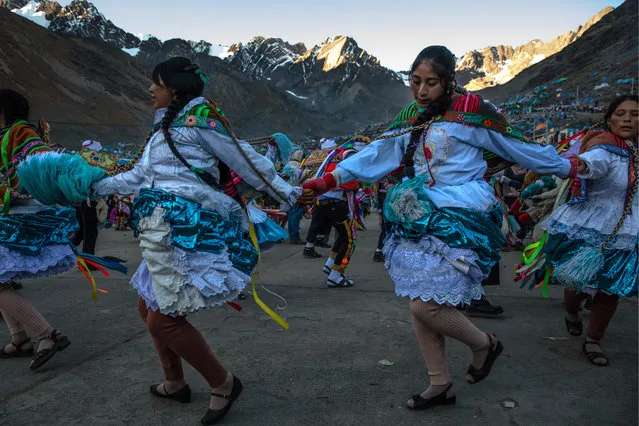
Costumed dancers parade on the first day of the annual Qoyllur Rit'i festival on May 27, 2018 in Ocongate, Peru. (Photo by Dan Kitwood/Getty Images)

Costumed dancers parade on the first day of the annual Qoyllur Rit'i festival on May 27, 2018 in Ocongate, Peru. Every year, since 1783 in the Sinakara Valley at the foot of Mt Ausagante, the Qoyllur Rit'i, or “Snow and Star” festival draws tens of thousands of pilgrims from across the Peruvian Andes and beyond to what is the biggest religious gathering of its kind. Since 1780 the event merged into a mosaic of indigenous, pagan and Catholic worship when an image of Jesus appeared on a boulder after the death of a young shepherd. (Photo by Dan Kitwood/Getty Images)
Details
05 Jun 2018 00:01:00
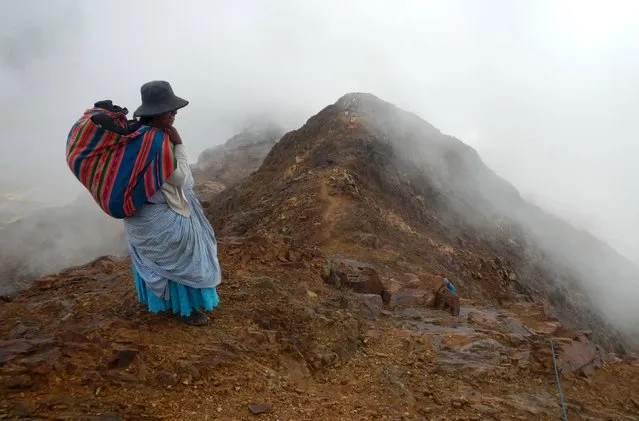
A porter stands at the bottom of the Illimani mountain, on the outskirts of La Paz, Bolivia, April 16, 2016. (Photo by David Mercado/Reuters)

A porter stands at the bottom of the Illimani mountain, on the outskirts of La Paz, Bolivia, April 16, 2016. For years, Lydia Huayllas, 48, has worked as a cook at base camps and mountain-climbing refuges on the steep, glacial slopes of Huayna Potosi, a 19,974-foot (6,088-meter) Andean peak outside of La Paz, Bolivia. But two years ago, she and 10 other Aymara indigenous women, ages 42 to 50, who also worked as porters and cooks for mountaineers, put on crampons – spikes fixed to a boot for climbing – under their wide traditional skirts and started to do their own climbing. (Photo by David Mercado/Reuters)
Details
22 Apr 2016 12:33:00
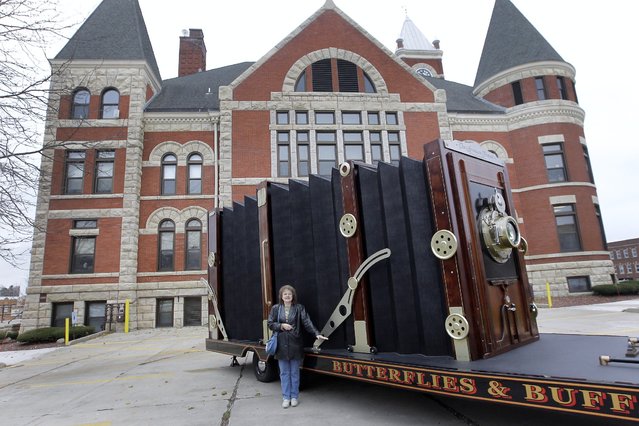
A woman poses for her husband alongside a giant camera Thursday, November 7, 2013 outside the Historic Green County Courthouse in Monroe, Wis. Chicago photographer Dennis Manarchy created what's being called the world's largest camera. (Photo by Mark Hoffman)

A woman poses for her husband alongside a giant camera Thursday, November 7, 2013 outside the Historic Green County Courthouse in Monroe, Wis. Chicago photographer Dennis Manarchy created what's being called the world's largest camera. It's 35-feet long and 12-feet tall it's a working replica of a vintage accordion-style camera that produces 16- by 24-foot prints, the equivalent of a two-story building. The giant camera is on display in Monroe through November 17 because a Monroe company manufactured the specially-built trailer. Manarchy plans to tow the camera around the country to shoot photos of indigenous cultures. (Photo by Mark Hoffman)
Details
16 Nov 2013 09:33:00


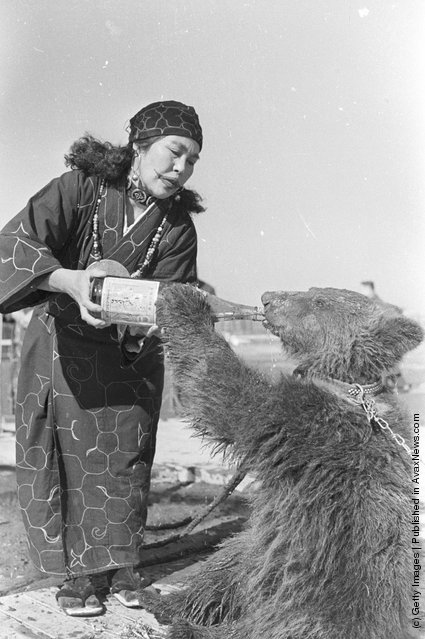
“The Ainu (アイヌ?), also called Aynu, Aino (アイノ), and in historical texts Ezo (蝦夷), are indigenous people or groups in Japan and Russia. Historically they spoke the Ainu language and related varieties and lived in Hokkaidō, the Kuril Islands, and much of Sakhalin. Most of those who identify themselves as Ainu still live in this same region, though the exact number of living Ainu is unknown. This is due to ethnic issues in Japan resulting in those with Ainu backgrounds hiding their identities and confusion over mixed heritages. In Japan, because of intermarriage over many years with Japanese, the concept of a 'pure Ainu' ethnic group is no longer feasible. Official estimates of the population are of around 25,000, while the unofficial number is upwards of 200,000 people”. – Wkipedia

Photo: A captive bear drinking from a large bottle held by an Ainu tribeswoman. (Photo by Evans/Three Lions/Getty Images). Circa 1955
Details
24 Mar 2011 14:01:00
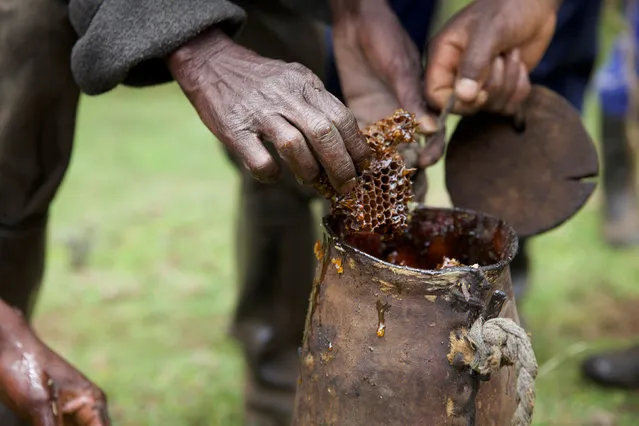
A man from the Ogiek community harvests honey in Mount Elgon game reserve, where they have reached an agreement with the government allowing them to remain in their ancestral lands in western Kenya, April 26, 2016. (Photo by Katy Migiro/Reuters)

A man from the Ogiek community harvests honey in Mount Elgon game reserve, where they have reached an agreement with the government allowing them to remain in their ancestral lands in western Kenya, April 26, 2016. (Photo by Katy Migiro/Reuters)
Details
20 May 2016 12:51:00
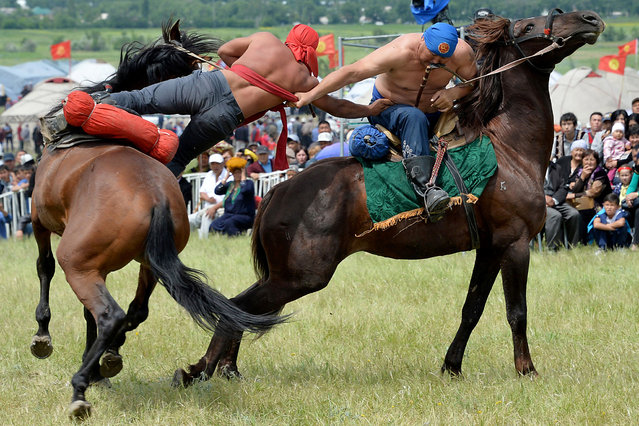
Kyrgyz men on horseback compete during their traditional game of “Oodarysh” during the celebrations of the 90th anniversary formation of the Chui region in the village of Kuntu some 20 kms from Bishkek on May 27, 2016. (Photo by Vyacheslav Oseledko/AFP Photo)

Kyrgyz men on horseback compete during their traditional game of “Oodarysh” during the celebrations of the 90th anniversary formation of the Chui region in the village of Kuntu some 20 kms from Bishkek on May 27, 2016. (Photo by Vyacheslav Oseledko/AFP Photo)
Details
28 May 2016 12:31:00
South Korean youths play Pokemon Go on July 15, 2016 in Sokcho, South Korea. (Photo by Jean Chung/Getty Images)

South Korean youths play Pokemon Go on July 15, 2016 in Sokcho, South Korea. South Korea is not one of the initial Pokemon Go released countries, nor is the game likely to be released officially any time soon as the South Korean government does not allow Google to use its map; however, South Korean game enthusiasts are now visiting a handful of loophole areas in the north eastern side of the country near the border of North Korea to join the global frenzy of Pokemon Go. (Photo by Jean Chung/Getty Images)
Details
16 Jul 2016 08:49:00