Loading...
Done
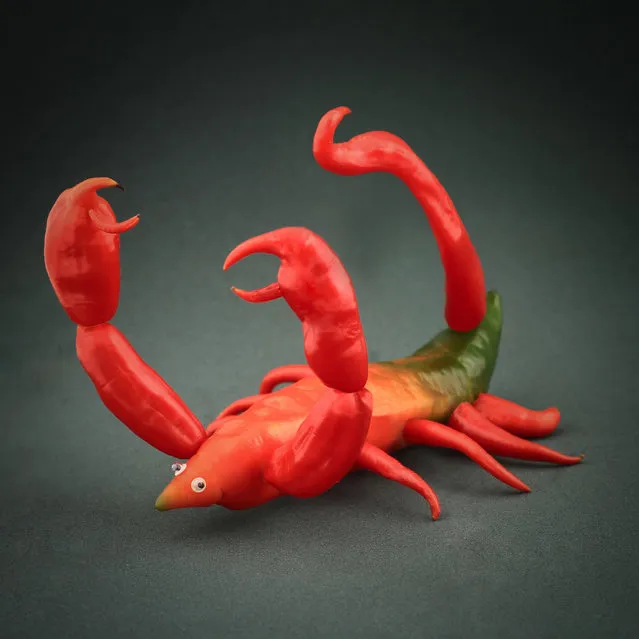
“Red Pepperpion. (Photo by Vanessa Dualib)

“Red Pepperpion. Red Pepperpions are secretive, nocturnal arachilli which can be spotted in kitchens of arid climates all around the world.

Red Pepperpions are equipped with a delicious (and depending on the quantity...deadly!) stinger at the end of its tail. If you happen to get bitten (or if you bite him!) it will produce a burning sensation on your taste nerves.

However, there is no need to worry, since the fact is that his potent stinger is usually only used when hunting or whenever the Pepperpion feels like he might become part of someones meal...

At daylight or when encountering a larger foe, such as a Saucier Chef, they retreat into burrows inside the fridge or hide beneath the oven”. (Photo and comment by Vanessa Dualib)


Details
08 Feb 2013 09:24:00
People feed the birds in Battery Park in the Manhattan borough of New York, December 18, 2014. (Photo by Carlo Allegri/Reuters)

People feed the birds in Battery Park in the Manhattan borough of New York, December 18, 2014. Hart has been feeding the birds three times a week for the last three years. (Photo by Carlo Allegri/Reuters)
Details
20 Dec 2014 11:50:00
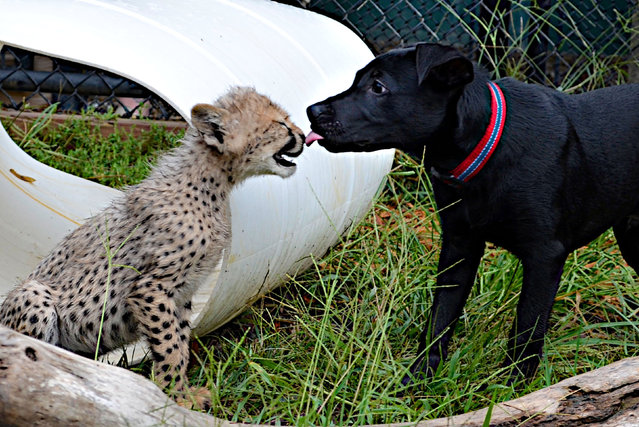
These stunning images could be mistaken for a cheetah ravenously chasing down a dog, but in fact, the pair are best of friends. Savanah, the one-and-a-half-year-old cheetah and Max, who is just a few weeks younger, were put together when Savanah was just 10-weeks-old. (Photo by Caters News Agency)

These stunning images could be mistaken for a cheetah ravenously chasing down a dog, but in fact, the pair are best of friends. Savanah, the one-and-a-half-year-old cheetah and Max, who is just a few weeks younger, were put together when Savanah was just 10-weeks-old. Ever since, their friendship has amazed visitors at Cincinatti Zoo, who are delighted but confused as to why the spotted beast hasnt eaten the dashing hound. So, when it snowed, Savanah and Max just like young children were very excitable and wasted no time playing in the snow. (Photo by Caters News Agency)
Details
21 Dec 2013 13:56:00
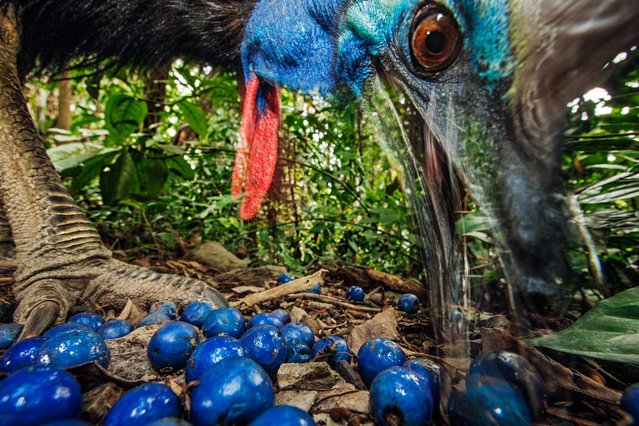
“Cassowaries are large, flightless birds related to emus and (more distantly) to ostriches, rheas, and kiwis”, writes Olivia Judson in the September issue of National Geographic magazine. (Photo by Christian Ziegler/National Geographic)

“Cassowaries are large, flightless birds related to emus and (more distantly) to ostriches, rheas, and kiwis”, writes Olivia Judson in the September issue of National Geographic magazine. How large? People-size: Adult males stand well over five foot five and top 110 pounds. Females are even taller, and can weigh more than 160 pounds. Dangerous when roused, they’re shy and peaceable when left alone. But even birds this big and tough are prey to habitat loss. The dense New Guinea and Australia rain forests where they live have dwindled. Today cassowaries might number 1,500 to 2,000. And because they help shape those same forests – by moving seeds from one place to another – “if they vanish”, Judson writes, “the structure of the forest would gradually change” too. (Photo by Christian Ziegler/National Geographic)
Details
06 Jan 2014 12:21:00
A girl performs martial arts during a function to mark International Women's Day at a school in Hyderabad, India, on March 7, 2014. (Photo by Mahesh Kumar A./Associated Press)

A girl performs martial arts during a function to mark International Women's Day at a school in Hyderabad, India, on March 7, 2014. (Photo by Mahesh Kumar A./Associated Press)
Details
08 Mar 2014 11:18:00
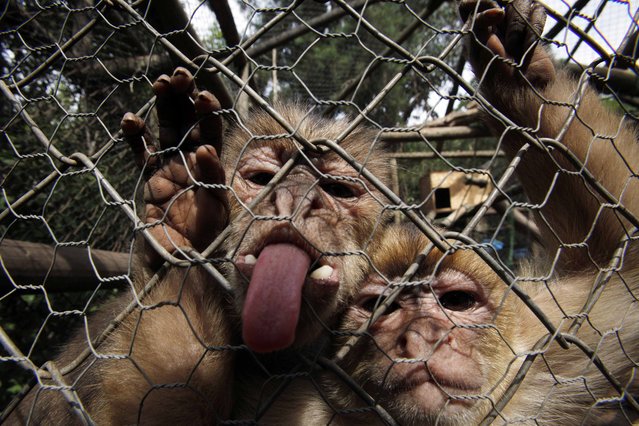
A couple of monkeys look from inside their cage at a rescue and rehabilitation center in Santiago, Chile, Saturday, November 22, 2014. (Photo by Luis Hidalgo/AP Photo)

A couple of monkeys look from inside their cage at a rescue and rehabilitation center in Santiago, Chile, Saturday, November 22, 2014. Elba Munoz who runs the center, says that one of the goals of the Center for the Rescue and Rehabilitation of Primates is to stop the trafficking of the animals. (Photo by Luis Hidalgo/AP Photo)
Details
29 Nov 2014 13:16:00
Spectators cheer as the United Launch Alliance Delta 4-Heavy rocket, with NASA's Orion spacecraft mounted atop, lifts off from the Air Force Station, December 5, 2014, in Cape Canaveral, Fla. (Photo by Smiley N. Pool/AP Photo/Houston Chronicle)

Spectators cheer as the United Launch Alliance Delta 4-Heavy rocket, with NASA's Orion spacecraft mounted atop, lifts off from the Air Force Station, December 5, 2014, in Cape Canaveral, Fla. (Photo by Smiley N. Pool/AP Photo/Houston Chronicle)
Details
06 Dec 2014 12:28:00
Ecuadorian indigenous people celebrate the festival of the moon or Kulla Raymi, in Quito, Ecuador, 21 September 2021. A circle on the ground made up of fruits and inside the Andean symbol of the chacana, multinational geometric flags and a cross that symbolizes the four cardinal points, were the setting in which the festival of the moon, the Kulla, was commemorated this Tuesday. Raymi, on a hill in Quito. It is one of the four most significant festivities of the Andean agroecological calendar, which commemorates the beginning of life and exalts women as the maximum representation of fertility. (Photo by Jose Jacome/EPA/EFE)

Ecuadorian indigenous people celebrate the festival of the moon or Kulla Raymi, in Quito, Ecuador, 21 September 2021. A circle on the ground made up of fruits and inside the Andean symbol of the chacana, multinational geometric flags and a cross that symbolizes the four cardinal points, were the setting in which the festival of the moon, the Kulla, was commemorated this Tuesday. Raymi, on a hill in Quito. It is one of the four most significant festivities of the Andean agroecological calendar, which commemorates the beginning of life and exalts women as the maximum representation of fertility. (Photo by Jose Jacome/EPA/EFE)
Details
22 Sep 2021 09:01:00