Loading...
Done
Beatriz Hatz of the United States competes in the women's T62 long jump final during the 2020 Paralympics at the National Stadium in Tokyo, Saturday, August 28, 2021. (Photo by Kiichiro Sato/AP Photo)

Beatriz Hatz of the United States competes in the women's T62 long jump final during the 2020 Paralympics at the National Stadium in Tokyo, Saturday, August 28, 2021. (Photo by Kiichiro Sato/AP Photo)
Details
06 Sep 2021 08:46:00
Julia Robinson of the Jillaroos scores a try during the rugby league Pacific Cup Women's Final match between the Australian Jillaroos and the New Zealand Ferns at CommBank Stadium in Sydney, New South Wales, Australia, 09 November 2025. (Photo by Mark Evans/EPA)

Julia Robinson of the Jillaroos scores a try during the rugby league Pacific Cup Women's Final match between the Australian Jillaroos and the New Zealand Ferns at CommBank Stadium in Sydney, New South Wales, Australia, 09 November 2025. (Photo by Mark Evans/EPA)
Details
18 Nov 2025 04:16:00
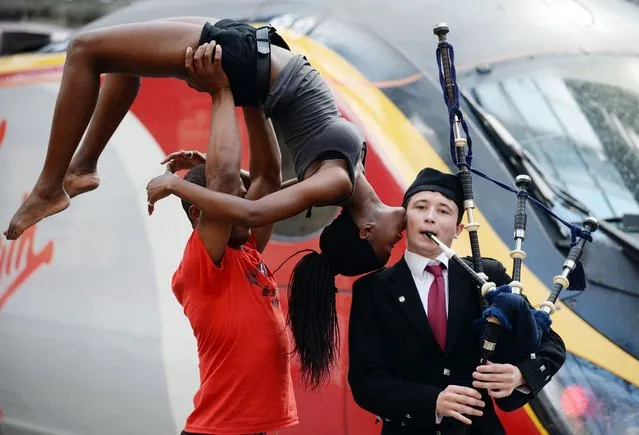
Commonwealth dance group on the right track with Virgin Trains – Photo call at Glasgow Central Station. (Photo by Daily Record)

Commonwealth dance group on the right track with Virgin Trains – Photo call at Glasgow Central Station. (Photo by Daily Record)
Details
14 Jul 2014 13:09:00
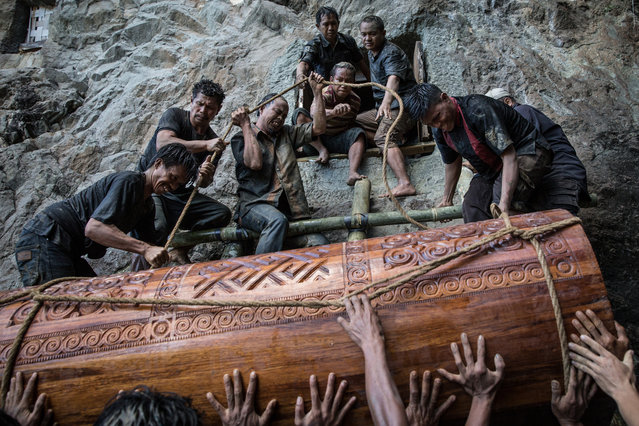
It is said that Torajans are people who “live to die”. For this Indonesian ethnic group, funerals are such extravagant events that they sometimes attract tourists. Families can postpone burials years (and the deceased are considered sick and hosted at home until the funeral) until the family can raise enough money and gather as many relatives as possible. And then it’s a jubilant multiday social event with a parade, dances and animal sacrifices. Agung Parameswara photographed these funerary practices when he traveled to South Sulawesi province, where the Torajans live. But often, their funeral isn’t the last time the dead are seen. In August, crypts are opened, coffins are slid back out and bodies delicately unsheathed. This tender ritual is known as Ma’Nene, which is customarily performed every few years. (Photo by Agung Parameswara/The Washington Post)

It is said that Torajans are people who “live to die”. For this Indonesian ethnic group, funerals are such extravagant events that they sometimes attract tourists. Families can postpone burials years (and the deceased are considered sick and hosted at home until the funeral) until the family can raise enough money and gather as many relatives as possible. And then it’s a jubilant multiday social event with a parade, dances and animal sacrifices. Agung Parameswara photographed these funerary practices when he traveled to South Sulawesi province, where the Torajans live. (Photo by Agung Parameswara/The Washington Post)
Details
06 Oct 2016 09:15:00
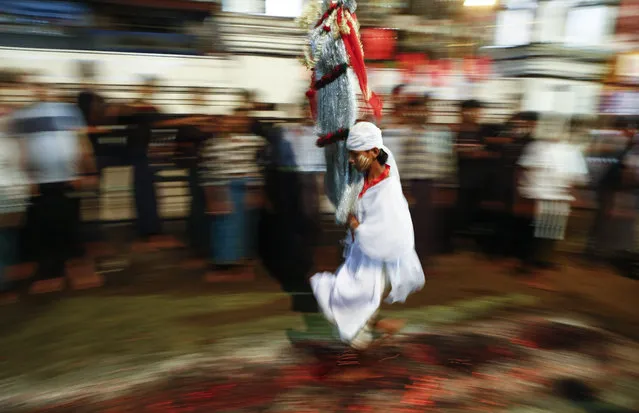
A Myanmar Shiite Muslim devotee runs  barefoot over a bed of burning coals as he takes part in a Muharram procession ahead of the Islamic holiday Ashura, in Yangon, Myanmar, October 22, 2015. Muslims across the world are observing Moharram, the first month of Islamic calender, the climax of Moharram is the Ashura festival commemorating the martyrdom of Imam Hussein, a grandson of the Prophet Mohammed in the Iraqi city of Karbala in the seventh century. (Lynn Bo Bo/EPA)

A Myanmar Shiite Muslim devotee runs barefoot over a bed of burning coals as he takes part in a Muharram procession ahead of the Islamic holiday Ashura, in Yangon, Myanmar, October 22, 2015. Muslims across the world are observing Moharram, the first month of Islamic calender, the climax of Moharram is the Ashura festival commemorating the martyrdom of Imam Hussein, a grandson of the Prophet Mohammed in the Iraqi city of Karbala in the seventh century. (Lynn Bo Bo/EPA)
Details
24 Oct 2015 09:30:00
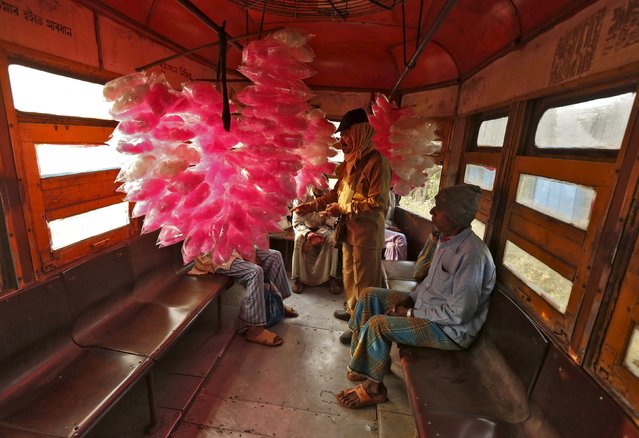
A conductor (C) collects fares from candy floss sellers as they travel in a tram to a marketplace early morning in Kolkata, India, December 23, 2015. (Photo by Rupak De Chowdhuri/Reuters)

A conductor (C) collects fares from candy floss sellers as they travel in a tram to a marketplace early morning in Kolkata, India, December 23, 2015. (Photo by Rupak De Chowdhuri/Reuters)
Details
30 Dec 2015 08:05:00
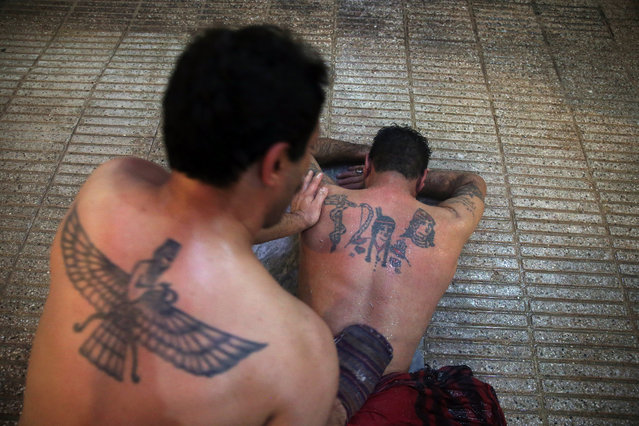
In this Friday, January 9, 2015 photo, bathhouse worker Omid Riahi, 39, scrubs a man to remove dead skin, at the Ghebleh public bathhouse, in Tehran, Iran. The steamy air and curved tiled walls of Iran's famed public bathhouses, some rinsing and massaging patrons for hundreds of years, slowly may wash away as interest in them wanes. (Photo by Ebrahim Noroozi/AP Photo)

In this Friday, January 9, 2015 photo, bathhouse worker Omid Riahi, 39, scrubs a man to remove dead skin, at the Ghebleh public bathhouse, in Tehran, Iran. The steamy air and curved tiled walls of Iran's famed public bathhouses, some rinsing and massaging patrons for hundreds of years, slowly may wash away as interest in them wanes. The bathhouses, known as “hammams” in Persian, find themselves in rough financial times as modern conveniences now allow showers and baths in most homes across the Islamic Republic. (Photo by Ebrahim Noroozi/AP Photo)

Details
03 Apr 2015 12:40:00
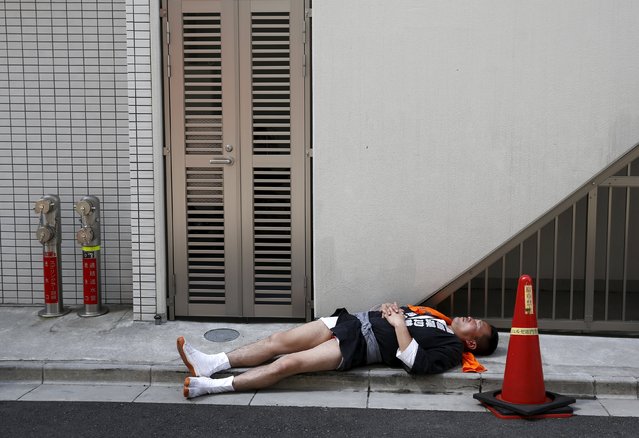
A reveller sleeps on the pavement during the Sanja Matsuri festival in the Asakusa district of Tokyo May 17, 2015. The Sanja Matsuri festival attracts over about one million visitors over its duration of three days, when parties of revellers carry portable shrines through the Asakusa neighbourhood, rocking and shaking them in a belief that this intensified the powers of the deities that reside inside them. (Photo by Thomas Peter/Reuters)

A reveller sleeps on the pavement during the Sanja Matsuri festival in the Asakusa district of Tokyo May 17, 2015. The Sanja Matsuri festival attracts over about one million visitors over its duration of three days, when parties of revellers carry portable shrines through the Asakusa neighbourhood, rocking and shaking them in a belief that this intensified the powers of the deities that reside inside them. (Photo by Thomas Peter/Reuters)
Details
19 May 2015 12:06:00