Loading...
Done
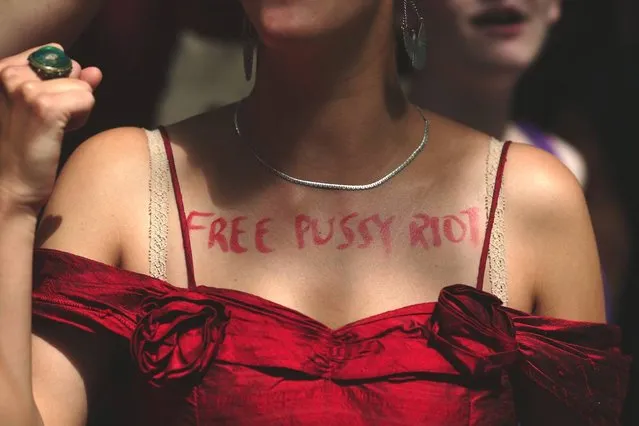
A woman wears on her chest the text 'free p*ssy riot' as a demonstration by supporters of the jailed feminist punk band 'p*ssy Riot' takes place outside the Russian Embassy on August 17, 2012 in London, England. The three women who staged an anti-Kremlin protest in a church in February, were found guilty today of hooliganism motivated by religious hatred, and could face a three-year jail sentence. Supporters are gathering in several cities around the world today as a mark of solidarity. (Photo by Dan Kitwood)

“On Friday, after something of a show trial, three young women in a Russian punk band were found guilty and sentenced to two years in prison for an anti-Vladimir Putin protest in a Moscow cathedral earlier this year”. – Daniel Schwartz via CBC News

Photo: A woman wears on her chest the text “free p*ssy riot” as a demonstration by supporters of the jailed feminist punk band p*ssy Riot takes place outside the Russian Embassy on August 17, 2012 in London, England. The three women who staged an anti-Kremlin protest in a church in February, were found guilty today of hooliganism motivated by religious hatred, and could face a three-year jail sentence. Supporters are gathering in several cities around the world today as a mark of solidarity. (Photo by Dan Kitwood)
Details
18 Aug 2012 11:26:00


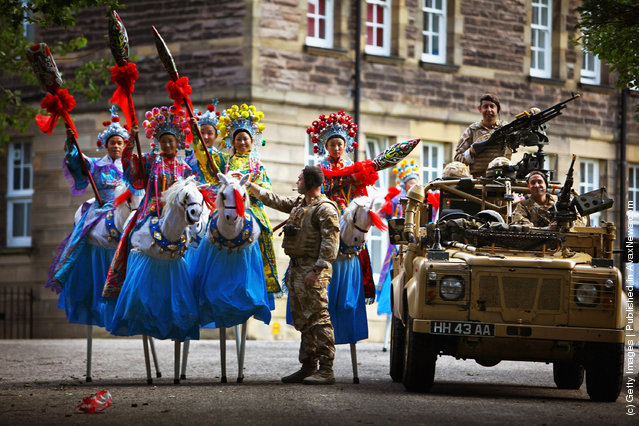
Entertainers from the She Huo cultural troupe rehearse for the Edinburgh Military Tattoo at Redford barracks on August 5, 2009 in Edinburgh, Scotland. (Photo by Jeff J Mitchell/Getty Images)
Details
12 Jun 2011 10:24:00
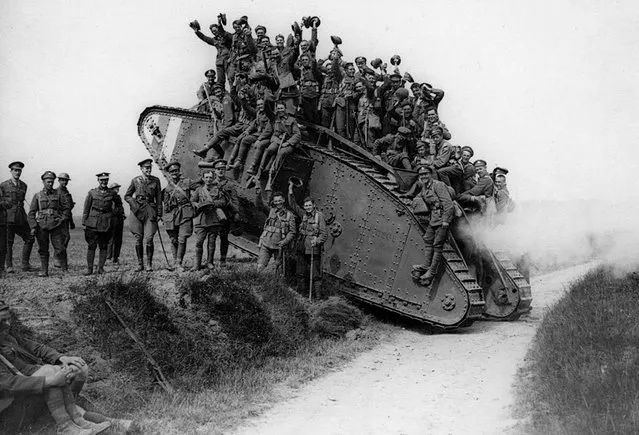
These black-and-white photos are taken from the new book “Armoured Warfare in the First World War 1916 – 1918” by Anthony Tucker-Jones and published by Pen & Sword Military. “Interestingly the British, French and Germans took completely different approaches with varying results”. The British military produced “Little Willie” in Autumn 1915 weighing 18 tonnes, which had a crew of two plus four gunners. “Inspired by a tracked artillery tractor “Little Willie” was referred to as a water tank – hence the name tank – to ensure secrecy”, said Anthony. “This led to the strange looking Mark I with its peculiar rhomboid shape, designed to cross trenches with guns in sponsons on either side. The Germans saw the tank as unchivalrous and were slow to grasp its utility. They favoured the Stormtrooper (specialist soldiers used to infiltrate enemy trenches) and artillery, not the tank”, said Anthony. “However, they didn’t hesitate to make use of captured British tanks. Although the tank helped secure victory and German soldiers dubbed it “Germany’s Downfall” the country was ultimately brought to its knees by the Allies blockade”. Here: British troops hitch a ride on a Mark IV after the massed tank fleet spearheading attack at Cambrai on November 20, 1917. (Photo by Anthony Tucker-Jones/Mediadrumworld.com)

These black-and-white photos are taken from the new book “Armoured Warfare in the First World War 1916 – 1918” by Anthony Tucker-Jones and published by Pen & Sword Military. Here: British troops hitch a ride on a Mark IV after the massed tank fleet spearheading attack at Cambrai on November 20, 1917. (Photo by Anthony Tucker-Jones/Mediadrumworld.com)
Details
23 Feb 2017 00:02:00
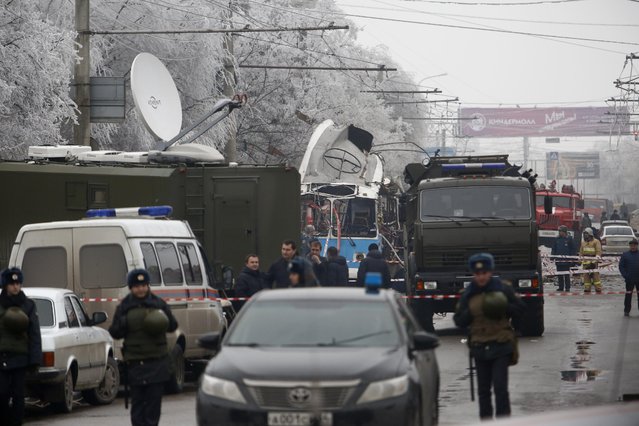
Military vehicles surround a wreckage of a trolleybus, in Volgograd, Russia, Monday, December 30, 2013. A bomb blast tore through a trolleybus in the city of Volgograd on Monday morning, killing at least 10 people a day after a suicide bombing that killed at least 17 at the city's main railway station. Volgograd is about 650 kilometers (400 miles) northeast of Sochi, where the Olympics are to be held. (Photo by Denis Tyrin/AP Photo)

Military vehicles surround a wreckage of a trolleybus, in Volgograd, Russia, Monday, December 30, 2013. A bomb blast tore through a trolleybus in the city of Volgograd on Monday morning, killing at least 10 people a day after a suicide bombing that killed at least 17 at the city's main railway station. Volgograd is about 650 kilometers (400 miles) northeast of Sochi, where the Olympics are to be held. (Photo by Denis Tyrin/AP Photo)
Details
30 Dec 2013 10:50:00
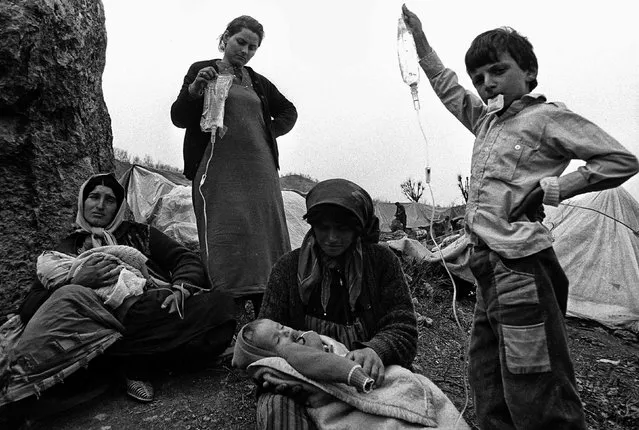
Iraqi Kurdish refugees wait with children in Cukurca refugee camp in Turkey April 8, 1991. Reuters photographers have chronicled Kurdish refugee crises over the years. In 1991 Srdjan Zivulovic documented refugees in Cukurca who had escaped a military operation by Saddam Hussein's government in Iraq aimed at “Arabising” Kurdish areas in the north. (Photo by Srdjan Zivulovic/Reuters)

Iraqi Kurdish refugees wait with children in Cukurca refugee camp in Turkey April 8, 1991. Reuters photographers have chronicled Kurdish refugee crises over the years. In 1991 Srdjan Zivulovic documented refugees in Cukurca who had escaped a military operation by Saddam Hussein's government in Iraq aimed at “Arabising” Kurdish areas in the north. Hundreds of thousands fled into Turkey and Iran. Images shot in recent months show familiar scenes as crowds of people flee Islamic State militants in Syria. There are as many as 30 million Kurds, spread through Turkey, Iraq, Syria and Iran. Most Kurds are Sunni Muslims, but tend to feel more loyalty to their Kurdishness, rather than their religion. (Photo by Srdjan Zivulovic/Reuters)
Details
14 Nov 2014 14:09:00
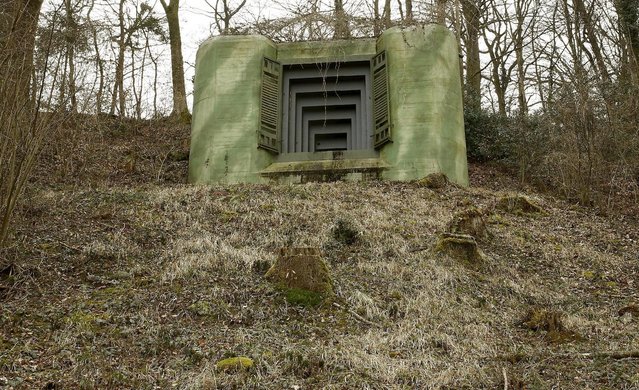
A bunker at aformer Swiss artillery fortress called Heldsberg stands near the town of St. Margareten, Switzerland March 22, 2015. Heldsberg fortress, located on the Swiss-Austrian border near the River Rhine and Lake Constance was built from 1938 to 1940 and remained in military use until 1992. Since 1993 it is open to the public as Fortress Museum Heldsberg. (Photo by Arnd Wiegmann/Reuters)

A bunker at aformer Swiss artillery fortress called Heldsberg stands near the town of St. Margareten, Switzerland March 22, 2015. Heldsberg fortress, located on the Swiss-Austrian border near the River Rhine and Lake Constance was built from 1938 to 1940 and remained in military use until 1992. Since 1993 it is open to the public as Fortress Museum Heldsberg. (Photo by Arnd Wiegmann/Reuters)
Details
09 Jan 2016 08:03:00
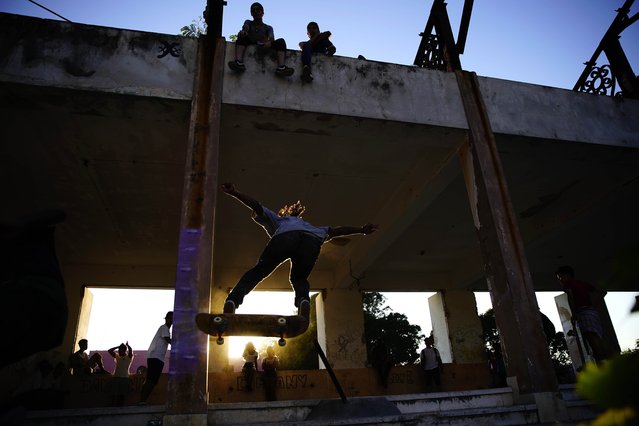
In this January 11, 2018 photo, a skater jumps a ramp during the inauguration of a new recreational space for skateboarders, created in an abandoned gym at the Educational complex Ciudad Libertad, a former military barracks that the late Fidel Castro turned into a school complex after the revolution in Havana, Cuba. Foreign skateboard enthusiasts supply their Cuban counterparts with boards and other equipment. (Photo by Ramon Espinosa/AP Photo)

In this January 11, 2018 photo, a skater jumps a ramp during the inauguration of a new recreational space for skateboarders, created in an abandoned gym at the Educational complex Ciudad Libertad, a former military barracks that the late Fidel Castro turned into a school complex after the revolution in Havana, Cuba. Foreign skateboard enthusiasts supply their Cuban counterparts with boards and other equipment. (Photo by Ramon Espinosa/AP Photo)
Details
03 Feb 2018 06:51:00
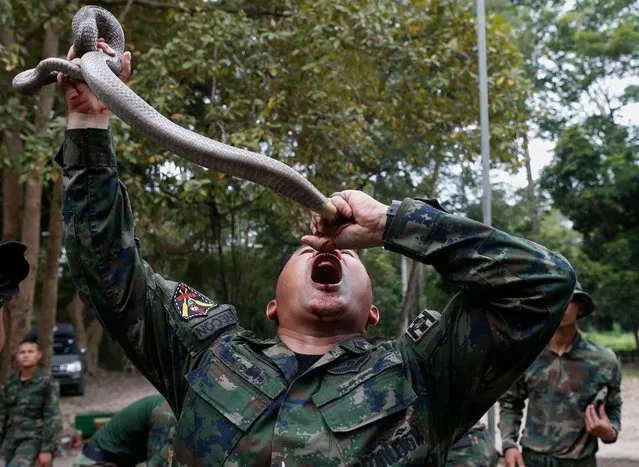
A Thai Marine instructor drinks a cobra's raw blood after killing it as he gives instruction to US Marines and South Korean Marines during jungle survival training as part of the multinational joint military exercise Cobra Gold 2018 at a Force Reconnaissance Battalion camp in the Royal Thai Naval Base, Sattahip district, Chonburi province, Thailand, 19 February 2018. (Photo by Rungroj Yongrit/EPA/EFE)

A Thai Marine instructor drinks a cobra's raw blood after killing it as he gives instruction to US Marines and South Korean Marines during jungle survival training as part of the multinational joint military exercise Cobra Gold 2018 at a Force Reconnaissance Battalion camp in the Royal Thai Naval Base, Sattahip district, Chonburi province, Thailand, 19 February 2018. (Photo by Rungroj Yongrit/EPA/EFE)
Details
21 Feb 2018 00:01:00