Yedam Kim (L) and Chaewon Kim, both of South Korea, look at a smartphone backstage after performing on stage during the first day of the 51st Prix de Lausanne at the Theatre de Beaulieu, in Lausanne, Switzerland, 30 January 2023. (Photo by Laurent Gillieron/EPA)
Ukrainian refugee circus student Mariia Lysytska stretching in a training room in Budapest, Hungary, Monday, February 13, 2023. More than 100 Ukrainian refugee circus students, between the ages of 5 and 20, found a home with the Capital Circus of Budapest after escaping the embattled cities of Kharkiv and Kyiv amid Russian bombings. (Photo by Denes Erdos/AP Photo)
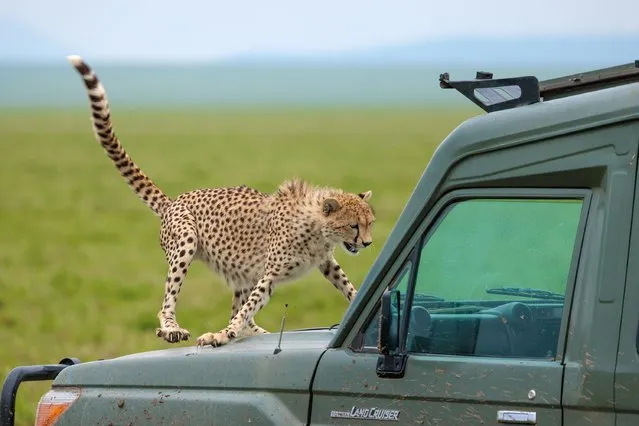
Tourists in the Serengeti, Tanzania in the second decade of February 2024, get more than they bargained for as a cheetah jumps on the bonnet of their jeep to make their acquaintance. (Photo by Ann Aveyard/Animal News Agency)
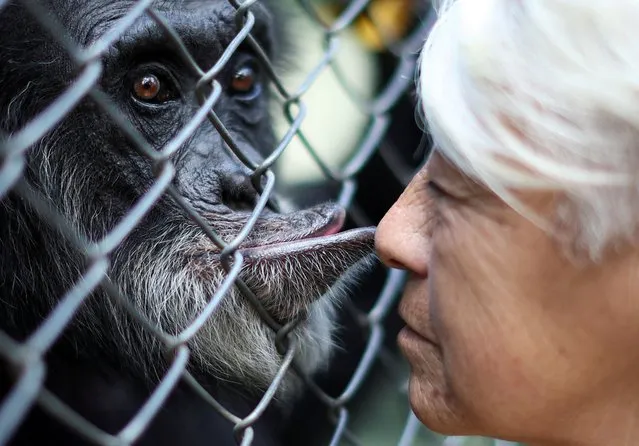
Keeper Silvia Salvatierra, 59, is kissed by a chimp named “Jony”, 54, who was rescued from a circus, at the Lujan Zoo from where felines, including tigers and lions, will be transferred to a wildlife sanctuary in India, in Lujan, on the outskirts of Buenos Aires, Argentina on April 8, 2024. (Photo by Agustin Marcarian/Reuters)
A man set wood on fire to prepare for worshippers to walk barefoot over burning coals during the Nine Emperor Gods festival at a temple in Kuala Lumpur, Malaysia, Monday, October 7, 2024. (Photo by Vincent Thian/AP Photo)
“Horst Ludwig Wessel (October 9, 1907 – February 23, 1930) was a German Nazi activist who was made a posthumous hero of the Nazi movement following his violent death in 1930. He was the author of the lyrics to the song “Die Fahne hoch” (“The Flag On High”), usually known as Horst-Wessel-Lied (“The Horst Wessel Song”), which became the Nazi Party anthem and, de facto, Germany's co-national anthem from 1933 to 1945”. – Wikipedia
Photo: German Nazi activist Horst Wessel (left) at the head of a parade of S.A. stormtroopers, or “brownshirts”, in Nuremberg, Germany, 1929. (Photo by Hulton Archive/Getty Images)