Loading...
Done


“The Trabant is a car that was produced by former East German auto maker VEB Sachsenring Automobilwerke Zwickau in Zwickau, Sachsen. It was the most common vehicle in East Germany, and was also exported to countries both inside and outside the communist bloc. The main selling points was that it had room for four adults and luggage in a compact, light and durable shell and that it was fast (when introduced) and durable. With its mediocre performance, smoky two-stroke engine, and production shortages, the Trabant is often cited as an example of the disadvantages of centralized planning; on the other hand, it is regarded with derisive affection as a symbol of the failed former East Germany and of the fall of communism (in former West Germany, as many East Germans streamed into West Berlin and West Germany in their Trabants after the opening of the Berlin Wall in 1989). It was in production without any significant changes for nearly 30 years with 3,096,099 Trabants produced in total”. – Wikipedia

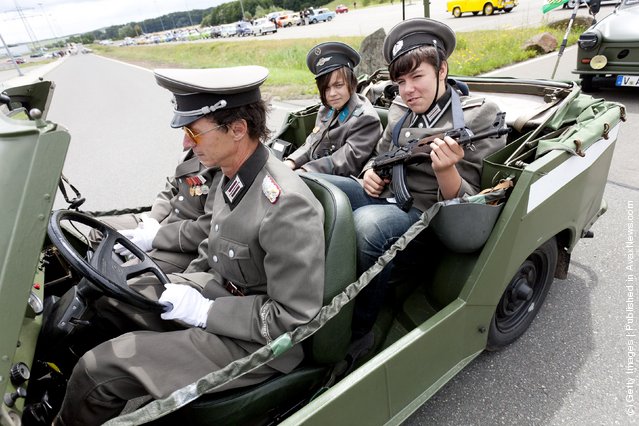
Photo: Enthusiasts weared in uniforms of the former eastern german army trive in a military Trabant car as fans and owners of East German-era Trabant cars gather at the 2011 International Trabantfahrer Treffen (International Trabant Drivers Meeting) on June 26, 2011 in Zwickau, Germany. The Trabant, also known as the Trabi, was among the main cars produced in communist East Germany and built by VEB Sachsenring Automobilwerke in Zwickau for 30 years until 1989. Today the car has cult status for many followers and one company, IndiKar, is even seeking to revive the brand in a modern, electric version. (Photo by Carsten Koall/Getty Images)
Details
27 Jun 2011 12:21:00
Jenna carefully watches two giant boa constrictors that their owner, a street performer she barely knows, entrusted to her. She is careful to keep the one snake wrapped around exercise bars to prevent a wound in the animal’s mouth from touching the sand and getting infected. Jenna is a single mom on disability. She suffers from failed back surgery syndrome, acquired from a violent car accident she had as a teenager. She and her young son Jackson can be found most afternoons on the beach. Originally from South Carolina, Jenna came to Venice in 2010 and describes herself as “an open-minded Christian who loves everyone for who they are”. Nowadays Jenna sometimes has trouble reconciling her inclusive progressive values with her family’s conservative political stance, especially in today’s toxic political climate. (Photo by Dotan Saguy)

Over the past three years, Los Angeles-based photographer Dotan Saguy has spent hundreds of hours documenting the diverse culture, people and pageantry of the iconic Venice Beach boardwalk. He was irresistibly drawn to the free-spirited, anti-materialistic and inclusive nature of the world-famous location, which he found to be a breath of fresh air in contrast to Los Angeles’s sometimes homogenized, celebrity-obsessed culture. (Photo by Dotan Saguy)
Details
01 Aug 2018 00:03:00
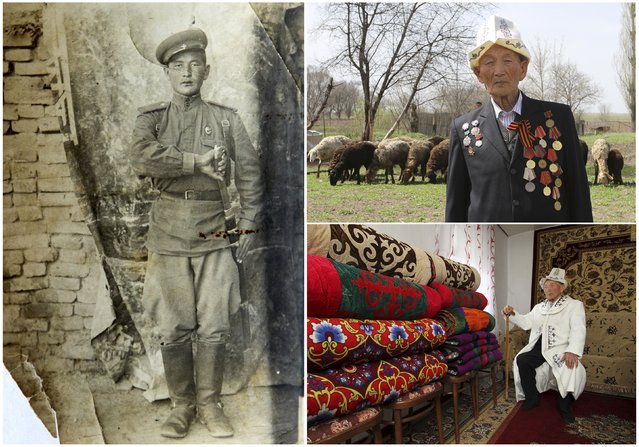
World War Two veteran Abla Begaliyev, 91, is seen in an undated handout picture (L), poses for a picture in Arashan (Top R) and at home in Kyrgyzstan April 14, 2015. Begaliyev served in the border guard cavalry from February 1942 until April 1947. Originally from Kyrgyzstan, he fought on the Ukrainian front and relocated to the border with Afghanistan at the end of World War Two. (Photo by Vladimir Pirogov/Reuters/Family handout (L))

World War Two veteran Abla Begaliyev, 91, is seen in an undated handout picture (L), poses for a picture in Arashan (Top R) and at home in Kyrgyzstan April 14, 2015. Begaliyev served in the border guard cavalry from February 1942 until April 1947. Originally from Kyrgyzstan, he fought on the Ukrainian front and relocated to the border with Afghanistan at the end of World War Two. As the world marks the 70th anniversary of the end of World War Two, Reuters photographers the length and breadth of the former Soviet republics (CCCP) captured portraits of Red Army veterans, mostly now in their 80s and 90s, today and through archive pictures at the time. More than 20 million Soviet citizens were killed in the war. (Photo by Vladimir Pirogov/Reuters/Family handout (L))
Details
08 May 2015 14:22:00
Andrew Parkinson, animal behaviour category winner: Crepuscular Contentment, Derbyshire. “In 15 years of working with badgers I’ve never seen a badger sit out in the open to have a scratch. I was sat concealed behind a tree and downwind so it was especially nice that the badger had his back to me, demonstrating just how inconspicuous and inconsequential my presence was”. (Photo by Andrew Parkinson/British Wildlife Photography Awards 2017)

Andrew Parkinson, animal behaviour category winner: Crepuscular Contentment, Derbyshire. “In 15 years of working with badgers I’ve never seen a badger sit out in the open to have a scratch. I was sat concealed behind a tree and downwind so it was especially nice that the badger had his back to me, demonstrating just how inconspicuous and inconsequential my presence was”. (Photo by Andrew Parkinson/British Wildlife Photography Awards 2017)
Details
10 Nov 2017 09:01:00


“Sektor gaza” (Russian: Сектор газа) was a Russian rock band formed on 5 December 1987 in the city of Voronezh, Russia. Despite only semi-officially existing (due to obscene lyrics), the group remains popular in Russia today. The group name was taken from an eponymous industrial district of Voronezh (itself named for high levels of environmental contamination). Their music style could be defined as Russian punk, integrated with elements of different musical genres such as rock, rap, and Russian folk. On 4 July 2000, group leader Yuri “Hoy” Klinskih complained of strong pains in his stomach and the left side of his chest. He suffered heart failure shortly thereafter. Klinskikh died in Voronezh (Russia)at the age of 35. He is buried in the Levoberezhniy Cemetery. The group ceased to exist.

About the music video: The First Chechen War, also known as the War in Chechnya, was a conflict between the Russian Federation and the Chechen Republic of Ichkeria, fought from December 1994 to August 1996. After the initial campaign of 1994 – 1995, culminating in the devastating Battle of Grozny, Russian federal forces attempted to seize control of the mountainous area of Chechnya but were set back by Chechen guerrilla warfare and raids on the flatlands in spite of Russia's overwhelming manpower, weaponry, and air support...
Details
24 May 2012 14:38:00
Spectacular images offering insight into the lives of the Huaorani people in the Ecuadorian Amazon have been revealed showing how they use traditional methods to hunt monkeys for food. The stunning pictures were taken by conservation photographer Pete Oxford from Torquay, Devon in the Ecuadorian Amazon. “The Huaorani Indians are a forest people highly in tune with their environment. Many are now totally acculturated since the 1950s by missionaries”, said Pete. “Today they face radical change to their culture to the proximity of oil exploration within their territory and the Yasuni National Park and Biosphere Reserve, they are vastly changed. Some still live very traditionally and for this shoot, through my Huaorani friend, a direct relative of those photographed he wanted to depict them as close to their original culture as possible. They still largely hunt with blow pipes and spears eating a lot of monkeys and peccaries”. The Huaorani are also known as the Waorani, Waodani or the Waos and are native Amerindians. Their lands are located between the Curaray and Napo rivers and speak the Huaorani language. Pete says that during his visit he was welcomed into the group and hopes that ancient cultures can be saved. Here: The tribe were seen celebrating after a hunter returned to camp with a wild pig. (Photo by Pete Oxford/Mediadrumworld.com)

Spectacular images offering insight into the lives of the Huaorani people in the Ecuadorian Amazon have been revealed showing how they use traditional methods to hunt monkeys for food. The stunning pictures were taken by conservation photographer Pete Oxford from Torquay, Devon in the Ecuadorian Amazon. Here: The tribe were seen celebrating after a hunter returned to camp with a wild pig. (Photo by Pete Oxford/Mediadrumworld.com)
Details
20 Jan 2017 07:58:00
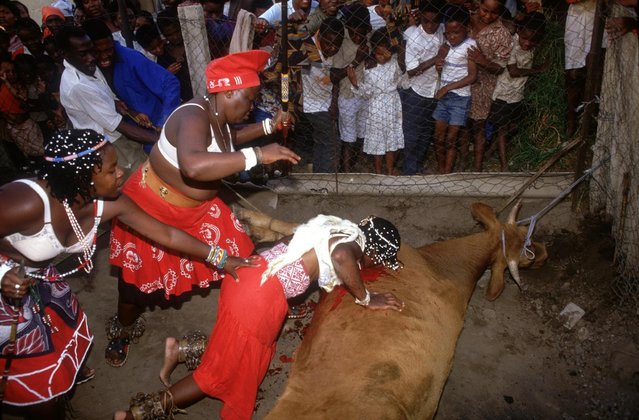
South African Sangomas are wizards and witches who are supposedly chosen by their ancestors to follow a traditional training and go through a rite of passage after which they become Sangomas and can cure and help people. They are so respected and trusted that western medical authorities have actually advised the government of South Africa to develop its cooperation with Sangomas in order to improve hygiene and health among the population. Today is graduation day for Trissa, 25, a Sangoma student in Tembisa, near Pretoria. Thanks to the help of the spirits of her ancestors, she has found a cow that had been hidden. The cow has then been killed by Sangoma Thelma and Trissa is now drinking its blood, thus becoming a Sangoma and changing her name to Nomadlozi. Location: Tembisa, near Pretoria, South Africa. (Photo by Patrick Durand/Sygma via Getty Images)

South African Sangomas are wizards and witches who are supposedly chosen by their ancestors to follow a traditional training and go through a rite of passage after which they become Sangomas and can cure and help people. They are so respected and trusted that western medical authorities have actually advised the government of South Africa to develop its cooperation with Sangomas in order to improve hygiene and health among the population. (Photo by Patrick Durand/Sygma via Getty Images)
Details
24 Feb 2017 00:05:00


“The Volkswagen Microbus Concept Car (also known as the Volkswagen New Microbus and Volkswagen Microbus Concept) was a concept car recalling the original Volkswagen Microbus and first presented at the 2001 North American International Auto Show. The new Microbus was completely modern compared to its predecessor, featuring a 7-inch screen in the center console and a second ceiling-located 7-inch screen that allowed the driver to see behind the vehicle”. – Wikipedia

Photo: A Volkswagen Bulli concept vehicle is displayed during the New York International Auto Show April 21, 2011 in New York City. The New York Auto Show is one of the largest auto shows in the country. (Photo by Ramin Talaie/Getty Images)
Details
23 Apr 2011 14:03:00