Loading...
Done
Residents ride on top of an overcrowded “Jeepney”, a locally manufactured public transport, along a highway in Mogpog town on Marinduque island in central Philippines April 8, 2015. (Photo by Erik De Castro/Reuters)

Residents ride on top of an overcrowded “Jeepney”, a locally manufactured public transport, along a highway in Mogpog town on Marinduque island in central Philippines April 8, 2015. (Photo by Erik De Castro/Reuters)
Details
03 Sep 2016 09:47:00
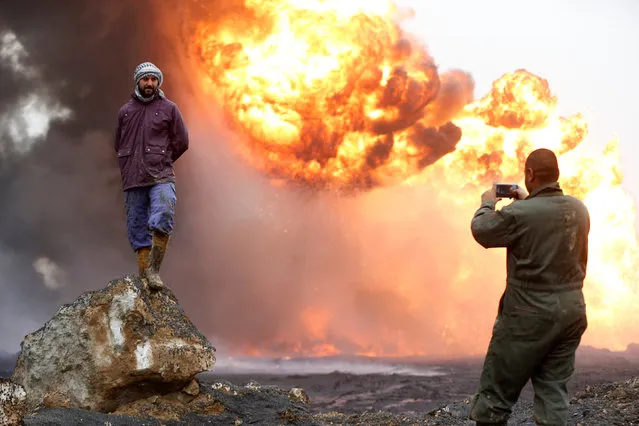
A man takes a photograph of his friend as thick smoke rises from a fire, which broke out at oil wells set ablaze by Islamic State militants before they fled the oil-producing region of Qayyara, Iraq, January 28, 2017. (Photo by Muhammad Hamed/Reuters)

A man takes a photograph of his friend as thick smoke rises from a fire, which broke out at oil wells set ablaze by Islamic State militants before they fled the oil-producing region of Qayyara, Iraq, January 28, 2017. (Photo by Muhammad Hamed/Reuters)
Details
03 Jan 2018 07:39:00
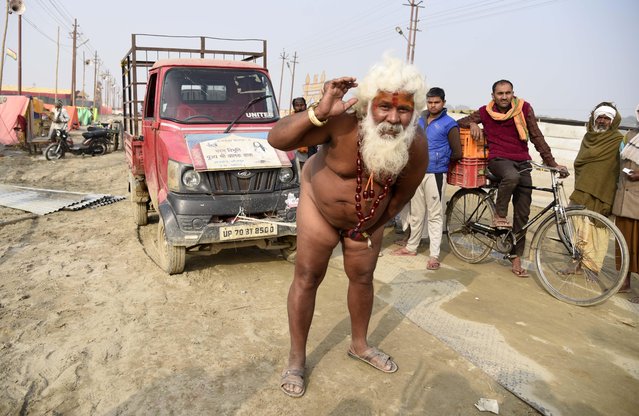
A naked holy man pulls a vehicle using his pen*s during the Magh mela festival in Allahabad, India on January 3, 2018. (Photo by Prabhat Kumar Verma/ZUMA Wire/Rex Features/Shutterstock)

A naked holy man pulls a vehicle using his pen*s during the Magh mela festival in Allahabad, India on January 3, 2018. (Photo by Prabhat Kumar Verma/ZUMA Wire/Rex Features/Shutterstock)
Details
04 Jan 2018 09:59:00
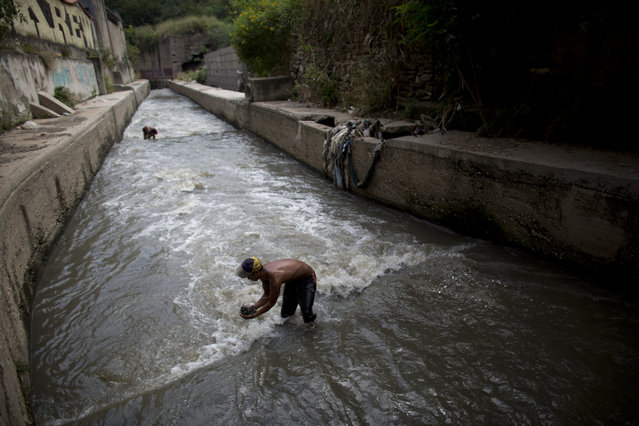
In this November 30, 2017 photo, Douglas scoops up mud from the bottom of the polluted Guaire River, in search of gold and anything valuable he can sell, in Caracas, Venezuela. Some stretches of the river smell of sewer while others emit a toxic odor of fuel, a stench that stays in ones nose for hours after leaving the water. (Photo by Ariana Cubillos/AP Photo)

In this November 30, 2017 photo, Douglas scoops up mud from the bottom of the polluted Guaire River, in search of gold and anything valuable he can sell, in Caracas, Venezuela. Some stretches of the river smell of sewer while others emit a toxic odor of fuel, a stench that stays in ones nose for hours after leaving the water. (Photo by Ariana Cubillos/AP Photo)
Details
11 Jan 2018 07:35:00
A demonstrator shows her arm with the name "Marielle" written on it, as she performs during a protest against the murder of councilwoman Marielle Franco in Rio de Janeiro, Brazil, Tuesday, March 20, 2018. Franco's murder came just a month after the government put the military in charge of security in Rio, which is experiencing a sharp spike in violence less than two years after hosting the 2016 Summer Olympics. (AP Photo/Leo Correa)

A demonstrator shows her arm with the name “Marielle” written on it, as she performs during a protest against the murder of councilwoman Marielle Franco in Rio de Janeiro, Brazil, Tuesday, March 20, 2018. Franco's murder came just a month after the government put the military in charge of security in Rio, which is experiencing a sharp spike in violence less than two years after hosting the 2016 Summer Olympics. (Photo by Leo Correa/AP Photo)
Details
21 Mar 2018 09:12:00
An elderly woman plays an accordion in Moscow, Russia on October 3, 2017. (Photo by Mladen Antonov/AFP Photo)

An elderly woman plays an accordion in Moscow, Russia on October 3, 2017. (Photo by Mladen Antonov/AFP Photo)
Details
07 Oct 2017 07:48:00
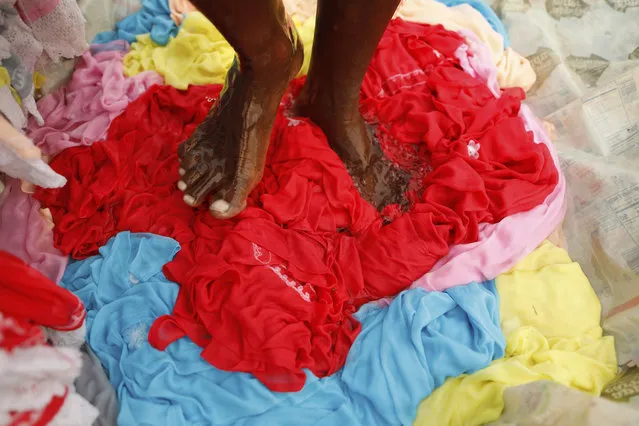
A dhobi, or a washerman washes cloths on the banks of the River Gomti in Lucknow, India, Saturday, September 12, 2020. Dhobis are traditional laundry workers who wash clothes by hand and dry them in the sun, an occupation which has been in existence for generations. Most cities in India have a Dhobi Ghat, or washermen's area, where the city's pile of clothes is laundered. This practice is still popular in India, despite of modern technology. Around 1,000 families work in Lucknow's Dhobi Ghat. However, in light of the novel coronavirus, their wages have decreased drastically. With each family earning around US$100-200 per month. (Photo by Rajesh Kumar Singh/AP Photo)


A dhobi, or a washerman washes cloths on the banks of the River Gomti in Lucknow, India, Saturday, September 12, 2020. Dhobis are traditional laundry workers who wash clothes by hand and dry them in the sun, an occupation which has been in existence for generations. Most cities in India have a Dhobi Ghat, or washermen's area, where the city's pile of clothes is laundered. This practice is still popular in India, despite of modern technology. Around 1,000 families work in Lucknow's Dhobi Ghat. However, in light of the novel coronavirus, their wages have decreased drastically. With each family earning around US$100-200 per month. (Photo by Rajesh Kumar Singh/AP Photo)
Details
25 Sep 2020 00:03:00
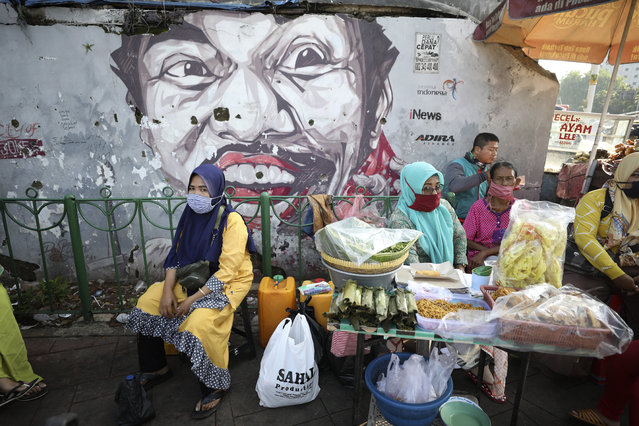
Indonesian women wearing masks as a precaution against the coronavirus outbreak sit at a food stall near a mural in Jakarta, Indonesia, Monday, September 21, 2020. (Photo by Dita Alangkara/AP Photo)

Indonesian women wearing masks as a precaution against the coronavirus outbreak sit at a food stall near a mural in Jakarta, Indonesia, Monday, September 21, 2020. (Photo by Dita Alangkara/AP Photo)
Details
03 Oct 2020 00:01:00