Loading...
Done


“The ONE Campaign is a international, nonpartisan, non-profit organization which aims to increase government funding for and effectiveness of international aid programs. ONE was originally founded by a coalition of 11 non-profit humanitarian and advocacy organizations — including DATA, World Vision, Oxfam America, and Bread for the World — with funding from the Bill & Melinda Gates Foundation. In 2007, ONE announced that it would be merging with DATA. Currently, ONE is campaigning for resources to help developing countries adapt to climate change. During the 2008 U.S. presidential election the organization launched a campaign, called ONE Vote '08, which was co-chaired by former U.S. Senate majority leaders Tom Daschle (D-SD) and Bill Frist (R-TN). The campaign is named after the U2 song “One” which was a top ten hit single on the critically acclaimed 1991 Achtung Baby album”. – Wikipedia

Photo: Bill Gates, founder of Microsoft and now philanthropist, poses with One.org charity volunteers at Pariser Platz square during a brief stop at Brandenburg Gate on April 6, 2011 in Berlin, Germany. Gates is in Berlin to meet with German government officials, including Chancellor Angela Merkel and Development Minister Dirk Niebel, to discuss aid for developing countries and promote his One.org charity initiative, which is part of the Bill and Melinda Gates Foundation. (Photo by Sean Gallup/Getty Images)
Details
07 Apr 2011 08:31:00
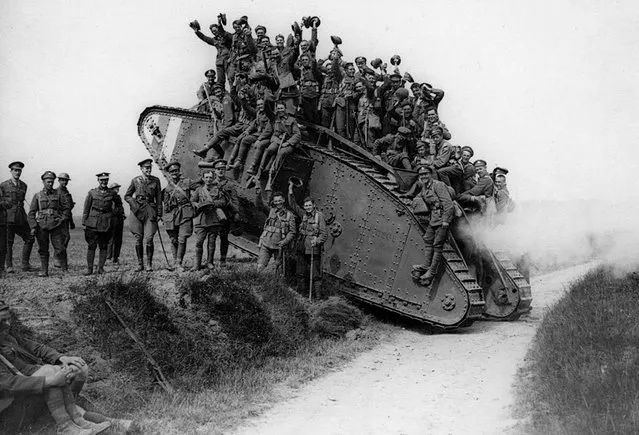
These black-and-white photos are taken from the new book “Armoured Warfare in the First World War 1916 – 1918” by Anthony Tucker-Jones and published by Pen & Sword Military. “Interestingly the British, French and Germans took completely different approaches with varying results”. The British military produced “Little Willie” in Autumn 1915 weighing 18 tonnes, which had a crew of two plus four gunners. “Inspired by a tracked artillery tractor “Little Willie” was referred to as a water tank – hence the name tank – to ensure secrecy”, said Anthony. “This led to the strange looking Mark I with its peculiar rhomboid shape, designed to cross trenches with guns in sponsons on either side. The Germans saw the tank as unchivalrous and were slow to grasp its utility. They favoured the Stormtrooper (specialist soldiers used to infiltrate enemy trenches) and artillery, not the tank”, said Anthony. “However, they didn’t hesitate to make use of captured British tanks. Although the tank helped secure victory and German soldiers dubbed it “Germany’s Downfall” the country was ultimately brought to its knees by the Allies blockade”. Here: British troops hitch a ride on a Mark IV after the massed tank fleet spearheading attack at Cambrai on November 20, 1917. (Photo by Anthony Tucker-Jones/Mediadrumworld.com)

These black-and-white photos are taken from the new book “Armoured Warfare in the First World War 1916 – 1918” by Anthony Tucker-Jones and published by Pen & Sword Military. Here: British troops hitch a ride on a Mark IV after the massed tank fleet spearheading attack at Cambrai on November 20, 1917. (Photo by Anthony Tucker-Jones/Mediadrumworld.com)
Details
23 Feb 2017 00:02:00
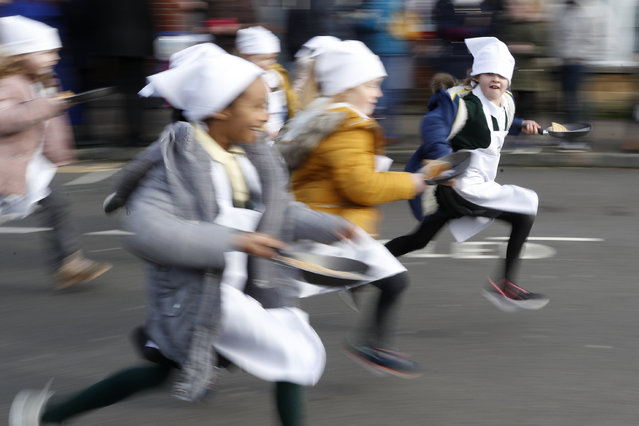
Schoolchildren from local schools take part in the children's races prior to the annual Pancake race in Olney, Buckinghamshire, England, Tuesday, February 25, 2020. Every year women clad in aprons and head scarves from Olney and the city of Liberal, in Kansas, USA, run their respective legs of the race with pancakes in their pans. According to legend, the Olney race started in 1445 when a harried housewife arrived at church on Shrove Tuesday still clutching her frying pan with a pancake in it. (Photo by Alastair Grant/AP Photo)

Schoolchildren from local schools take part in the children's races prior to the annual Pancake race in Olney, Buckinghamshire, England, Tuesday, February 25, 2020. Every year women clad in aprons and head scarves from Olney and the city of Liberal, in Kansas, USA, run their respective legs of the race with pancakes in their pans. According to legend, the Olney race started in 1445 when a harried housewife arrived at church on Shrove Tuesday still clutching her frying pan with a pancake in it. (Photo by Alastair Grant/AP Photo)
Details
27 Feb 2020 00:07:00
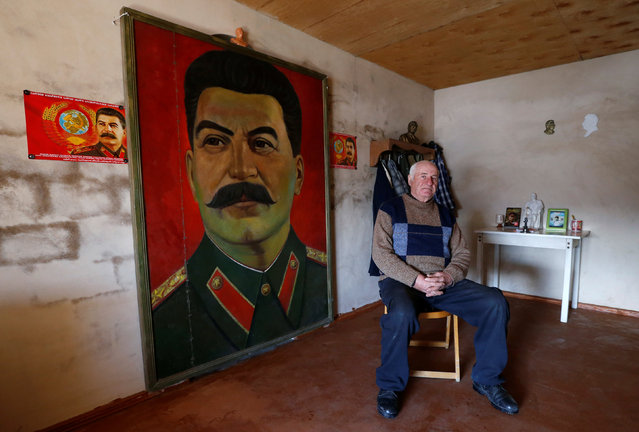
Retired builder Vasili Sidamonidze, 70, poses for a portrait at his home in Gori, Georgia, December 6, 2016. “Unfortunately, Stalin is not popular nowadays. Our people don't respect him. Only we, members of the (Communist) Party, respect him”, Sidamonidze said. “I always try to attend Stalin's birthday anniversaries in Gori. Unfortunately many people don't want to join us even if they live nearby. They look at us from their windows”. Stalin, who was born in Gori in 1878 and died in 1953, is largely reviled today in Georgia, which regained its independence during the 1991 collapse of the Soviet Union. Over the years, his memorials have been dismantled, most recently in 2010 when authorities removed a statue of the dictator from Gori's central square. But Stalin is still revered by a small group of mainly elderly supporters who stress his role in the industrialisation of the Soviet Union and in defeating Nazi Germany in World War Two. Each Dec. 21, a few dozen people mark his birthday by gathering outside a Gori museum dedicated to Stalin, where they make speeches and walk to the square where a 6-meter-high bronze statue of him once stood, calling for it to be reinstated. Opponents say it was a symbol of Moscow's still lingering shadow. In 2008, Russia fought a brief war with Georgia and recognised its breakaway regions of Abkhazia and South Ossetia as independent states. (Photo by David Mdzinarishvili/Reuters)

Retired builder Vasili Sidamonidze, 70, poses for a portrait at his home in Gori, Georgia, December 6, 2016. “Unfortunately, Stalin is not popular nowadays. Our people don't respect him. Only we, members of the (Communist) Party, respect him”, Sidamonidze said. “I always try to attend Stalin's birthday anniversaries in Gori. Unfortunately many people don't want to join us even if they live nearby. They look at us from their windows”. (Photo by David Mdzinarishvili/Reuters)
Details
17 Dec 2016 07:59:00
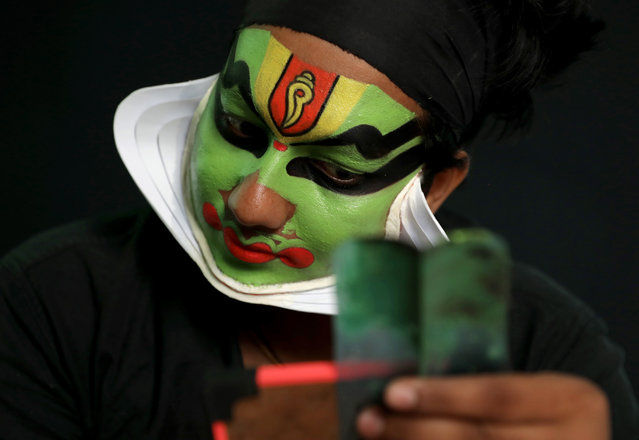
A South Indian dancer puts finishing touches to his make up as he gets ready to performs a traditional dance during a promotion event for Indian tourism in the Kerala state, in Kolkata, Eastern India, 28 January 2020. (Photo by Piyal Adhikary/EPA/EFE)

A South Indian dancer puts finishing touches to his make up as he gets ready to performs a traditional dance during a promotion event for Indian tourism in the Kerala state, in Kolkata, Eastern India, 28 January 2020. (Photo by Piyal Adhikary/EPA/EFE)
Details
30 Jan 2020 00:07:00
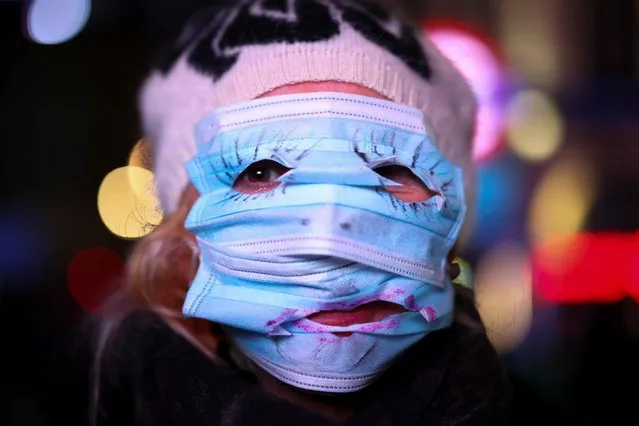
A woman uses protection masks to cover her face as protestors from the Million Mask March and anti lockdown protesters demonstrate, amid the coronavirus (COVID-19) outbreak in London, Britain on November 5, 2020. (Photo by Henry Nicholls/Reuters)

A woman uses protection masks to cover her face as protestors from the Million Mask March and anti lockdown protesters demonstrate, amid the coronavirus (COVID-19) outbreak in London, Britain on November 5, 2020. (Photo by Henry Nicholls/Reuters)
Details
08 Nov 2020 00:07:00
A model composes herself during the Ukrainian Fashion Week 2020-2021 at the Mystetskyi Arsenal National Art and Culture Museum Complex on February 4, 2020. (Photo by Irynka Hromotska/Radio Free Europe/Radio Liberty)

A model composes herself during the Ukrainian Fashion Week 2020-2021 at the Mystetskyi Arsenal National Art and Culture Museum Complex on February 4, 2020. (Photo by Irynka Hromotska/Radio Free Europe/Radio Liberty)
Details
05 Feb 2020 00:07:00
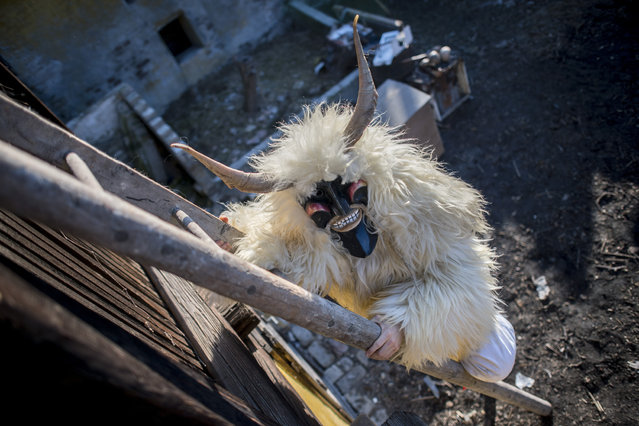
A man wears a busho mask and a costume made of sheep pelt while climbing up a ladder outside a barn in Mohacs, Hungary, 20 February 2020, on the first day of carnival. The traditional Busho carnival, which marks the end of winter, dates back to the 16th century. According to local legend, members of an ethnic South Slavic group living in Mohacs at the time dressed up in similar costumes and wore wooden masks to scare away Ottoman invaders, who mistook them for demons. (Photo by Tamas Soki/EPA/EFE)

A man wears a busho mask and a costume made of sheep pelt while climbing up a ladder outside a barn in Mohacs, Hungary, 20 February 2020, on the first day of carnival. The traditional Busho carnival, which marks the end of winter, dates back to the 16th century. According to local legend, members of an ethnic South Slavic group living in Mohacs at the time dressed up in similar costumes and wore wooden masks to scare away Ottoman invaders, who mistook them for demons. (Photo by Tamas Soki/EPA/EFE)
Details
23 Feb 2020 00:07:00