Loading...
Done
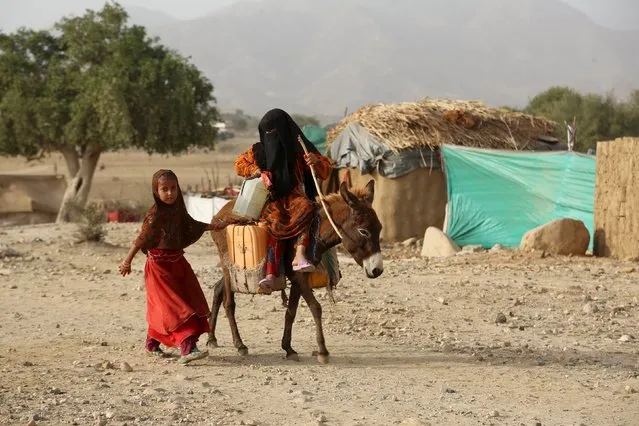
A girl rides a donkey as another walks by at the Shawqaba camp for internally displaced people who were forced to leave their villages by the war in Yemen's northwestern province of Hajjah March 12, 2016. In northwest Yemen, one of the poorest countries in the Middle East, about 400 families uprooted by the war have been stuck in the Shawqaba camp in Hajjah province for the past year. Residents live in poorly built huts that protect them neither from summer heat nor winter cold in a camp that lacks the most basic services. (Photo by Abduljabbar Zeyad/Reuters)

A girl rides a donkey as another walks by at the Shawqaba camp for internally displaced people who were forced to leave their villages by the war in Yemen's northwestern province of Hajjah March 12, 2016. In northwest Yemen, one of the poorest countries in the Middle East, about 400 families uprooted by the war have been stuck in the Shawqaba camp in Hajjah province for the past year. Residents live in poorly built huts that protect them neither from summer heat nor winter cold in a camp that lacks the most basic services. (Photo by Abduljabbar Zeyad/Reuters)
Details
09 Apr 2016 13:16:00
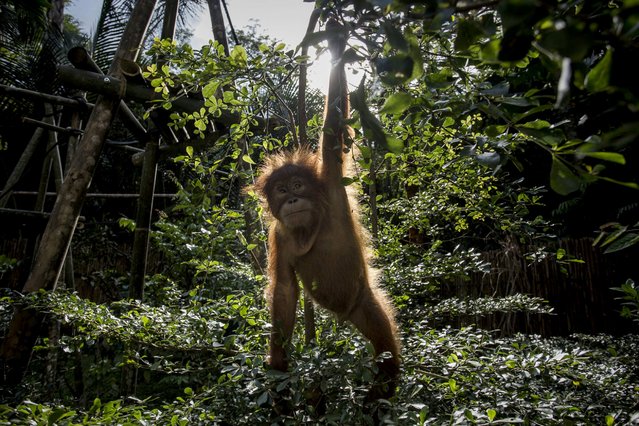
A Baby sumatran orangutan (Pongo abelii) plays around in a tree as they train at Sumatran Orangutan Conservation Programme's rehabilitation center on November 12, 2016 in Kuta Mbelin, North Sumatra, Indonesia. The Orangutans in Indonesia have been known to be on the verge of extinction as a result of deforestation and poaching. Found mostly in South-East Asia, where they live on the islands of Sumatra and Borneo, the endangered species continue to lose their habitat as a result of corporate expansion in a developing economy. Indonesia approved palm oil concessions on nearly 15 million acres of peatlands over the past years and thousands of square miles have been cleared for plantations, including the lowland areas that are the prime habitat for orangutans. (Photo by Ulet Ifansasti/Getty Images)

A Baby sumatran orangutan (Pongo abelii) plays around in a tree as they train at Sumatran Orangutan Conservation Programme's rehabilitation center on November 12, 2016 in Kuta Mbelin, North Sumatra, Indonesia. The Orangutans in Indonesia have been known to be on the verge of extinction as a result of deforestation and poaching. Found mostly in South-East Asia, where they live on the islands of Sumatra and Borneo, the endangered species continue to lose their habitat as a result of corporate expansion in a developing economy. Indonesia approved palm oil concessions on nearly 15 million acres of peatlands over the past years and thousands of square miles have been cleared for plantations, including the lowland areas that are the prime habitat for orangutans. (Photo by Ulet Ifansasti/Getty Images)
Details
16 Nov 2016 11:14:00
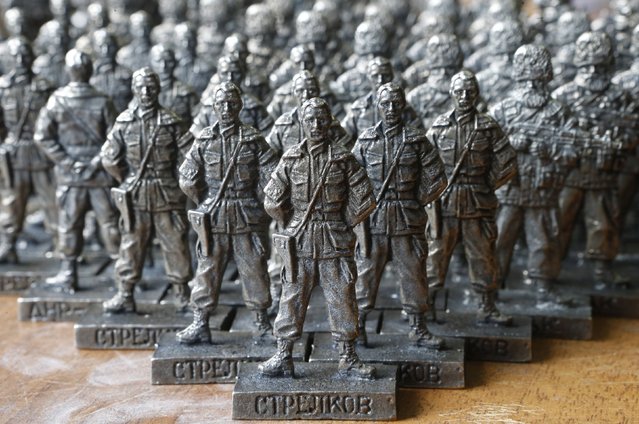
Figurines of former pro-Russian separatist commander Igor Strelkov from the collection entitled “Toy Soldiers of Novorossiya” are on display at a workshop in Moscow August 29, 2014. (Photo by Sergei Karpukhin/Reuters)

Figurines of former pro-Russian separatist commander Igor Strelkov from the collection entitled “Toy Soldiers of Novorossiya” are on display at a workshop in Moscow August 29, 2014. A Moscow-based maker of toy soldiers has sought inspiration for his creations from Ukrainian rebels fighting government troops in the east of Ukraine. Toy soldier maker, Timur Zamilov, displayed his new collection of rebel fighters cast in metal on Friday, before they are due to go on sale. His new collection is entitled “Toy Soldiers of Novorossiya” (New Russia), a reference to regions in eastern Ukraine where pro-Russian separatist fighters want full independence. Zamilov's selection includes models of Cossack soldiers, volunteers, soldiers bearing anti-aircraft missiles and even a miniature of prominent rebel leader Igor Strelkov. (Photo by Sergei Karpukhin/Reuters)
Details
01 Sep 2014 10:21:00
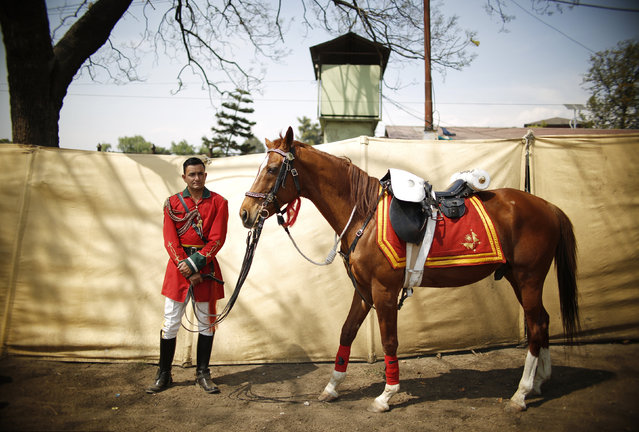
A Nepalese army solder stand next to a horse during the “Ghodejatra” Horse Race festival, which is organised by the Nepal Army, in Kathmandu, Nepal, April 7, 2016. Ghode Jatra, the horse racing festival of Nepal, celebrated on the New Moon day of mid March or early April is among the important celebrations of the Kathmandu Valley. exists a tree in the South-East part of the Tundikhel where Gurumapa supposed to be resides. (Photo by Navesh Chitrakar/Reuters)

A Nepalese army solder stand next to a horse during the “Ghodejatra” Horse Race festival, which is organised by the Nepal Army, in Kathmandu, Nepal, April 7, 2016. Ghode Jatra, the horse racing festival of Nepal, celebrated on the New Moon day of mid March or early April is among the important celebrations of the Kathmandu Valley. Grand horse parade including various acrobatic style of shows are performed by Nepal military at Tundikhel-a fenced parade ground located in the heart of Kathmandu city. (Photo by Navesh Chitrakar/Reuters)
Details
08 Apr 2016 14:33:00
Aliana Alexis of Haiti stands on the concrete slab of what is left of her home after destruction from Hurricane Dorian in an area called “The Mud” at Marsh Harbour in Great Abaco Island, Bahamas on September 5, 2019. (Photo by Al Diaz/Zuma Press via AFP Photo)

Aliana Alexis of Haiti stands on the concrete slab of what is left of her home after destruction from Hurricane Dorian in an area called “The Mud” at Marsh Harbour in Great Abaco Island, Bahamas on September 5, 2019. Hurricane Dorian lashed the Carolinas with driving rain and fierce winds as it neared the US east coast Thursday after devastating the Bahamas and killing at least 20 people. (Photo by Al Diaz/Zuma Press via AFP Photo)
Details
07 Sep 2019 00:05:00
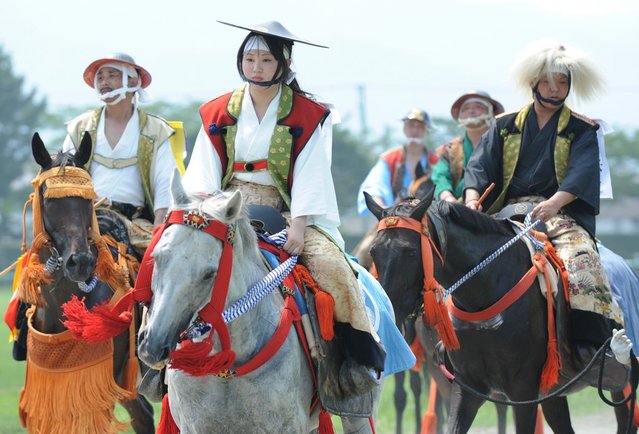
A young woman (C) clad in samurai costume leads other local poeple as she rides her horse during a parade at the annual Soma Nomaoi festival in Minamisoma, Fukushima Prefecture, on July 28, 2012.  The traditional full-scale festival kicked off for the first time after the accident of the Fukushima Dai-ichi Nuclear Power Plant following the massive earthquake and the tsunami on March 11, 2011. (Photo by Toru Yamanaka/AFP Photo)

Soma-Nomaoi is a festival that recreates a battle scene from more than 1,000 years ago. It is annually held for 4 days from July 22 to 25 in Haramachi City, Fukushima Prefecture, in the eastern part of Japan. In this historical event, 600 mounted samurai in traditional Japanese armor, with long swords at their side and ancestral flagstaffs streaming from their backs, ride across open fields. Soma-Nomaoi has been designated an Important Intangible Folk Cultural Property.

Photo: A young woman (C) clad in samurai costume leads other local poeple as she rides her horse during a parade at the annual Soma Nomaoi festival in Minamisoma, Fukushima Prefecture, on July 28, 2012. The traditional full-scale festival kicked off for the first time after the accident of the Fukushima Dai-ichi Nuclear Power Plant following the massive earthquake and the tsunami on March 11, 2011. (Photo by Toru Yamanaka/AFP Photo)
Details
02 Aug 2012 12:59:00
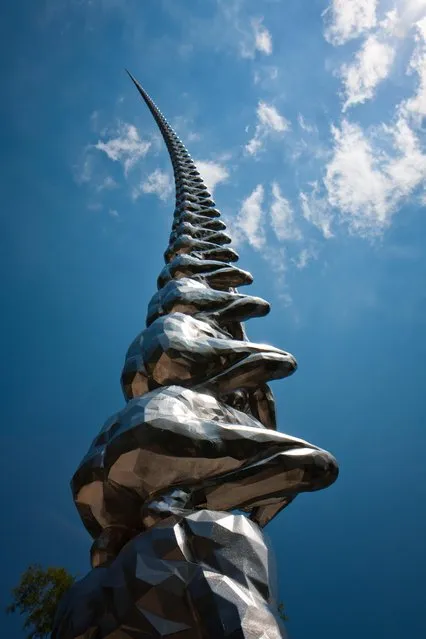
“Karma” by Do-Ho Suh. Sydney and Walda Besthoff Sculpture Garden, New Orleans Museum of Art, New Orleans, LA. (Photo by Alan Teo)

“Do-Ho Suh addresses issues of identity, memory, and relationships. Son of the famous Korean ink-painter Suh Se-Ok, Do-Ho Suh is a leading figure in the transnational avant-garde generation of Korean artists who came of age in the late 1990s, and his work eloquently represents a dual consciousness between East and West”.

Photo: “Karma” by Do-Ho Suh. Sydney and Walda Besthoff Sculpture Garden, New Orleans Museum of Art, New Orleans, LA. (Photo by Alan Teo)


Details
05 Mar 2013 09:37:00


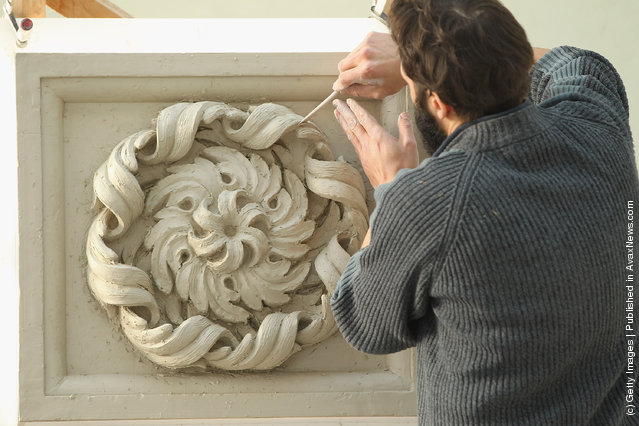
BERLIN, GERMANY - NOVEMBER 11: Sculptor Oleg Bessonov creates a rosette from clay at the Schlossbauhuette studio where a team of sculptors is creating decorative elements for the facade of the Berliner Schloss city palace on November 11, 2011 in Berlin, Germany. The Berliner Schloss was the residence of the Prussian Kaiser and was among the major architectural landmarks of Berlin until it was heavily damaged by Allied bombing in 1945. The communist authorities of East Berlin demolished the building in the 1950s, and today's Berlin government is pursuing an ambitious project to rebuild the palace according to a design by Italian architect Franco Stella, which will recreate the facade of the building but with a modern interior at a cost of approximately EUR 590 million. The Humboldt Forum, the foundation leading the project, has given the Schlossbauhuette sculptors the formidable task of recreating the hundreds of architectural elements that decorated the facade, and though some original pieces were saved, more often the sculptors have only old black and white photos as reference. (Photo by Sean Gallup/Getty Images)
Details
21 Nov 2011 11:22:00