Loading...
Done
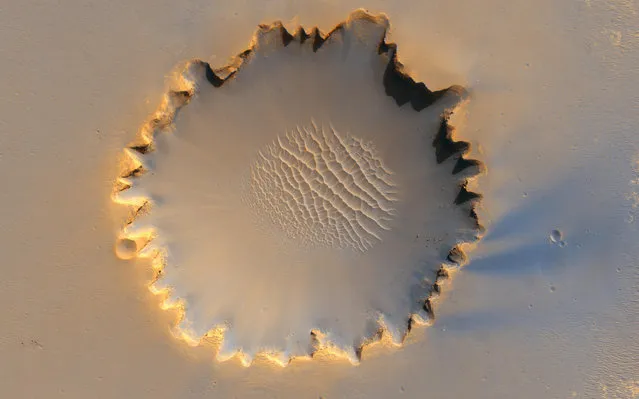
NASA's rover Opportunity visits Victoria Crater, viewed from orbit by the High Resolution Imaging Science Experiment on NASA's Mars Reconnaissance Orbiter in october of 2006. Opportunity is a small dot on the crater's lip, at top right. Opportunity first reached the crater's rim on September 27, 2006. (Photo by NASA/JPL-Caltech/University of Arizona/The Atlantic)

“NASA's Mars rover Opportunity just celebrated its ninth anniversary on Mars – a mission that was originally meant to last just 90 days...” – The Atlantic. Photo: NASA's rover Opportunity visits Victoria Crater, viewed from orbit by the High Resolution Imaging Science Experiment on NASA's Mars Reconnaissance Orbiter in october of 2006. Opportunity is a small dot on the crater's lip, at top right. Opportunity first reached the crater's rim on September 27, 2006. (Photo by NASA/JPL-Caltech/University of Arizona via The Atlantic)


Details
14 Feb 2013 10:58:00
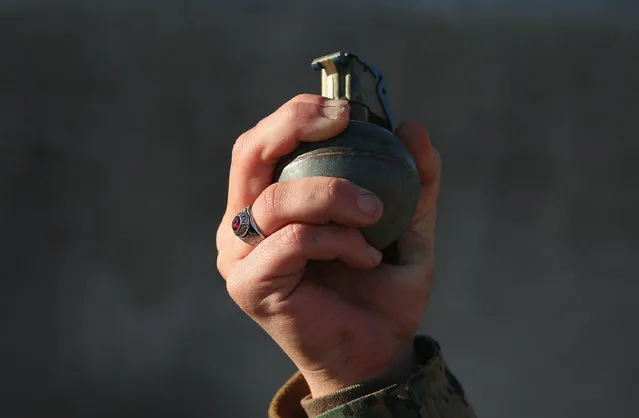
A female Marine prepares to throw a practice grenade during Marine Combat Training (MCT) on February 21, 2013 at Camp Lejeune, North Carolina.  Since 1988 all non-infantry enlisted male Marines have been required to complete 29 days of basic combat skills training at MCT after graduating from boot camp. MCT has been required for all enlisted female Marines since 1997. About six percent of enlisted Marines are female.  (Photo by Scott Olson)

A female Marine prepares to throw a practice grenade during Marine Combat Training (MCT) on February 21, 2013 at Camp Lejeune, North Carolina. Since 1988 all non-infantry enlisted male Marines have been required to complete 29 days of basic combat skills training at MCT after graduating from boot camp. MCT has been required for all enlisted female Marines since 1997. About six percent of enlisted Marines are female. (Photo by Scott Olson)
Details
22 Feb 2013 11:34:00
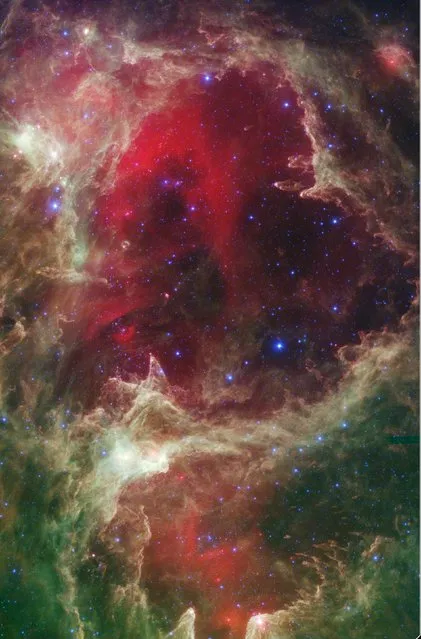
An infrared portrait from NASA's Spitzer Space Telescope which shows generations of stars is seen in this undated NASA handout image released February 14, 2013. In this wispy star-forming region, called W5, the oldest stars can be seen as blue dots in the centers of the two hollow cavities (other blue dots are background and foreground stars not associated with the region). Red shows heated dust that pervades the region's cavities, while green highlights dense clouds. (Photo by NASA/Reuters/JPL-Caltech/Harvard-Smithsonian/Handout)

An infrared portrait from NASA's Spitzer Space Telescope which shows generations of stars is seen in this undated NASA handout image released February 14, 2013. In this wispy star-forming region, called W5, the oldest stars can be seen as blue dots in the centers of the two hollow cavities (other blue dots are background and foreground stars not associated with the region). Red shows heated dust that pervades the region's cavities, while green highlights dense clouds. (Photo by NASA/Reuters/JPL-Caltech/Harvard-Smithsonian/Handout)
Details
03 Mar 2013 08:44:00
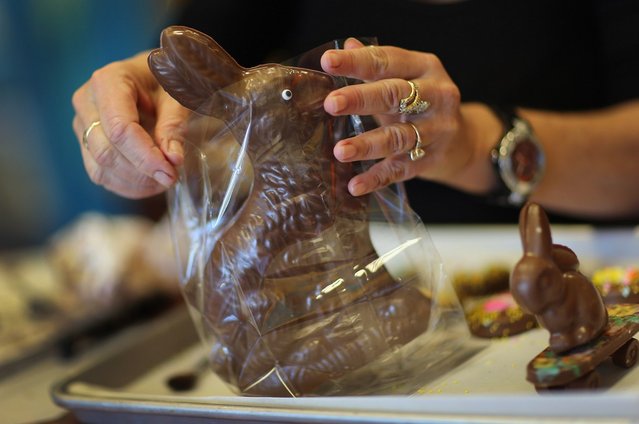
Darlene Eddy packages up a chocolate Easter bunny that she made in her store Amazing Chocolates on March 28, 2013 in Hollywood, Florida. As Easter Sunday approaches chocolatiers are busy manufacturing many different types of delights for the holiday when Americans spend roughly $1.9 billion on Easter candy, second only to Halloween in candy consumption. Around ninety million chocolate Easter bunnies are produced each year, from white to dark chocolate, and with an unlimited varieties of styles. (Photo by Joe Raedle)

Darlene Eddy packages up a chocolate Easter bunny that she made in her store Amazing Chocolates on March 28, 2013 in Hollywood, Florida. As Easter Sunday approaches chocolatiers are busy manufacturing many different types of delights for the holiday when Americans spend roughly $1.9 billion on Easter candy, second only to Halloween in candy consumption. Around ninety million chocolate Easter bunnies are produced each year, from white to dark chocolate, and with an unlimited varieties of styles. (Photo by Joe Raedle)
Details
29 Mar 2013 12:39:00
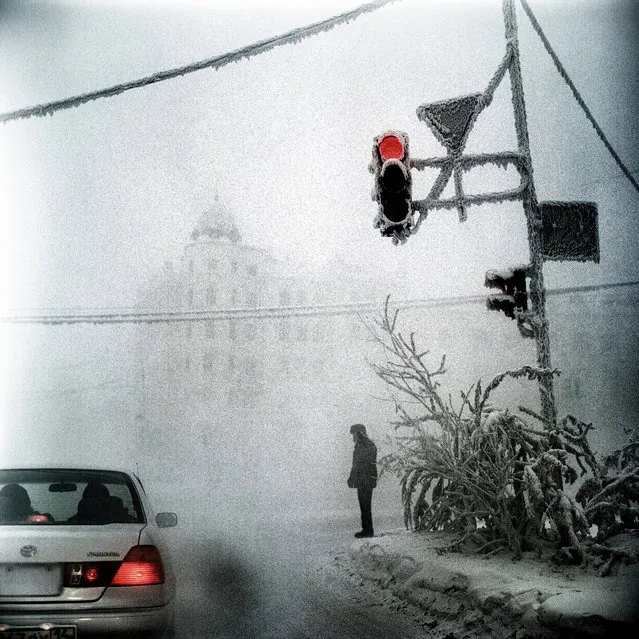
January 2013. A scene in Yakutsk, Siberia, the coldest city in the world. (Photo by Steeve Iuncker/Agence VU)

Yakutsk, a remote city in Eastern Siberia along the Lena River, is the coldest city in the world. Located 1840 km away from Irkoustk and 5000 km away from Moscow, this city founded in 1632 by the Cossacks imposes upon its inhabitants an extreme way of life. And yet, despite particularly harsh conditions, Yakutsk boasts a population of 270,000, or a quarter of the entire population of Siberia. No other place on the planet experiences the temperature extreme found here: in winter, the temperatures regularly fall to minus 40° (the coldest temperature recorded was –64°C) and in summer often reaches temperatures above 30°C. Photo: January 2013. A scene in Yakutsk, Siberia, the coldest city in the world. (Photo by Steeve Iuncker/Agence VU)
Details
29 Apr 2013 10:30:00
An Indian child artisan carries an idol of elephant-headed Hindu God Ganesha at a workshop ahead of Ganesh Chaturthi festival in Chennai, India, Saturday, September 7, 2013. Ganesh Chaturthi, which begins from September 9, is celebrated as the birthday of Lord Ganesha who is widely worshiped by Hindus as the God of wisdom, prosperity and good fortune. (Photo by Arun Sankar K./AP Photo)

An Indian child artisan carries an idol of elephant-headed Hindu God Ganesha at a workshop ahead of Ganesh Chaturthi festival in Chennai, India, Saturday, September 7, 2013. Ganesh Chaturthi, which begins from September 9, is celebrated as the birthday of Lord Ganesha who is widely worshiped by Hindus as the God of wisdom, prosperity and good fortune. (Photo by Arun Sankar K./AP Photo)
Details
09 Sep 2013 08:07:00
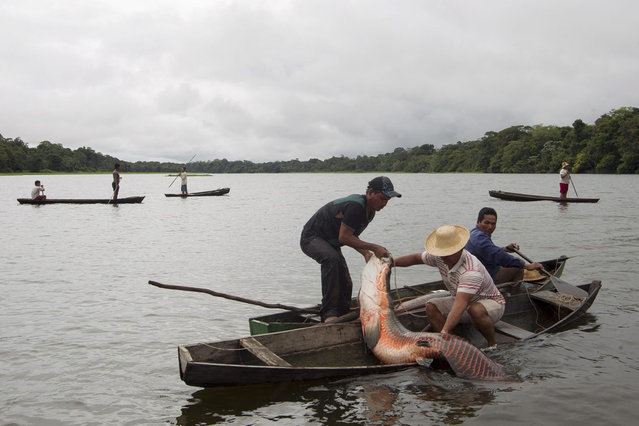
Villagers from the Porto Novo community load into their canoes arapaima or pirarucu, the largest freshwater fish species in South America and one of the largest in the world, while fishing in Poco Fundo lake along a branch of the Solimoes river, one of the main tributaries of the Amazon, in the Mamiraua nature reserve near Fonte Boa about 600 km (373 miles) west of Manaus, November 26, 2013. (Photo by Bruno Kelly/Reuters)

Villagers from the Porto Novo community load into their canoes arapaima or pirarucu, the largest freshwater fish species in South America and one of the largest in the world, while fishing in Poco Fundo lake along a branch of the Solimoes river, one of the main tributaries of the Amazon, in the Mamiraua nature reserve near Fonte Boa about 600 km (373 miles) west of Manaus, November 26, 2013. Catching the arapaima, a fish that is sought after for its meat and is considered by biologists to be a living fossil, is only allowed once a year by Brazil's environmental protection agency. The minimum size allowed for a fisherman to keep an arapaima is 1.5 meters (4.9 feet). (Photo by Bruno Kelly/Reuters)
Details
17 Dec 2013 08:03:00
Mikhail Kalashnikov, the father of the world's most popular assault rifle, is handed  an AK-74 November 23, 2002 in Izhevsk,1000 East km. from Moscow. November 23 marked the 55th anniversary of the release of the first Kalashnikov gun. According to the Moscow-based Center for Analysis of Strategic and Technologies some 70 million to 100 million Kalashnikovs have been built worldwide since 1947, compared about 7 million to Kalashnikov's Western rival the M-16 assault rifles. (Photo by Oleg Nikishin/Getty Images)

Mikhail Kalashnikov, the father of the world's most popular assault rifle, is handed an AK-74 November 23, 2002 in Izhevsk,1000 East km. from Moscow. November 23 marked the 55th anniversary of the release of the first Kalashnikov gun. According to the Moscow-based Center for Analysis of Strategic and Technologies some 70 million to 100 million Kalashnikovs have been built worldwide since 1947, compared about 7 million to Kalashnikov's Western rival the M-16 assault rifles. (Photo by Oleg Nikishin/Getty Images)
Details
24 Dec 2013 09:12:00