Loading...
Done
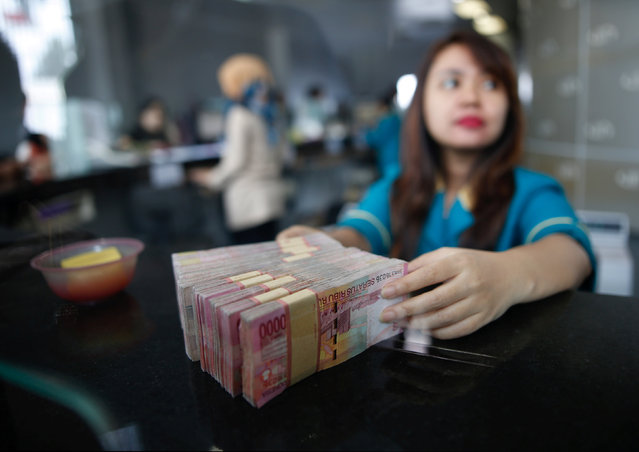
A teller at a money changer handles Indonesia rupiah bank notes in Jakarta, Indonesia November 11, 2016. (Photo by Darren Whiteside/Reuters)

A teller at a money changer handles Indonesia rupiah bank notes in Jakarta, Indonesia November 11, 2016. (Photo by Darren Whiteside/Reuters)
Details
08 Dec 2016 12:21:00
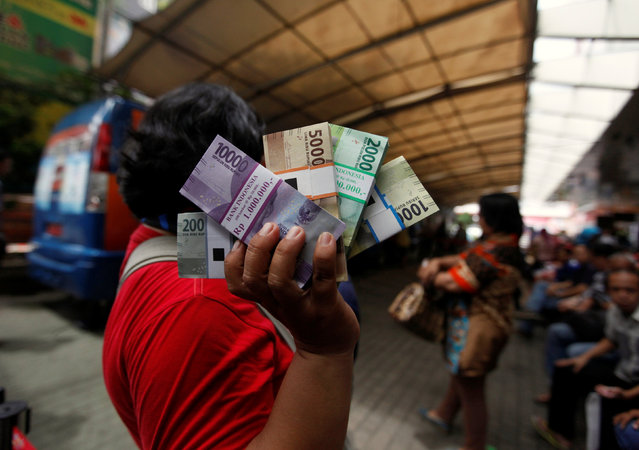
A woman holds newly designed Indonesia Rupiah banknotes after exchanging her old bills at a Bank Indonesia mobile bank in Jakarta, Indonesia December 19, 2016. (Photo by Fatima El-Kareem/Reuters)

A woman holds newly designed Indonesia Rupiah banknotes after exchanging her old bills at a Bank Indonesia mobile bank in Jakarta, Indonesia December 19, 2016. (Photo by Fatima El-Kareem/Reuters)
Details
14 Feb 2017 00:03:00
How Snakeskin Handbags Are Made

Images from a snake slaughterhouse at Kapetakan village in Indonesia’s West Java province. Wakira, who is known as “Boss Cobra”, owns the slaughterhouse that produces snake meat and skin. Snake meat is believed by some to be a remedy for skin diseases and asthma, as well as an aid to increase virility. The snake skins, measuring in the hundreds of metres, are sold to bag factories in the West and Central Java provinces on a monthly basis. The price of a bag made from snake skin costs between 150,000 rupiah ($ 15.60) and 300,000 rupiah ($31.20), depending on its size. That snakeskin handbag you’ll buy is costing a hell of a lot more.
Details
20 Feb 2013 12:00:00
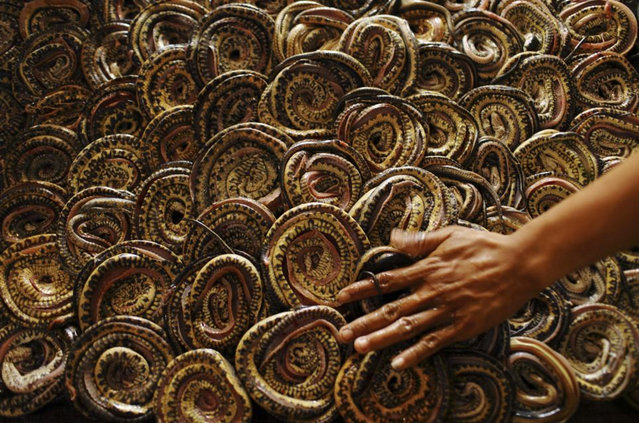
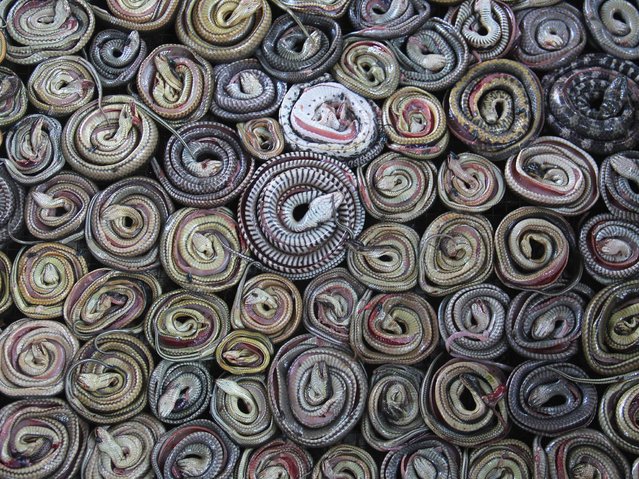
Snakes are collected and rolled before putting into the oven on March 2, 2014 in the village of Kertasura, Cirebon, Indonesia. (Photo by Nurcholis Anhari Lubis/Getty Images)

Snakes are collected and rolled before putting into the oven on March 2, 2014 in the village of Kertasura, Cirebon, Indonesia. At slaughter house snake skins measuring in the hundreds of metres, are sold to bag factories in the West and Central Java provinces on a monthly basis. From snake skin was manufactured into bags, shoes, wallets and belts. The price of a bag made from snake skin costs between 150,000 rupiah ($15 USD) and 300,000 rupiah ($30 USD), depending on its size. When snake skins reach Western fashion houses their price can increase dramatically and sell for up to $4,000 USD. (Photo by Nurcholis Anhari Lubis/Getty Images)
Details
05 Mar 2014 07:31:00
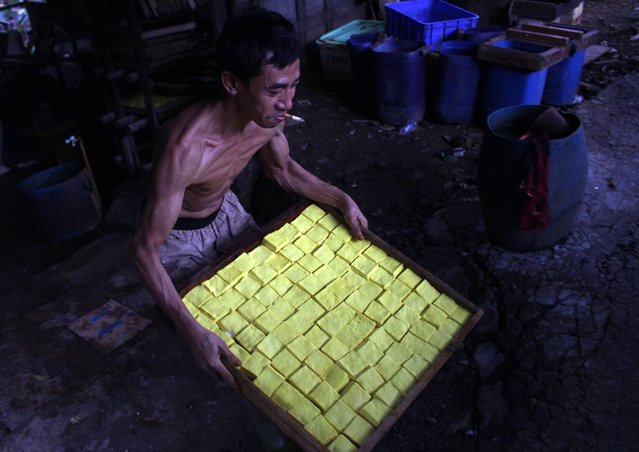
A  worker carries a tray of boiled tofu in a traditional tofu factory in Depok, Indonesia, 21 January 2015. (Photo by Adi Weda/EPA)

A worker carries a tray of boiled tofu in a traditional tofu factory in Depok, Indonesia, 21 January 2015. Tofu has been a common side dish for many Indonesian families. It is healthy, inexpensive and easy to find throughout the city. Tofu entrepreneurs in Indonesia are suffering due to the weakening of the rupiah against the US dollar and the rise in prices of imported soybeans in the international market, forcing tofu-makers to cut their production and lay off staff. (Photo by Adi Weda/EPA)
Details
27 Jan 2015 12:35:00
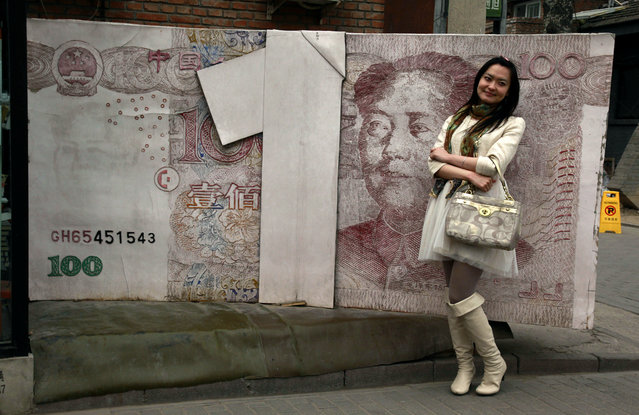
In this March 15, 2012 file photo, a Chinese woman poses for photos near a sculpture depicting a Chinese yuan note at an art district in Beijing, China. China devalued its tightly controlled currency on Tuesday, August 11,2015,  following a slump in trade, triggering the yuan's biggest one-day decline in a decade. The central bank said the yuan's 1.3 percent fall was due to a change aimed at making its exchange rate controls more market-oriented. But any change raises the risk of tensions with China's trading partners. (Photo by Ng Han Guan/AP Photo)

In this March 15, 2012 file photo, a Chinese woman poses for photos near a sculpture depicting a Chinese yuan note at an art district in Beijing, China. China devalued its tightly controlled currency on Tuesday, August 11,2015, following a slump in trade, triggering the yuan's biggest one-day decline in a decade. The central bank said the yuan's 1.3 percent fall was due to a change aimed at making its exchange rate controls more market-oriented. But any change raises the risk of tensions with China's trading partners. (Photo by Ng Han Guan/AP Photo)
Details
12 Aug 2015 13:11:00
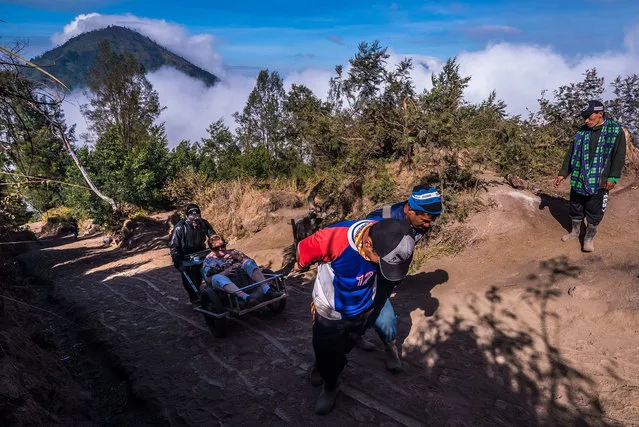
Miners pulling up lazy tourists to the rim of Kawah Ijen (Ijen Volcano), East Java, Indonesia on September 21, 2017. They will earn as much as they would bring down a load of sulfur. Nomadic Explorer, Cultural Lifestyle Photographer Claudio Sieber captured striking images of miners working at Ijen volcanic range in East Java, Indonesia. The sulphur miners risk their lives daily as they climb the active volcano carrying heavy loads, which they sell to sugar refineries. Shortly after midnight curious tourists are flocking in hundreds through the gate of Ijen's foothills to be right on time, driven by the images others took before them. Kawah Ijen is the one of the world's largest acidic volcanic crater lake; famous for its turquoise color as well as the unreal atmosphere it offers during darkness. A dusty path zigzags 3 kilometers up to the crater rim. This doesn't mean anything challenging; in particular, special sights have to be deserved anyway. The irritating smell of sulfur announces the near of the crater's existence. Arriving on the crater's rim the reward for the torture becomes visible. Blue fire darts its tongues through the fumes of sulfur dioxide. Somehow, the spectacle isn't as romantic as expected, since it is also the rough working space of approx. 150 sulfur miners who start their shift at 1 am. Lately, harvesting the abundance of devil's gold received international attention. This did obviously not really improve a miner's lifestyle; neither did it contribute to a better wage. (Photo by Claudio Sieber/Barcroft Images)

Miners pulling up lazy tourists to the rim of Kawah Ijen (Ijen Volcano), East Java, Indonesia on September 21, 2017. They will earn as much as they would bring down a load of sulfur. Nomadic Explorer, Cultural Lifestyle Photographer Claudio Sieber captured striking images of miners working at Ijen volcanic range in East Java, Indonesia. The sulphur miners risk their lives daily as they climb the active volcano carrying heavy loads, which they sell to sugar refineries. (Photo by Claudio Sieber/Barcroft Images)
Details
02 Oct 2017 08:31:00
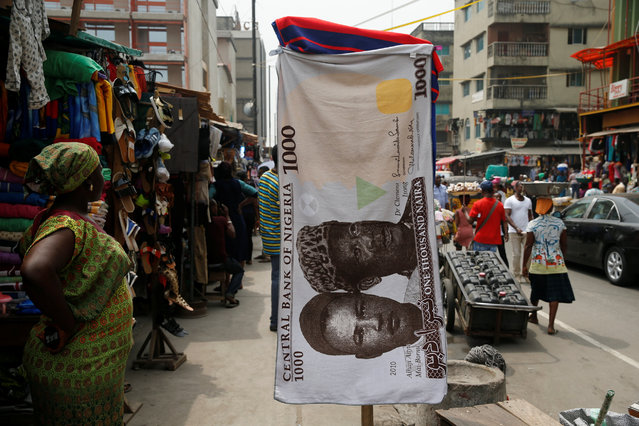
A towel with a print of the Nigerian naira is displayed for sale at a street market in the central business district in Nigeria's commercial capital Lagos February 4, 2016. (Photo by Akintunde Akinleye/Reuters)

A towel with a print of the Nigerian naira is displayed for sale at a street market in the central business district in Nigeria's commercial capital Lagos February 4, 2016. (Photo by Akintunde Akinleye/Reuters)
Details
07 Sep 2016 09:45:00