Loading...
Done
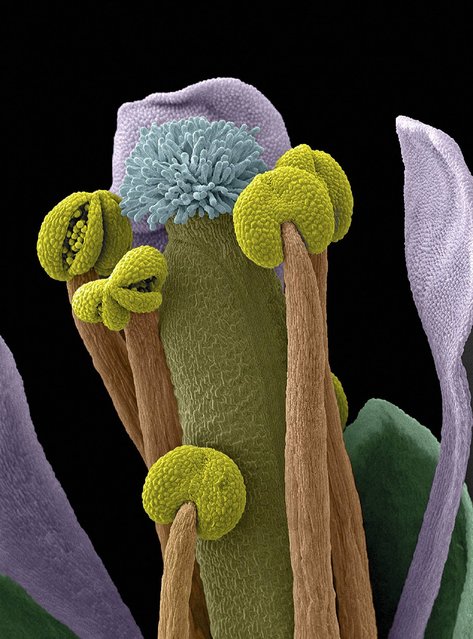
Scanning electron micrograph (SEM) of an Arabidopsis thaliana flower, also commonly known as thale cress. Some of the anthers are open, revealing pollen grains ready for dispersal. Arabidopsis was the first plant to have its entire genome sequenced and is widely used as a model organism in molecular and plant biology. Horizontal width of image is 1200 microns. Magnification 100x. (Photo by Stefan Eberhard/Wellcome Images)

Beautiful, strange and occasionally alarming pictures from the shortlist for this year’s Wellcome image awards – which celebrate the very best in science photography and imaging – from an x-ray of a bat to a micrograph of a kidney stone. The exhibition opens on 12 March at three science centres and the Museum of Science and Industry in Manchester. Photo: Scanning electron micrograph (SEM) of an Arabidopsis thaliana flower, also commonly known as thale cress. Some of the anthers are open, revealing pollen grains ready for dispersal. Arabidopsis was the first plant to have its entire genome sequenced and is widely used as a model organism in molecular and plant biology. Horizontal width of image is 1200 microns. Magnification 100x. (Photo by Stefan Eberhard/Wellcome Images)
Details
11 Mar 2014 05:58:00
Scientists say that a “Martian flower”, seen here in an image from the Curiosity rover's Mars Hand Lens Imager, is a 2-millimeter-wide grain or pebble that's embedded in the surrounding rock. Another, darker-colored mineral grain can be seen above and to the left. (Photo by NASA)

“The scientists behind NASA's $2.5 billion Curiosity rover mission on Mars on Tuesday explained the nature of a tiny, gleaming "flower" embedded in Red Planet rock, and revealed where they'll be using the SUV-sized robot's drill for the first time”. – Alan Boyle via NBCNews.com

Photo: Scientists say that a “Martian flower”, seen here in an image from the Curiosity rover's Mars Hand Lens Imager, is a 2-millimeter-wide grain or pebble that's embedded in the surrounding rock. Another, darker-colored mineral grain can be seen above and to the left. (Photo by NASA)
Details
16 Jan 2013 11:12:00
In this May 2016 photo released by The Ocean Agency/XL Catlin Seaview Survey, a boat sails near a coral reef that has been bleached white by heat stress in the Maldives. (Photo by The Ocean Agency/XL Catlin Seaview Survey via AP Photo)

In this May 2016 photo released by The Ocean Agency/XL Catlin Seaview Survey, a boat sails near a coral reef that has been bleached white by heat stress in the Maldives. oral reefs, unique underwater ecosystems that sustain a quarter of the world's marine species and half a billion people, are dying on an unprecedented scale. Scientists are racing to prevent a complete wipeout within decades. (Photo by The Ocean Agency/XL Catlin Seaview Survey via AP Photo)
Details
14 Mar 2017 00:05:00
NASA's rover Opportunity visits Victoria Crater, viewed from orbit by the High Resolution Imaging Science Experiment on NASA's Mars Reconnaissance Orbiter in october of 2006. Opportunity is a small dot on the crater's lip, at top right. Opportunity first reached the crater's rim on September 27, 2006. (Photo by NASA/JPL-Caltech/University of Arizona/The Atlantic)

“NASA's Mars rover Opportunity just celebrated its ninth anniversary on Mars – a mission that was originally meant to last just 90 days...” – The Atlantic. Photo: NASA's rover Opportunity visits Victoria Crater, viewed from orbit by the High Resolution Imaging Science Experiment on NASA's Mars Reconnaissance Orbiter in october of 2006. Opportunity is a small dot on the crater's lip, at top right. Opportunity first reached the crater's rim on September 27, 2006. (Photo by NASA/JPL-Caltech/University of Arizona via The Atlantic)


Details
14 Feb 2013 10:58:00
Golden Pearl Farming In Philippines

Jewelmer is the only pearl producer in the world that has successfully produced pearls with a rich, natural golden color. Through decades of research and biotechnology, Jewelmer was able to perfect the breeding process that produces gold-lipped Pinctada maxima pearl oysters capable of growing large, lustrous, golden pearls. This deep, rich color can only be found in South Sea pearls produced in the Philippines.
Details
08 Oct 2014 11:50:00
A killdeer (Charadrius vociferus) chick on sand dunes in Pacific Grove, California, US on June 21, 2023. The killdeer gets its name from its shrill, loud call. (Photo by Rory Merry/ZUMA Press Wire/Rex Features/Shutterstock)

A killdeer (Charadrius vociferus) chick on sand dunes in Pacific Grove, California, US on June 21, 2023. The killdeer gets its name from its shrill, loud call. (Photo by Rory Merry/ZUMA Press Wire/Rex Features/Shutterstock)
Details
02 Jul 2023 03:03:00
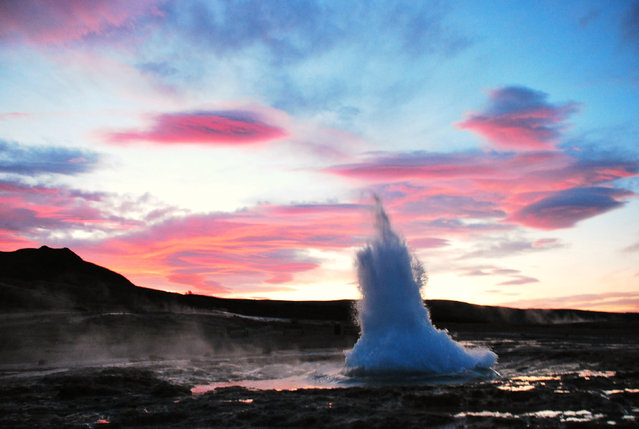
Strokkur geyser against cloudy sky at sunset. Strokkur is a fountain geyser located in a geothermal area beside the Hvítá River in Iceland in the southwest part of the country, east of Reykjavík. It is one of Iceland's most famous geysers, erupting once every 6–10 minutes. Its usual height is 15–20 m, although it can sometimes erupt up to 40 m high. (Photo by Teatsche Dijkhuis/Getty Images/EyeEm)

Strokkur geyser against cloudy sky at sunset. Strokkur is a fountain geyser located in a geothermal area beside the Hvítá River in Iceland in the southwest part of the country, east of Reykjavík. It is one of Iceland's most famous geysers, erupting once every 6–10 minutes. Its usual height is 15–20 m, although it can sometimes erupt up to 40 m high. (Photo by Teatsche Dijkhuis/Getty Images/EyeEm)
Details
18 Oct 2016 12:43:00
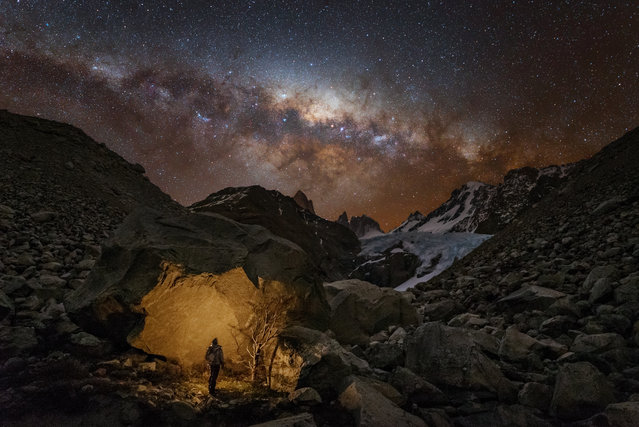
“People and Space”. Winner: Wanderer in Patagonia by Yuri Zvezdny (Russia) A lone stargazer stares up at the stars of our galaxy, the Milky Way, as they stretch across the night sky over the glacier “White Stones” (Piedras Blancas) in the Los Glaciares National Park, Argentina. El Chaltén, Santa Cruz Province, Argentina, 27 September 2016 iOptron Sky-Tracker mount, Sony A7S camera, 18 mm f/2.8 lens, ISO 5000, 30-second exposure Wanderer in Patagonia. (Photo by Yuri Zvezdny/Insight Astronomy Photographer of the Year 2017)

“People and Space”. Winner: Wanderer in Patagonia by Yuri Zvezdny (Russia) A lone stargazer stares up at the stars of our galaxy, the Milky Way, as they stretch across the night sky over the glacier “White Stones” (Piedras Blancas) in the Los Glaciares National Park, Argentina. El Chaltén, Santa Cruz Province, Argentina, 27 September 2016 iOptron Sky-Tracker mount, Sony A7S camera, 18 mm f/2.8 lens, ISO 5000, 30-second exposure Wanderer in Patagonia. (Photo by Yuri Zvezdny/Insight Astronomy Photographer of the Year 2017)
Details
18 Sep 2017 07:09:00