Loading...
Done
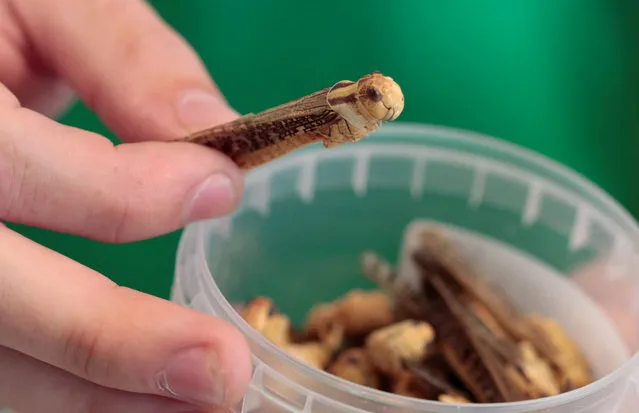
An attendee at the “Eating Insects Detroit: Exploring the Culture of Insects as Food and Feed” conference at Wayne State University shows an edible freeze-dried locust insect in Detroit, Michigan May 26, 2016. (Photo by Rebecca Cook/Reuters)

An attendee at the “Eating Insects Detroit: Exploring the Culture of Insects as Food and Feed” conference at Wayne State University shows an edible freeze-dried locust insect in Detroit, Michigan May 26, 2016. (Photo by Rebecca Cook/Reuters)
Details
29 May 2016 09:41:00
In this Thursday, February 19, 2015 photo, participants at a seminar on edible insects taste a Cricket Consomme at Le Cordon Bleu cooking school in Bangkok, Thailand. A group of chefs and food scientists at the esteemed French school's branch in Bangkok spent the week simmering, sautéing and grilling insects to extract innovative flavors they say could open a new frontier for the world of gastronomy. (Photo by Sakchai Lalit/AP Photo)

In this Thursday, February 19, 2015 photo, participants at a seminar on edible insects taste a Cricket Consomme at Le Cordon Bleu cooking school in Bangkok, Thailand. A group of chefs and food scientists at the esteemed French school's branch in Bangkok spent the week simmering, sautéing and grilling insects to extract innovative flavors they say could open a new frontier for the world of gastronomy. (Photo by Sakchai Lalit/AP Photo)
Details
22 Feb 2015 11:15:00
A combination photo shows various popular street foods under $6 from various hawker food stalls and eateries in Singapore, taken between July 28 to 31, 2016. Top row (L to R) bak chor mee, soya sauce chicken; Middle row (L to R) laksa, hokkien mee, nasi lemak, ice kachang; Bottom row (L to R) rojak, roti prata and satay. (Photo by Edgar Su/Reuters)

A combination photo shows various popular street foods under $6 from various hawker food stalls and eateries in Singapore, taken between July 28 to 31, 2016. Top row (L to R) bak chor mee, soya sauce chicken; Middle row (L to R) laksa, hokkien mee, nasi lemak, ice kachang; Bottom row (L to R) rojak, roti prata and satay. (Photo by Edgar Su/Reuters)
Details
27 Aug 2016 10:55:00
Yang Juan, an employee at Goopal Group, takes a nap in her seat after lunch, in Beijing, China, April 21, 2016. (Photo by Jason Lee/Reuters)

Yang Juan, an employee at Goopal Group, takes a nap in her seat after lunch, in Beijing, China, April 21, 2016. Office workers sleeping on the job is a common sight in China, where a surplus of cheap labour can lead to downtime at work. But in China's technology sector, where business is growing faster than many start-up firms can hire new staff, workers burn the midnight oil to meet deadlines and compete with their rivals. Some companies provide sleeping areas and beds for workers to rest during late nights. (Photo by Jason Lee/Reuters)
Details
12 May 2016 14:53:00
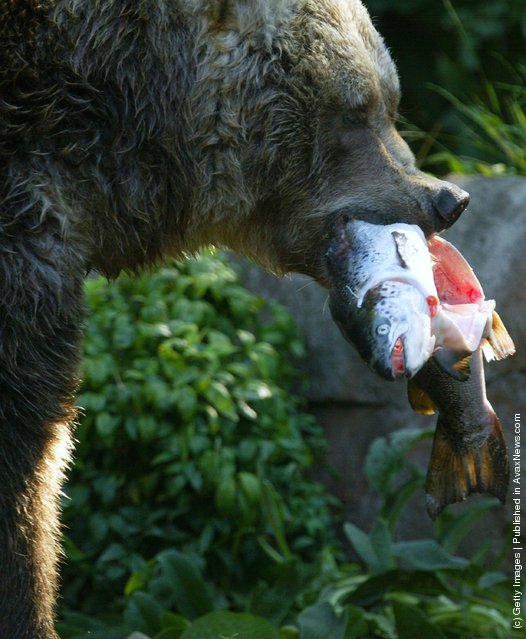
Bear Eat Fish

Cynthia the Kodiak Bear enjoys a whole Tasmanian Atlantic Salmon to celebrate her 28th birthday at Taronga Zoo on January 17, 2005 in Sydney, Australia. (Photo by Matt King/Getty Images)
Details
20 Sep 2011 12:34:00
A woman wears VR glasses while the projection mapping is cast on table and walls during its media preview at “TREE BY NAKED, yoyogi park” restaurant in Tokyo, Japan on July 19, 2018. (Photo by Kim Kyung-Hoon/Reuters)

A woman wears VR glasses while the projection mapping is cast on table and walls during its media preview at “TREE BY NAKED, yoyogi park” restaurant in Tokyo, Japan on July 19, 2018. This restaurant incorporates virtual reality, projection mapping, and music to enhance diners' enjoyment of their food. (Photo by Kim Kyung-Hoon/Reuters)
Details
23 Jul 2018 00:03:00
Migrants ride on top of a northern bound train toward the US-Mexico border in Juchitan, southern Mexico, Monday, April 29, 2013. Migrants crossing Mexico to get to the U.S. have increasingly become targets of criminal gangs who kidnap them to obtain ransom money. (Photo by Eduardo Verdugo/AP Photo)

Migrants ride on top of a northern bound train toward the US-Mexico border in Juchitan, southern Mexico, Monday, April 29, 2013. Migrants crossing Mexico to get to the U.S. have increasingly become targets of criminal gangs who kidnap them to obtain ransom money. (Photo by Eduardo Verdugo/AP Photo)
Details
01 May 2013 08:19:00
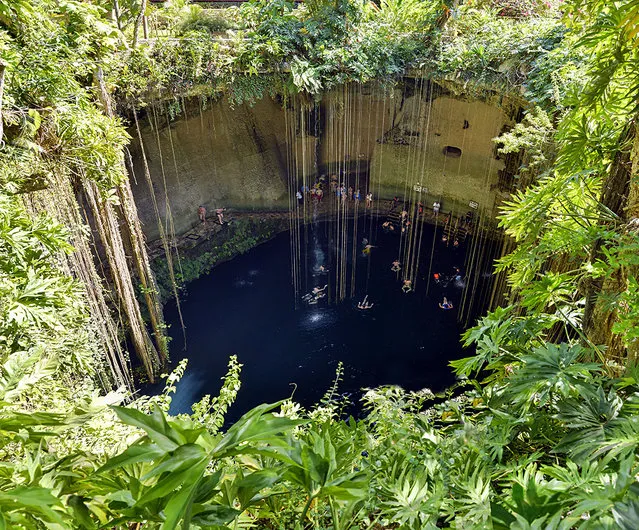
Cenote In Mexico

A cenote is a natural phenomenon, a sinkhole in the Earth’s surface. The Yucatan Peninsula in Mexico has an estimated 7,000 cenotes because it is primarily made up of porous limestone. For millions of years, rainfall slowly ate away at the limestone and a huge system of underground caves and caverns was formed. Many filled with water from rain or from the underground water table. When the roof of a water filled cave collapses, a cenote is born. The water found in a cenote may be fresh water, salt water, or both. Structurally it may be completely open, like a lake, almost completely closed with just a small opening at the top, or somewhere in between.
Details
06 Oct 2013 09:45:00