Loading...
Done
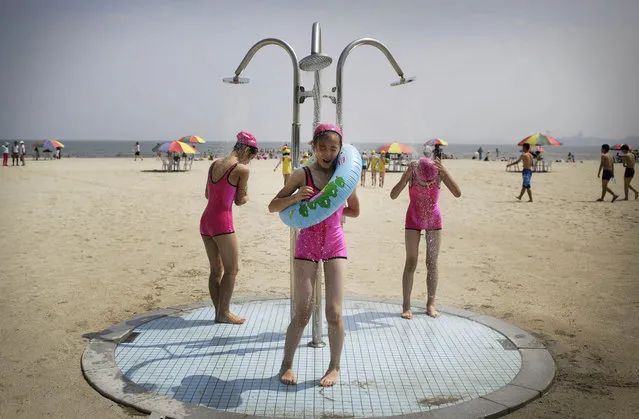
North Korean girls in similar bathing suits stand under a shower at the Songdowon International Children's Camp, Tuesday, July 29, 2014, in Wonsan, North Korea. The camp, which has been operating for nearly 30 years, was originally intended mainly to deepen relations with friendly countries in the Communist or non-aligned world. But officials say they are willing to accept youth from anywhere – even the United States. (Photo by Wong Maye-E/AP Photo)

North Korean girls in similar bathing suits stand under a shower at the Songdowon International Children's Camp, Tuesday, July 29, 2014, in Wonsan, North Korea. The camp, which has been operating for nearly 30 years, was originally intended mainly to deepen relations with friendly countries in the Communist or non-aligned world. But officials say they are willing to accept youth from anywhere – even the United States. (Photo by Wong Maye-E/AP Photo)
Details
31 Jul 2014 10:12:00
Camp You Are You

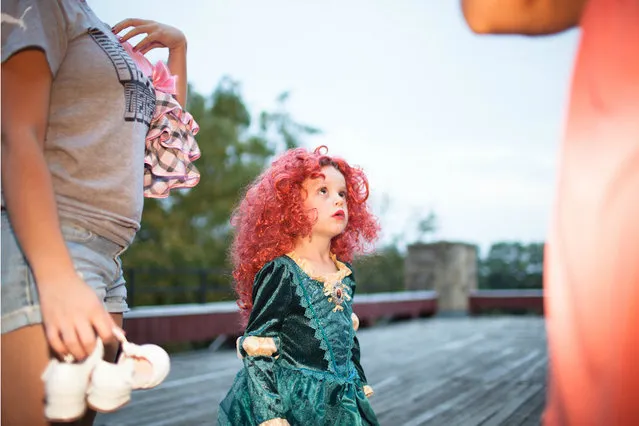
"Camp You Are You (whose name has been changed to protect the privacy of the participants) offers a temporary safe haven where gender-variant boys can freely express their interpretations of femininity alongside their parents and siblings. These images represent the spirit of the children as they shine in an atmoshpere of support. Here they can be true to their inner nature without feeling the need to look over their shoulders." Lindsay Morris
Details
22 Aug 2013 11:24:00
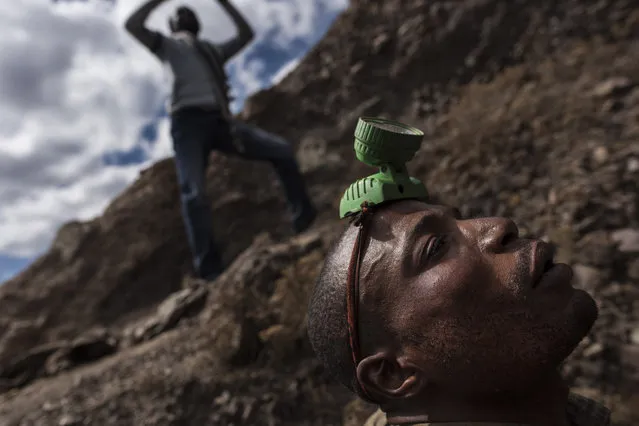
A “creuseur”, or digger, a plastic lantern on his head, readies to enter a copper and cobalt mine in Kawama, Democratic Republic of Congo on June 8, 2016. Cobalt is used in the batteries for electric cars and mobile phones. Working conditions are dangerous, often with no safety equipment or structural support for the tunnels. The diggers say they are paid on average US$2-3/day. (Photo by Michael Robinson Chavez/The Washington Post)

A “creuseur”, or digger, a plastic lantern on his head, readies to enter a copper and cobalt mine in Kawama, Democratic Republic of Congo on June 8, 2016. Cobalt is used in the batteries for electric cars and mobile phones. Working conditions are dangerous, often with no safety equipment or structural support for the tunnels. The diggers say they are paid on average US$2-3/day. (Photo by Michael Robinson Chavez/The Washington Post)
Details
30 Dec 2016 10:29:00
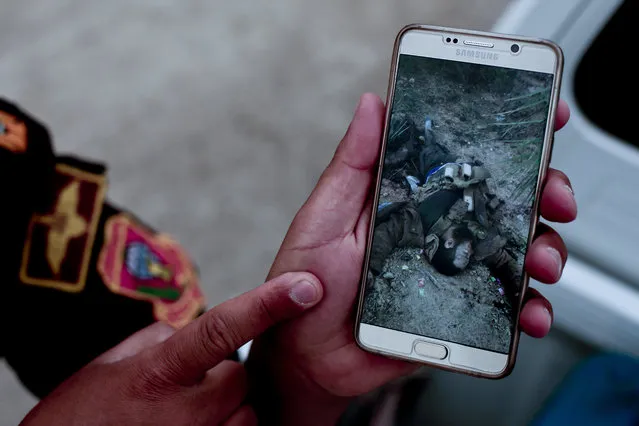
In this March 20, 2016 photo, Maj. Mohammed Hussein, an officer with Iraq's elite counterterrorism forces, shows a photo of a slain Islamic State group militant still wearing in a suicide vest, taken during fighting that freed the city of Ramadi from IS control earlier this year. As they fled, the militants destroyed some buildings and booby-trapped others with explosives, leaving behind an empty prize for government forces retaking the city. (Photo by Maya Alleruzzo/AP Photo)

In this March 20, 2016 photo, Maj. Mohammed Hussein, an officer with Iraq's elite counterterrorism forces, shows a photo of a slain Islamic State group militant still wearing in a suicide vest, taken during fighting that freed the city of Ramadi from IS control earlier this year. As they fled, the militants destroyed some buildings and booby-trapped others with explosives, leaving behind an empty prize for government forces retaking the city. (Photo by Maya Alleruzzo/AP Photo)
Details
05 May 2016 12:57:00
Julian, left, is photographed by his mother with friend Gianluca, right, under water at a public pool in Gelsenkirchen, Germany, on a hot Friday, July 3, 2015. Germany faces a heat wave with temperatures up to 38 degrees Celsius  (100 degrees Fahrenheit) at the weekend. (Photo by Martin Meissner/AP Photo)

Julian, left, is photographed by his mother with friend Gianluca, right, under water at a public pool in Gelsenkirchen, Germany, on a hot Friday, July 3, 2015. Germany faces a heat wave with temperatures up to 38 degrees Celsius (100 degrees Fahrenheit) at the weekend. (Photo by Martin Meissner/AP Photo)
Details
04 Jul 2015 10:39:00


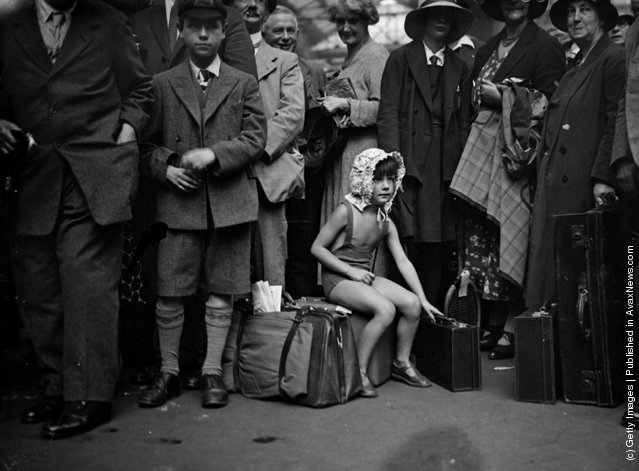
From the waters edge a New York policeman urges two young children to put their bathing costumes back on. (Photo by Ed Clarity/Keystone/Getty Images). July 1949
Details
25 Apr 2011 06:54:00
Somali couple Mohamed Noor (L) and Huda Omar pose for a photograph at their makeshift home during their wedding ceremony in Mogadishu's Rajo camp, Somalia August 17, 2016. Having met two years ago, the pair have just married at Rajo camp, where some 400 families live. Most, like Noor's parents, came here in the early 1990s to flee famine. They stayed on as years of conflict ravaged the Horn of Africa nation. As at any wedding, there is plenty of dancing and sweet treats for the young couple as they start married life in Noor's simple home, made of iron and plastic sheets. Noor works as a mason with his father. Others here are builders or sell sweets, nuts and stick toothbrushes to make money. Some beg around the seaside city, which like the rest of Somalia has been gripped by violence since the toppling of dictator Mohamed Siad Barre in 1991. (Photo by Feisal Omar/Reuters)

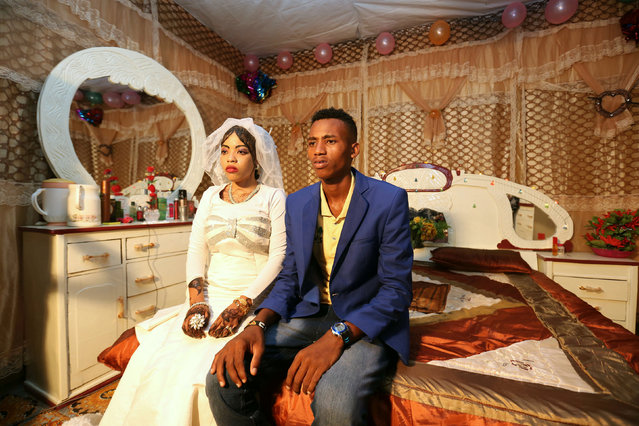
Somali couple Mohamed Noor (L) and Huda Omar pose for a photograph at their makeshift home during their wedding ceremony in Mogadishu's Rajo camp, Somalia August 17, 2016. Having met two years ago, the pair have just married at Rajo camp, where some 400 families live. Most, like Noor's parents, came here in the early 1990s to flee famine. (Photo by Feisal Omar/Reuters)
Details
14 Sep 2016 10:35:00
Faruk, 17, a Rohingya refugee trader holds betel leaves which are on sale at a stall in Palong Khali refugee camp near Cox's Bazar, Bangladesh, November 3, 2017. He left his village in Myanmar when the military opened fire towards the Rohingya. “I buy this betel leaf from Palong Khali market, in one bundle there are 160 pieces, I buy it for 80 taka and I sell it for 100 taka. Bangladeshi's and I sell for the same rate in the camp. Outside in the local market it is 80 taka per bundle. My problem is that I don't have money so I can't buy anything to eat, I can't buy fish to eat”, he said. (Photo by Hannah McKay/Reuters)

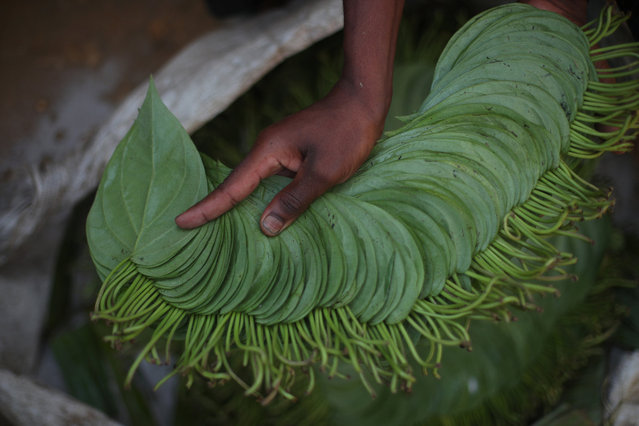
Faruk, 17, a Rohingya refugee trader holds betel leaves which are on sale at a stall in Palong Khali refugee camp near Cox's Bazar, Bangladesh, November 3, 2017. He left his village in Myanmar when the military opened fire towards the Rohingya. “I buy this betel leaf from Palong Khali market, in one bundle there are 160 pieces, I buy it for 80 taka and I sell it for 100 taka (1 Bangladeshi Taka = 0.012 US Dollar). Bangladeshi's and I sell for the same rate in the camp. Outside in the local market it is 80 taka per bundle. My problem is that I don't have money so I can't buy anything to eat, I can't buy fish to eat”, he said. (Photo by Hannah McKay/Reuters)
Details
27 Nov 2017 08:54:00