Loading...
Done
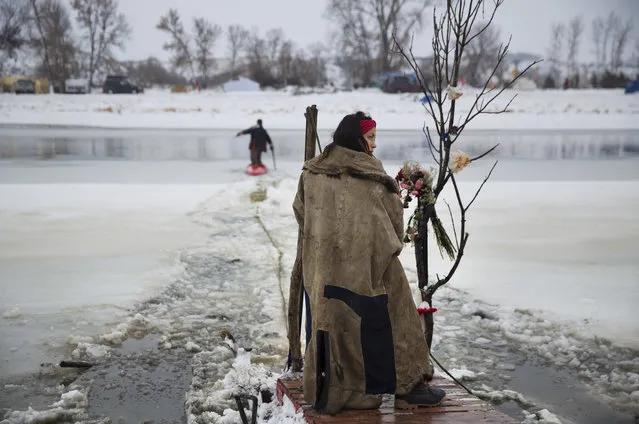
In this Thursday, December 1, 2016 photo, Cat Bigney, part of the Oglala Native American tribe, waits on the shore of the Cannonball river for travelers to arrive by canoe at the Oceti Sakowin camp where people have gathered to protest the Dakota Access oil pipeline in Cannon Ball, N.D. So far, those at the camp have shrugged off the heavy snow, icy winds and frigid temperatures. But if they defy next week's government deadline to abandon the camp, demonstrators know the real deep freeze lies ahead. Life-threatening wind chills and towering snow drifts could mean the greatest challenge is simple survival. (Photo by David Goldman/AP Photo)

In this Thursday, December 1, 2016 photo, Cat Bigney, part of the Oglala Native American tribe, waits on the shore of the Cannonball river for travelers to arrive by canoe at the Oceti Sakowin camp where people have gathered to protest the Dakota Access oil pipeline in Cannon Ball, N.D. So far, those at the camp have shrugged off the heavy snow, icy winds and frigid temperatures. But if they defy next week's government deadline to abandon the camp, demonstrators know the real deep freeze lies ahead. Life-threatening wind chills and towering snow drifts could mean the greatest challenge is simple survival. (Photo by David Goldman/AP Photo)
Details
06 Dec 2016 10:22:00
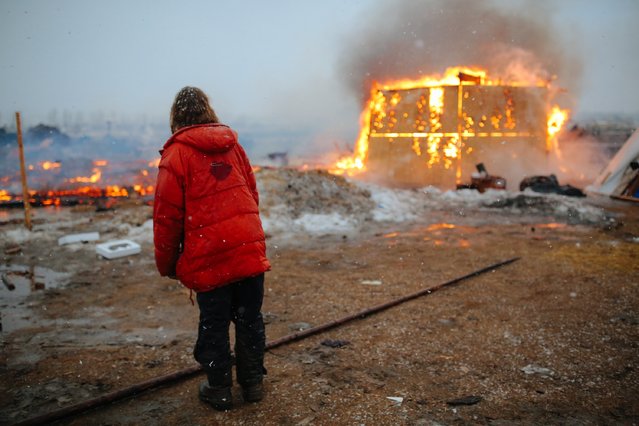
Campers set structures on fire in preparation of the Army Corp's 2pm deadline to leave the Oceti Sakowin protest camp on February 22, 2017 in Cannon Ball, North Dakota. (Photo by Stephen Yang/Getty Images)

Campers set structures on fire in preparation of the Army Corp's 2pm deadline to leave the Oceti Sakowin protest camp on February 22, 2017 in Cannon Ball, North Dakota. Activists and protesters have occupied the Standing Rock Sioux reservation for months in opposotion to the completion of the Dakota Access Pipeline. (Photo by Stephen Yang/Getty Images)
Details
26 Feb 2017 00:01:00
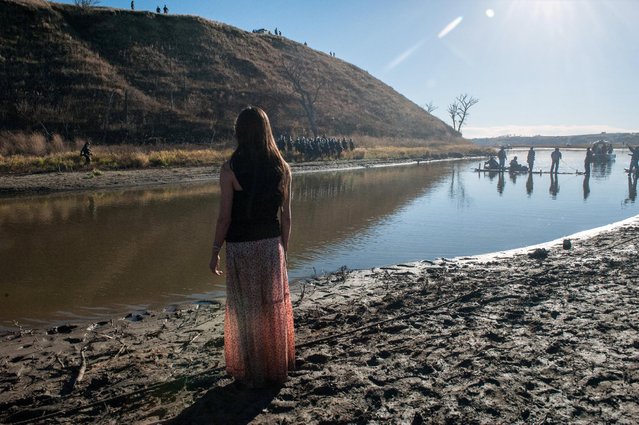
A woman prays at the edge of a river during a protest against the building of a pipeline near the Standing Rock Indian Reservation near Cannonball, North Dakota, U.S. November 2, 2016. (Photo by Stephanie Keith/Reuters)

A woman prays at the edge of a river during a protest against the building of a pipeline near the Standing Rock Indian Reservation near Cannonball, North Dakota, U.S. November 2, 2016. (Photo by Stephanie Keith/Reuters)
Details
09 Nov 2016 06:11:00
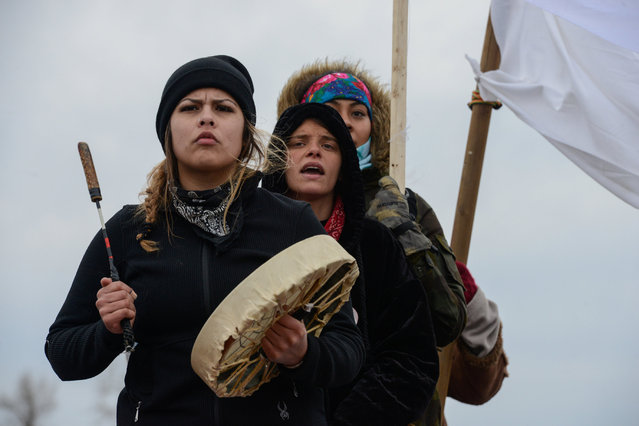
Women hold a demonstration on Backwater Bridge during a protest against plans to pass the Dakota Access pipeline near the Standing Rock Indian Reservation, near Cannon Ball, North Dakota, U.S. November 27, 2016. (Photo by Stephanie Keith/Reuters)

Women hold a demonstration on Backwater Bridge during a protest against plans to pass the Dakota Access pipeline near the Standing Rock Indian Reservation, near Cannon Ball, North Dakota, U.S. November 27, 2016. (Photo by Stephanie Keith/Reuters)
Details
30 Nov 2016 13:36:00
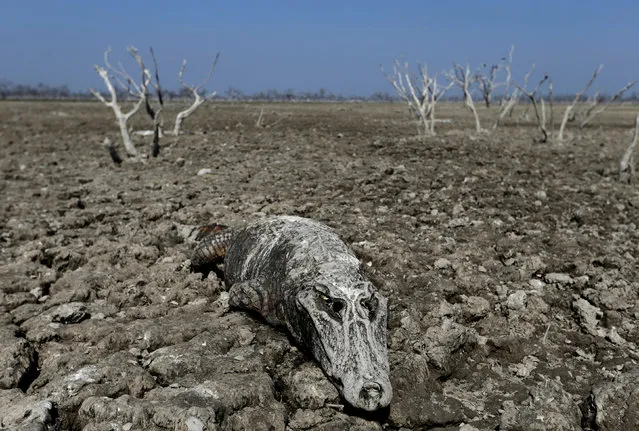
The carcass of a yacare caiman lies in the dried-up river bed of the Pilcomayo river in Boqueron, Paraguay, August 14, 2016. In Paraguay, alongside the Pilcomayo River, black vultures flew over a shrinking pond where a group of crocodilian reptiles known as yacare caimans sought refuge. Water from the river, which divides Paraguay and Argentina in the area of the Gran Chaco, was scarce. This is not an uncommon sight in the region of General Diaz, about 700 kilometres (435 miles) northwest of the country's capital Asuncion, where the Pilcomayo's waters form lakes and streams that give life to capybaras, birds and caimans. “The river's situation is critical. No water is forecast to enter the basin until December, as happens every year”, said Alcides Gonzalez, a resident of the area. (Photo by Jorge Adorno/Reuters)

The carcass of a yacare caiman lies in the dried-up river bed of the Pilcomayo river in Boqueron, Paraguay, August 14, 2016. In Paraguay, alongside the Pilcomayo River, black vultures flew over a shrinking pond where a group of crocodilian reptiles known as yacare caimans sought refuge. Water from the river, which divides Paraguay and Argentina in the area of the Gran Chaco, was scarce. This is not an uncommon sight in the region of General Diaz, about 700 kilometres (435 miles) northwest of the country's capital Asuncion, where the Pilcomayo's waters form lakes and streams that give life to capybaras, birds and caimans. (Photo by Jorge Adorno/Reuters)
Details
03 Nov 2016 12:40:00
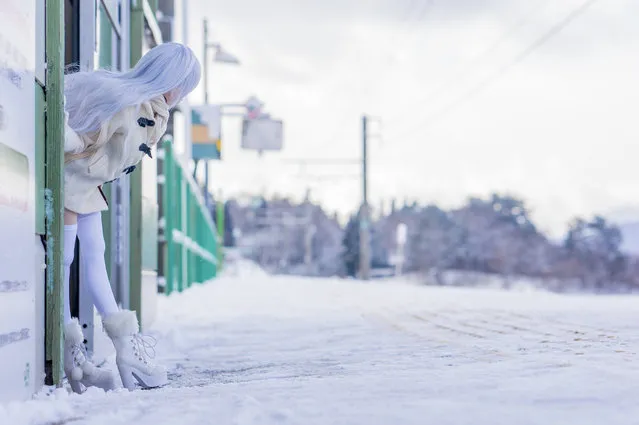
“Can't wait”. Location: Inao Station (JR Oito-Line). (AZURE)

“Can't wait”. Location: Inao Station (JR Oito-Line), Nagano Prefecture, Japan. (Photo by AZURE)
Details
25 Mar 2013 12:20:00
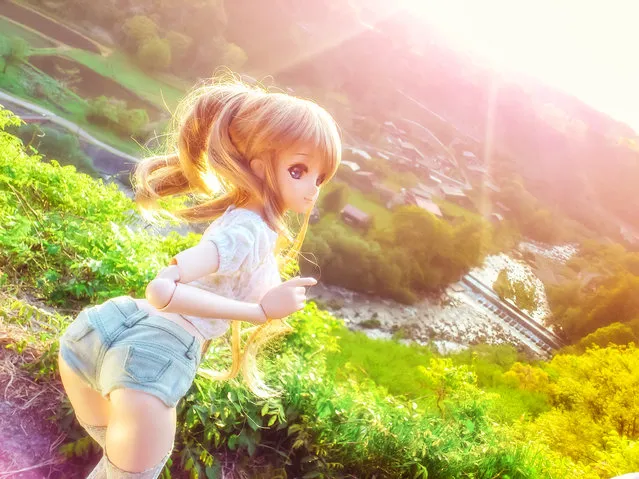
“To tomorrow”. Location: Kaida Highlands at sunset, Japan. (Photo and caption by AZURE)

“To tomorrow”. Location: Kaida Highlands at sunset, Japan. (Photo and caption by AZURE)
Details
20 Nov 2013 09:49:00
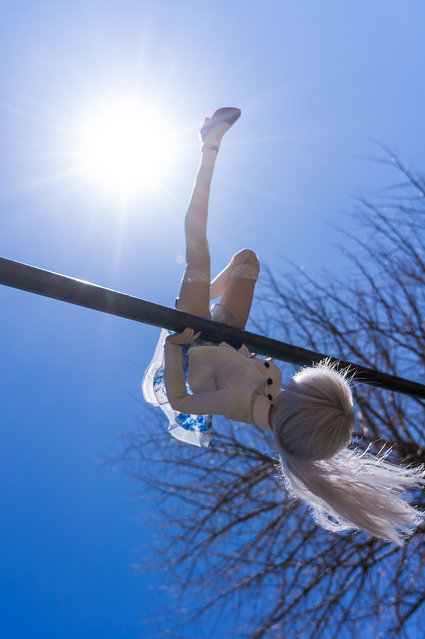
Kick the Sun!!

“I do not want to take a picture of the doll. I want to take a picture of scenery with the doll”. – AZURE

Photo: Kick the Sun!! (Photo by AZURE)


Details
01 Nov 2012 10:06:00