Loading...
Done
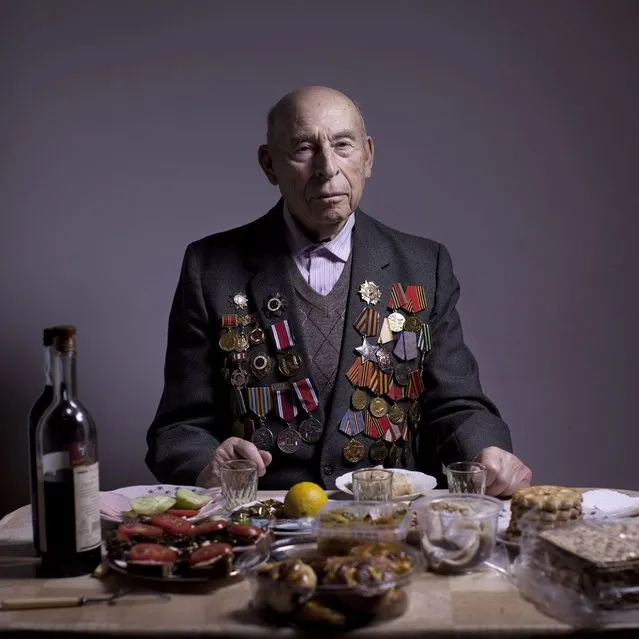
In this photo made Thursday, April 11, 2013, Soviet Jewish World War Two veteran Boris Ginsburg poses for a portrait at his house in the southern Israeli city of Ashdod. Ginsburg, born in Belorussia, was kept by a German garrison in the Lenin ghetto since 1941 until its destruction by partisan units in September 1942. (Photo by Oded Balilty/AP Photo)

In this photo made Thursday, April 11, 2013, Soviet Jewish World War Two veteran Boris Ginsburg poses for a portrait at his house in the southern Israeli city of Ashdod. Ginsburg, born in Belorussia, was kept by a German garrison in the Lenin ghetto since 1941 until its destruction by partisan units in September 1942. In 1942 he joined the partisans for two years and in 1944 he joined the Red Army as a combat soldier and fought till the and of the war. Ginsubrg demobilized in 1947 and immigrated to Israel in 2001. About 500,000 Soviet Jews served in the Red Army during World War Two, and the majority of those still alive today live in Israel. (Photo by Oded Balilty/AP Photo)
Details
07 May 2013 08:08:00
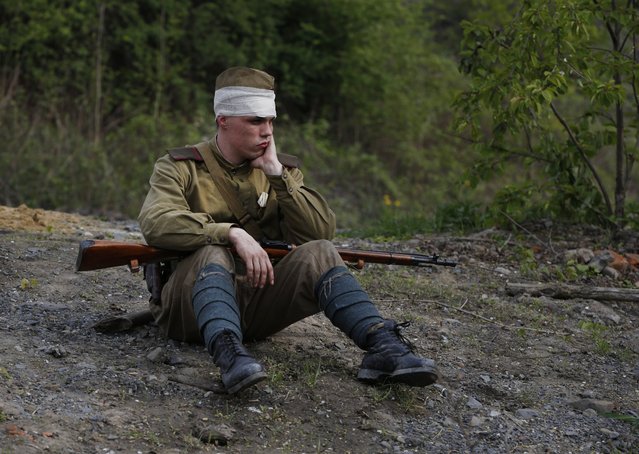
A World War II re-enactor dressed as Red Army soldiers rests after a staged battle to mark the liberation of the city of Ostrava by Red Army from the Nazi invaders in 1945, Czech Republic, Thursday, April 30, 2015. (Photo by Sergei Grits/AP Photo)

A World War II re-enactor dressed as Red Army soldiers rests after a staged battle to mark the liberation of the city of Ostrava by Red Army from the Nazi invaders in 1945, Czech Republic, Thursday, April 30, 2015. (Photo by Sergei Grits/AP Photo)
Details
01 May 2015 12:25:00


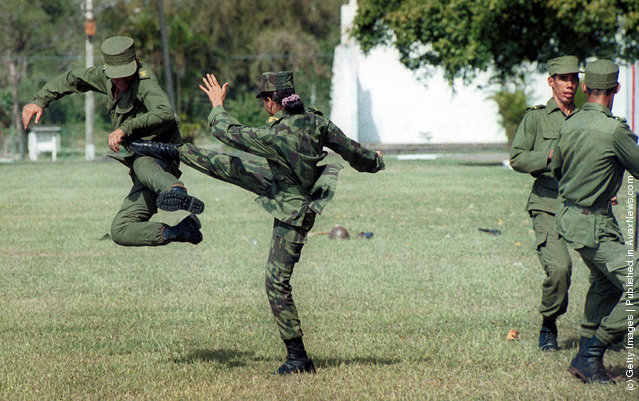
Cuban soldiers receive combat training at the Cadets School “Antonio Maceo” November 28, 2001, 30 kilometers East of Havana. (Photo by Jorge Rey/Getty Images)
Details
25 Jul 2011 12:12:00
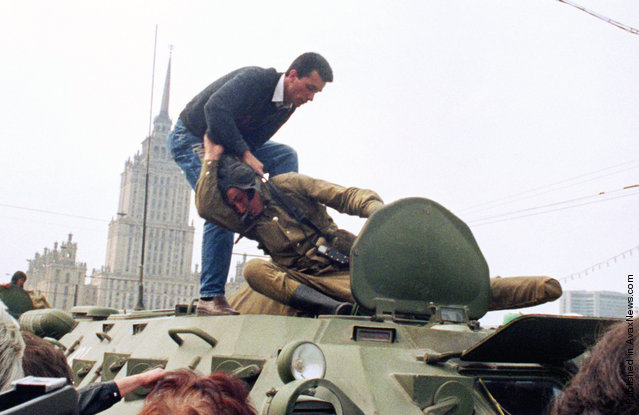
A pro-democracy demonstrator fights with a Soviet soldier on top of a tank parked in front of the Russian Federation building on August 19, 1991, after a coup toppled Soviet President Mikhail Gorbachev. The same day, thousands in Moscow, Leningrad, and other cities answered Russian Republic President Boris Yeltsin's call to raise barricades against tanks and troops

A pro-democracy demonstrator fights with a Soviet soldier on top of a tank parked in front of the Russian Federation building on August 19, 1991, after a coup toppled Soviet President Mikhail Gorbachev. The same day, thousands in Moscow, Leningrad, and other cities answered Russian Republic President Boris Yeltsin's call to raise barricades against tanks and troops. (Dima Tanin/AFP/Getty Images)
Details
06 Apr 2012 20:07:00
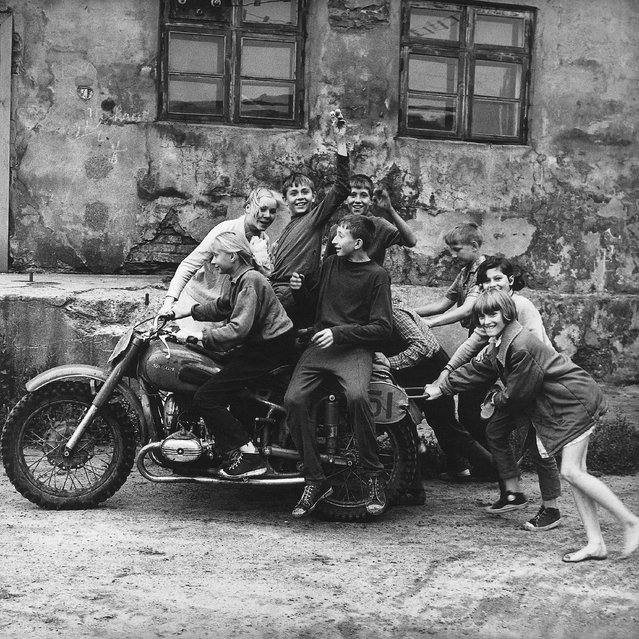
When he started using a camera there were very few documentary photographers working outside the government. Sutkus instead looked to writers and film-makers, and says he drew inspiration from the works of Franz Kafka, Jean-Paul Sartre, Ernest Hemingway and Vladimir Nabokov. Here: The first Lithuanian bikers, 1974. (Photo by Antanas Sutkus)

Rebelling against political propaganda, acclaimed photographer Antanas Sutkus embarked on a life-long journey to capture the everyday scenes around him. Antanas Sutkus, born in 1939, studied journalism at Vilnius University in the late 1950s before becoming disillusioned by the confines of the Soviet-controlled press. He began taking photographs instead, and soon co-founded the Lithuanian Association of Art Photographers. Here: The first Lithuanian bikers, 1974. (Photo by Antanas Sutkus)
Details
11 Apr 2016 10:54:00
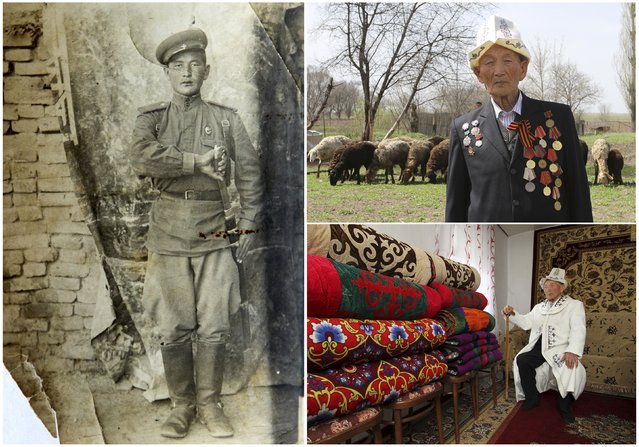
World War Two veteran Abla Begaliyev, 91, is seen in an undated handout picture (L), poses for a picture in Arashan (Top R) and at home in Kyrgyzstan April 14, 2015. Begaliyev served in the border guard cavalry from February 1942 until April 1947. Originally from Kyrgyzstan, he fought on the Ukrainian front and relocated to the border with Afghanistan at the end of World War Two. (Photo by Vladimir Pirogov/Reuters/Family handout (L))

World War Two veteran Abla Begaliyev, 91, is seen in an undated handout picture (L), poses for a picture in Arashan (Top R) and at home in Kyrgyzstan April 14, 2015. Begaliyev served in the border guard cavalry from February 1942 until April 1947. Originally from Kyrgyzstan, he fought on the Ukrainian front and relocated to the border with Afghanistan at the end of World War Two. As the world marks the 70th anniversary of the end of World War Two, Reuters photographers the length and breadth of the former Soviet republics (CCCP) captured portraits of Red Army veterans, mostly now in their 80s and 90s, today and through archive pictures at the time. More than 20 million Soviet citizens were killed in the war. (Photo by Vladimir Pirogov/Reuters/Family handout (L))
Details
08 May 2015 14:22:00
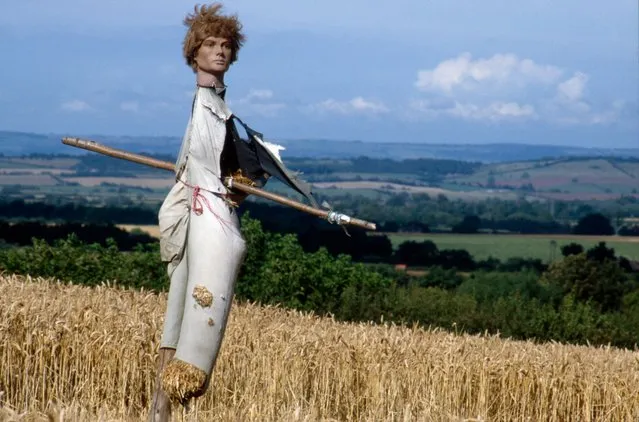
“The ripening crops eloquently signify that the scarecrow’s work is done. Few remain to see their task fulfilled because if they become entangled in the harvesting machinery it causes serious damage”. (Photo by Colin Garratt)

When Colin Garratt went to photograph the traditional sentinels of the British countryside, he found they ranged from the dapper to the downright sinister. “They are not from the anaesthetised world of the craft fair”, says Colin Garratt, “but are the direct descendants of the ancient spectres which have haunted the landscape for centuries”. The Scarecrow Exhibition is at Geddes Gallery, London, from 25 to 30 March. (Photo by Colin Garratt)
Details
29 Mar 2016 11:46:00
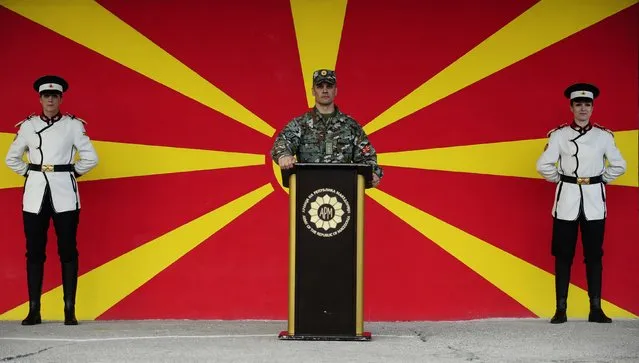
Corporals Verica Zlatevska (L) and Dragana Kitanovska (R) attend an honour guard training session at an army barracks in Skopje March 4, 2015. REUTERS/Ognen Teofilovski (MACEDONIA  - Tags: MILITARY SOCIETY)

Corporals Verica Zlatevska (L) and Dragana Kitanovska (R) attend an honour guard training session at an army barracks in Skopje March 4, 2015. Macedonia's honour army battalion, the ceremonial uniformed guard that receives every foreign president, dignitaries and delegations, but also sees off and welcomes the head of state every time he leaves the country, has a different glow. For the first time in the history of Macedonia's army, the honour guard has two women in its ranks. There has not been an event in which one of them is not in the first row. Zlatevska joined the army in 2003, Kitanovska in 2006. Picture taken March 4, 2015. REUTERS/Ognen Teofilovski (MACEDONIA - Tags: MILITARY SOCIETY)
Details
12 Mar 2015 11:05:00