Loading...
Done
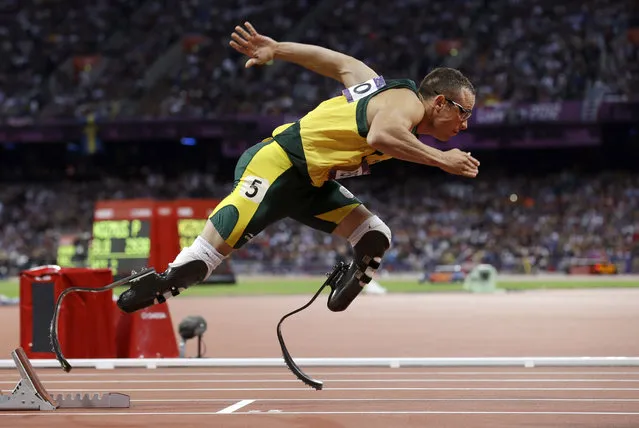
In this Sunday, August 5, 2012 file photo South Africa's Oscar Pistorius starts in the men's semi-finals of the 400-meter in the Olympic Stadium at the 2012 Summer Olympics, London.  Pistorius could be granted parole on Friday, Nov. 24, 2023 after nearly 10 years in prison for killing his girlfriend. The double-amputee Olympic runner was convicted of a charge comparable to third-degree murder for shooting Reeva Steenkamp in his home in 2013. He has been in prison since late 2014. (Photo by Anja Niedringhaus/AP Photo)

In this Sunday, August 5, 2012 file photo South Africa's Oscar Pistorius starts in the men's semi-finals of the 400-meter in the Olympic Stadium at the 2012 Summer Olympics, London. Pistorius could be granted parole on Friday, Nov. 24, 2023 after nearly 10 years in prison for killing his girlfriend. The double-amputee Olympic runner was convicted of a charge comparable to third-degree murder for shooting Reeva Steenkamp in his home in 2013. He has been in prison since late 2014. (Photo by Anja Niedringhaus/AP Photo)
Details
03 Dec 2023 03:10:00
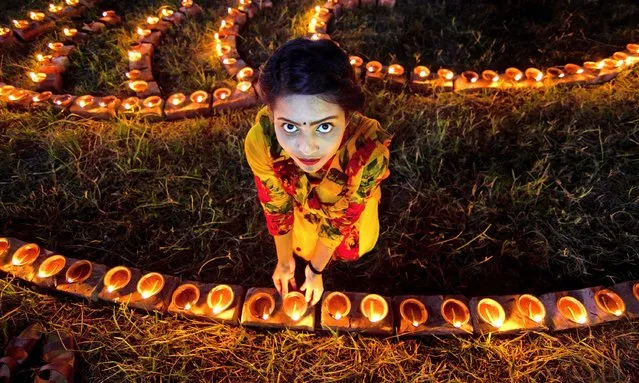
Hindu devotees light “Diyas” (earthen lamps) on a Rangoli, a framework of decorated pattern, as part of Diwali festivities in a temple premises in Dhaka, Bangladesh on November 12, 2023. The festival takes place every year in accordance with the Hindu lunar calendar. The word “Diwali” is derived from the Sanskrit word “Deepavali”, meaning series of lighted lamps; hence, it is also known as the festival of lights. Diwali is typically celebrated by socializing and exchanging gifts with family and friends. Many light oil lamps or candles to symbolize a victory of light over darkness, and fireworks are set off as part of the celebrations. (Photo by Joy Saha/Rex Features/Shutterstock)

Hindu devotees light “Diyas” (earthen lamps) on a Rangoli, a framework of decorated pattern, as part of Diwali festivities in a temple premises in Dhaka, Bangladesh on November 12, 2023. The festival takes place every year in accordance with the Hindu lunar calendar. The word “Diwali” is derived from the Sanskrit word “Deepavali”, meaning series of lighted lamps; hence, it is also known as the festival of lights. Diwali is typically celebrated by socializing and exchanging gifts with family and friends. Many light oil lamps or candles to symbolize a victory of light over darkness, and fireworks are set off as part of the celebrations. (Photo by Joy Saha/Rex Features/Shutterstock)
Details
18 Dec 2023 00:11:00
Two women enjoy drinks outside a pub in the soho area of central London on November 4, 2020, on the eve of a second novel coronavirus COVID-19 lockdown in an effort to combat soaring infections. English pubs call last orders at the bar for a month on Wednesday evening, as the country effectively shuts down from November 5, for the second time this year to try to cut coronavirus cases. Prime Minister Boris Johnson insisted that the lockdown for England would end “automatically” in four weeks, as he tried to placate party critics over the spiralling economic fallout. (Photo by Stephen Lock/i-Images)

Two women enjoy drinks outside a pub in the soho area of central London on November 4, 2020, on the eve of a second novel coronavirus COVID-19 lockdown in an effort to combat soaring infections. English pubs call last orders at the bar for a month on Wednesday evening, as the country effectively shuts down from November 5, for the second time this year to try to cut coronavirus cases. Prime Minister Boris Johnson insisted that the lockdown for England would end “automatically” in four weeks, as he tried to placate party critics over the spiralling economic fallout. (Photo by Stephen Lock/i-Images)
Details
06 Nov 2020 00:07:00
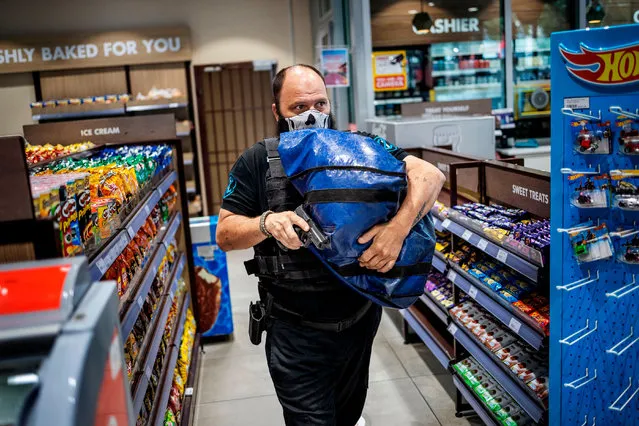
A CIT guard carries his gun handgun while bringing a bag containing cash inside an armoured vehicle during a money collection in Johannesburg's CBD, on December 8, 2020. As the Christmas festive season approaches, cash-in-transit (CIT) companies are gearing up as they continue to be target of crime, with about 3000 money vans traveling daily nationwide. Despite the COVID-19 lockdown, there have been 260 cash-in-transit heist incidents in South Africa this year, with 19 CIT crew members killed. Cash-in-transit heists in the country are often military-style planned operations with criminals recurring to bomb making and assault rifles attacks. (Photo by Michele Spatari/AFP Photo)

A CIT guard carries his gun handgun while bringing a bag containing cash inside an armoured vehicle during a money collection in Johannesburg's CBD, on December 8, 2020. As the Christmas festive season approaches, cash-in-transit (CIT) companies are gearing up as they continue to be target of crime, with about 3000 money vans traveling daily nationwide. Despite the COVID-19 lockdown, there have been 260 cash-in-transit heist incidents in South Africa this year, with 19 CIT crew members killed. Cash-in-transit heists in the country are often military-style planned operations with criminals recurring to bomb making and assault rifles attacks. (Photo by Michele Spatari/AFP Photo)
Details
18 Dec 2020 00:01:00
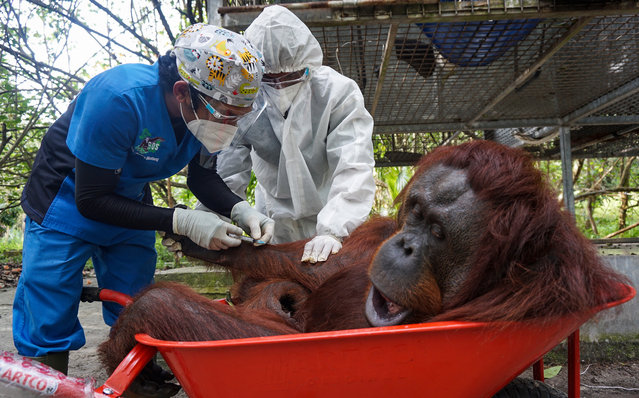
A handout photo made available by Borneo Orangutan Survival Foundation (BOSF) shows veterinarian wearing protective masks and suit, conducting anesthesia procedure on Nenuah, a nine year old Bornean Orangutan before being transported and released to the Bukit Batikap protection forest, at the Nyaru Menteng Orangutan Rehabilitation Center in Palangkaraya, Central Kalimantan, Indonesia, 15 February 2021. BOSF and the national nature conservation agency (BKSDA) released 10 orangutans back to the wild in Bukit Batikap Protection Forest in Central Kalimantan and the Kehje Sewen Forest in East Kalimantan amid the pandemic according to BOSF. (Photo by BOSF Handout/EPA/EFE)

A handout photo made available by Borneo Orangutan Survival Foundation (BOSF) shows veterinarian wearing protective masks and suit, conducting anesthesia procedure on Nenuah, a nine year old Bornean Orangutan before being transported and released to the Bukit Batikap protection forest, at the Nyaru Menteng Orangutan Rehabilitation Center in Palangkaraya, Central Kalimantan, Indonesia, 15 February 2021. BOSF and the national nature conservation agency (BKSDA) released 10 orangutans back to the wild in Bukit Batikap Protection Forest in Central Kalimantan and the Kehje Sewen Forest in East Kalimantan amid the pandemic according to BOSF. (Photo by BOSF Handout/EPA/EFE)
Details
07 Mar 2021 09:54:00
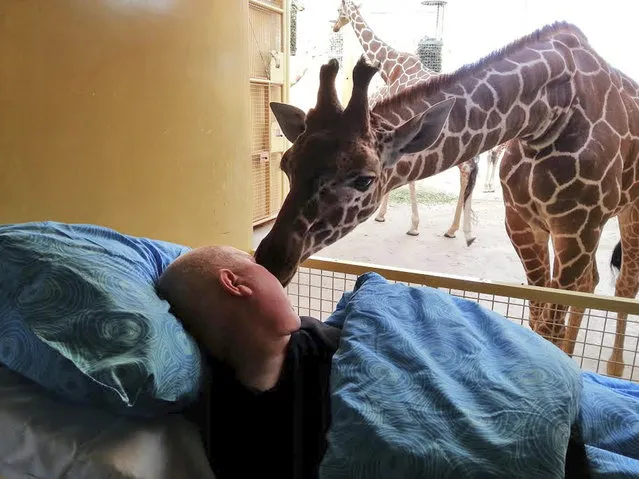
This photo released Saturday March 22, 2014 by Stichting Ambulance Wens or Ambulance Wish Foundation shows a giraffe at Blijdorp Zoo in Rotterdam giving a lick to terminally ill Mario Eijs on Wednesday March 19, 2014. The Stichting Ambulancewens “Ambulance Wish Foundation” offers transport for terminally ill patients who cannot walk to help fulfill a last wish, in Eijs' case to be taken to the Blijdorp Zoo in Rotterdam where he worked doing odd jobs for 25 years. (Photo by AP Photo/Stichting Ambulance Wens)

This photo released Saturday March 22, 2014 by Stichting Ambulance Wens or Ambulance Wish Foundation shows a giraffe at Blijdorp Zoo in Rotterdam giving a lick to terminally ill Mario Eijs on Wednesday March 19, 2014. The Stichting Ambulancewens “Ambulance Wish Foundation” offers transport for terminally ill patients who cannot walk to help fulfill a last wish, in Eijs' case to be taken to the Blijdorp Zoo in Rotterdam where he worked doing odd jobs for 25 years. Eijs, who has a mental handicap, is dying of a brain tumor and has difficulty walking or speaking. (Photo by AP Photo/Stichting Ambulance Wens)
Details
29 Mar 2014 14:20:00
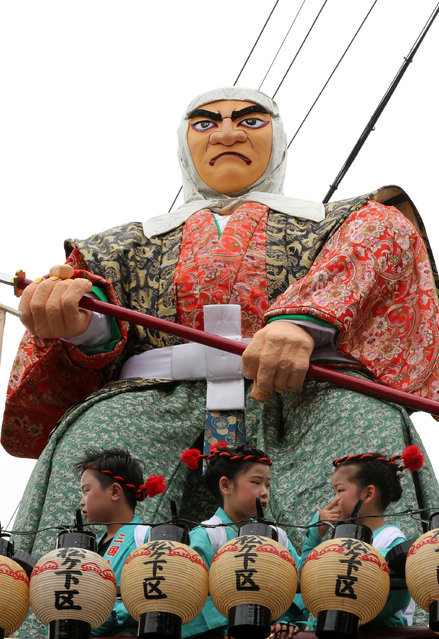
Children dressed in festival costume sit on the huge paper doll of historical Japanese figure named Hashi-Benkeii on the carts during the Mikuini annual festival on May 20, 2014 in Sakai, Japan. The annual festival takes place from May 19-21 and is attended by thousands of visitors. During the festival people dressed in traditional Japanese costumes pull carts carrying 6 meter high dolls of Japanese historical figures through the narrow streets. The origins of the festival are unclear but its history can be traced back more than 250 years. (Photo by Buddhika Weerasinghe/Getty Images)

Children dressed in festival costume sit on the huge paper doll of historical Japanese figure named Hashi-Benkeii on the carts during the Mikuini annual festival on May 20, 2014 in Sakai, Japan. The annual festival takes place from May 19-21 and is attended by thousands of visitors. During the festival people dressed in traditional Japanese costumes pull carts carrying 6 meter high dolls of Japanese historical figures through the narrow streets. The origins of the festival are unclear but its history can be traced back more than 250 years. (Photo by Buddhika Weerasinghe/Getty Images)
Details
21 May 2014 08:49:00


“The Trabant is a car that was produced by former East German auto maker VEB Sachsenring Automobilwerke Zwickau in Zwickau, Sachsen. It was the most common vehicle in East Germany, and was also exported to countries both inside and outside the communist bloc. The main selling points was that it had room for four adults and luggage in a compact, light and durable shell and that it was fast (when introduced) and durable. With its mediocre performance, smoky two-stroke engine, and production shortages, the Trabant is often cited as an example of the disadvantages of centralized planning; on the other hand, it is regarded with derisive affection as a symbol of the failed former East Germany and of the fall of communism (in former West Germany, as many East Germans streamed into West Berlin and West Germany in their Trabants after the opening of the Berlin Wall in 1989). It was in production without any significant changes for nearly 30 years with 3,096,099 Trabants produced in total”. – Wikipedia

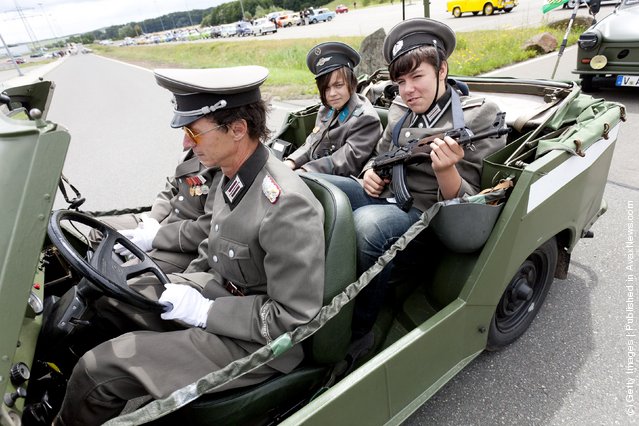
Photo: Enthusiasts weared in uniforms of the former eastern german army trive in a military Trabant car as fans and owners of East German-era Trabant cars gather at the 2011 International Trabantfahrer Treffen (International Trabant Drivers Meeting) on June 26, 2011 in Zwickau, Germany. The Trabant, also known as the Trabi, was among the main cars produced in communist East Germany and built by VEB Sachsenring Automobilwerke in Zwickau for 30 years until 1989. Today the car has cult status for many followers and one company, IndiKar, is even seeking to revive the brand in a modern, electric version. (Photo by Carsten Koall/Getty Images)

Details
27 Jun 2011 12:21:00