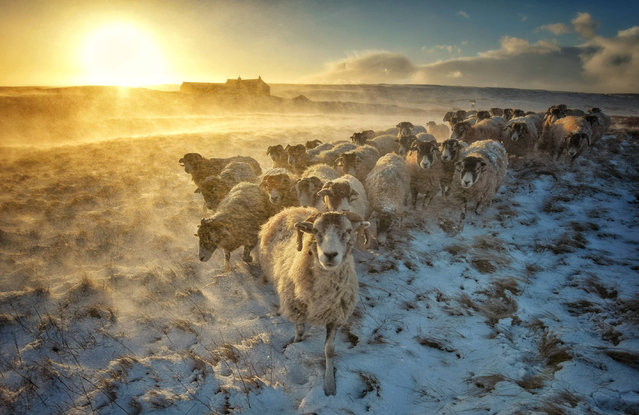
A flock of sheep huddles together while snow spindrift is whipped up by strong winds in Swaledale, North Yorkshire, UK on March 17, 2017. (Photo by Paul Kingston/NNP North News & Pictures Ltd)
Yerevan residents celebrate Armenian Prime Minister's Serzh Sargsyan's resignation in Yerevan, Armenia, Monday, April 23, 2018. Sargsyan resigned unexpectedly on Monday, an apparent move to bring to an end massive anti-government protests. (Photo by Amos Chapple/RFE/RL)
Contestant Emilce Lezcano, center, prepares for the evening gown portion of the “Miss Gordita” beauty contest in Asuncion, Paraguay, Saturday, April 25, 2015. In their elegant evening gowns and elaborate hair styles, the contestants defy the conventional idea that only skinny women can be beautiful. (Photo by Jorge Saenz/AP Photo)
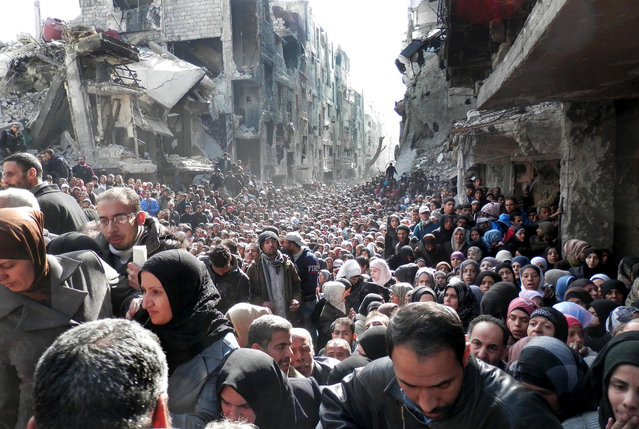
In this January 31, 2014 file photo released by the United Nations Relief and Works Agency for Palestine Refugees in the Near East (UNRWA), shows residents of the besieged Palestinian camp of Yarmouk, queuing to receive food supplies, in Damascus, Syria. That year, the U.N. was able to deliver food to about five percent of people in besieged areas including Yarmouk, while today estimates show the organization is reaching less than one percent. (Photo by UNRWA via AP Photo)
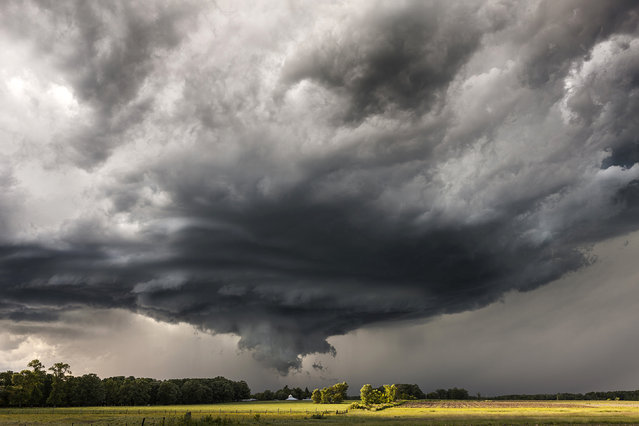
These stunning images show the phwoar-some power of some of Americas most extreme weather. Camille Seaman’s wondrous work features huge super cells, crashing lightning and gale-force winds. The roaming photographer has chased storms across the US from Iowa to Wyoming and from Minnesota to Texas. Her favorite places to chase are Kansas, Nebraska and South Dakota – notorious hotspots for spectacular storms. Here: Supercell in Minnesota, near Browerville, Minnesota in 2014. (Photo by Camille Seaman/Caters News)
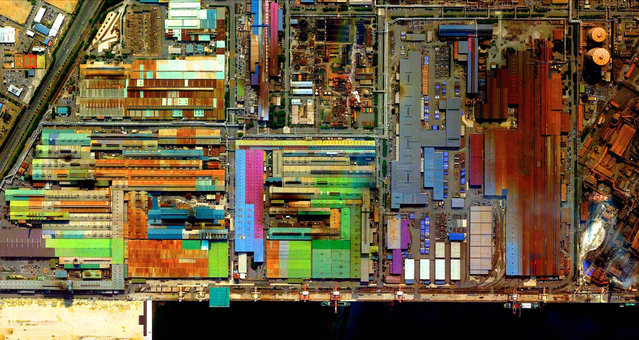
This series of pictures shot by satellite, show the man-made world as astronauts see it. Artist Benjamin Grant uses Google Earth to find the most compelling satellite images of human civilization. The stunning pictures of sprawling metropolises and vast reservoirs are sometimes unidentifiable until zoomed in. In order to find an extraordinary picture in the practically endless supply of satellite data, Benjamin focuses on the themes of current events or environmental issues. Here: Industrial Sector, Tokai, Japan. (Photo by Benjamin Grant/Digital Globe/Caters News)
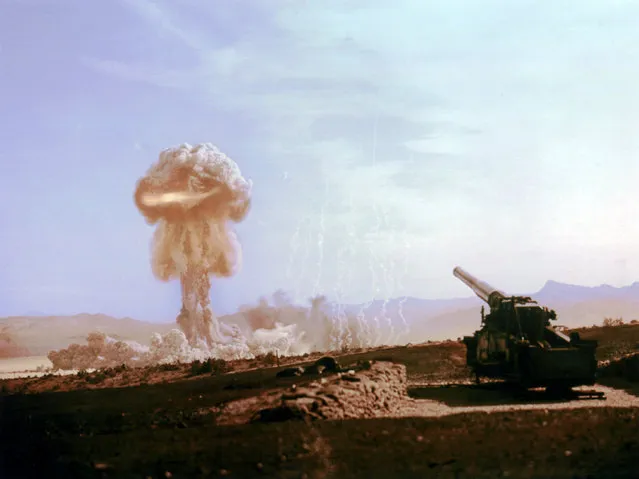
“A fter the former Soviet Union conducted its first nuclear test in August 1949, the US reevaluated its postwar defense policies. With the US monopoly on atomic weapons broken, military and political leaders chose to diversify the American stockpile by developing thermonuclear and tactical nuclear weapons. One of the more interesting concepts to come out of this period was atomic artillery, which was successfully tested at the Nevada Proving Grounds (now the Nevada Test Site) in May 1953”. – Alan Carr. Photo: Atomic Annie at work during the Upshot-Knothole test series, 1953. (Photo by Los Alamos National Laboratory/US Army)
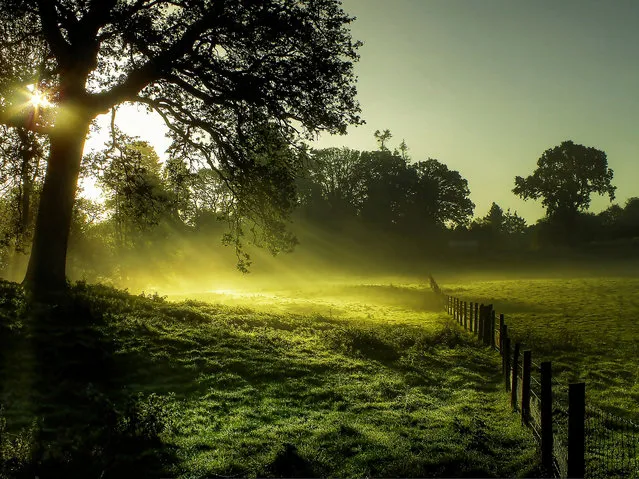
“I'm very lucky to be in a wonderful part of England , where the ever changing sky's are always a new opportunity for a good shot. To me photography is the art of using light to one's advantage”. – Eric Goncalves. Photo: “Let the light enter”. (Photo by Eric Goncalves)