Loading...
Done
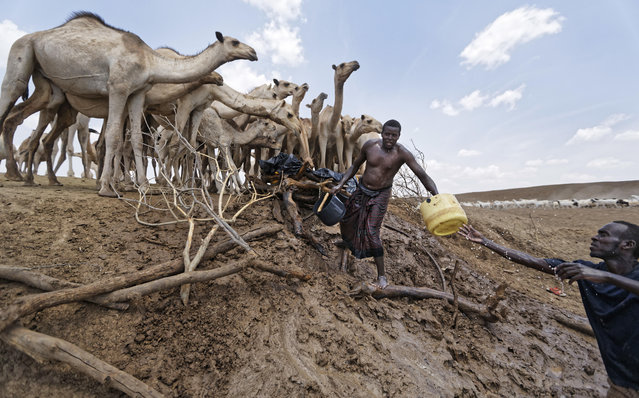
Camel herders scoop up water in plastic buckets from one of the few watering holes in the area, to water their animals near the drought-affected village of Bandarero, near Moyale town on the Ethiopian border, in northern Kenya, Friday, March 3, 2017. The U.N. humanitarian chief, Stephen O'Brien, toured Bandarero village on Friday and called on the international community to act to “avert the very worst of the effects of drought and to avert a famine to make sure we don't go from what is deep suffering to a catastrophe”. (Photo by Ben Curtis/AP Photo)

Camel herders scoop up water in plastic buckets from one of the few watering holes in the area, to water their animals near the drought-affected village of Bandarero, near Moyale town on the Ethiopian border, in northern Kenya, Friday, March 3, 2017. The U.N. humanitarian chief, Stephen O'Brien, toured Bandarero village on Friday and called on the international community to act to “avert the very worst of the effects of drought and to avert a famine to make sure we don't go from what is deep suffering to a catastrophe”. (Photo by Ben Curtis/AP Photo)
Details
05 Mar 2017 00:03:00
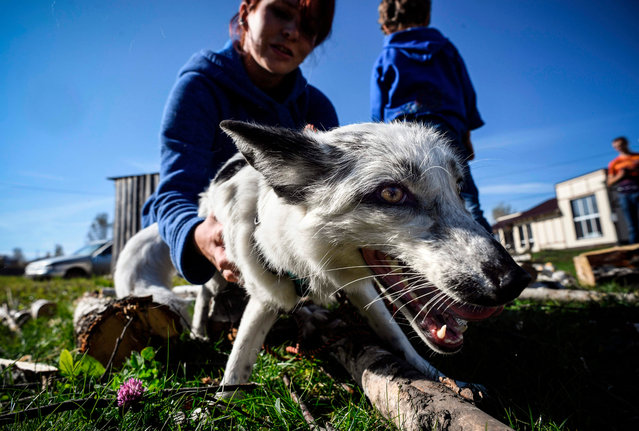
Tatyana Abramova, 33, plays with her home fox Plombir at her countryside house outside Siberian city of Novosibirsk on September 12, 2020. The official start of the Soviet experiment to better understand the domestication of animals by humans began in 1959, and was initiated by geneticists Dmitri Beliaiev and Lioudmila Trout on a farm in Akademgorodok, the scientific center of excellence in Siberia. Their primary objective was to domesticate foxes, to understand how the ancestor of wolves, another canine, evolved into a loyal and loving dog. And understand what this domestication tells us about the genetic evolution of species. (Photo by Alexander Nemenov/AFP Photo)

Tatyana Abramova, 33, plays with her home fox Plombir at her countryside house outside Siberian city of Novosibirsk on September 12, 2020. The official start of the Soviet experiment to better understand the domestication of animals by humans began in 1959, and was initiated by geneticists Dmitri Beliaiev and Lioudmila Trout on a farm in Akademgorodok, the scientific center of excellence in Siberia. Their primary objective was to domesticate foxes, to understand how the ancestor of wolves, another canine, evolved into a loyal and loving dog. And understand what this domestication tells us about the genetic evolution of species. (Photo by Alexander Nemenov/AFP Photo)
Details
25 Oct 2020 00:05:00
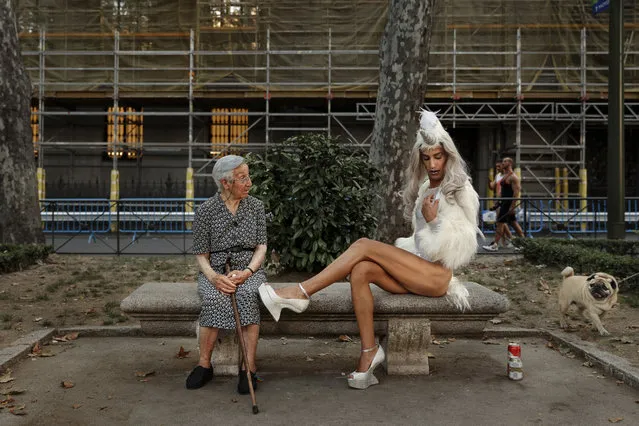
A woman looks across as a gay parade participant poses for pictures during Gay Pride parade in Madrid, Spain, Saturday, July 2, 2016. Hundreds of thousands of people defied high temperatures and relative security concerns and turned out in Madrid to march in Saturday's LGTB Pride parade, one of the biggest in Europe, along the streets of the Spanish capital, just three weeks after members of the gay, lesbian, bisexual and transgender community were tragically victimized in a shooting massacre at a United States nightclub. (Photo by Daniel Ochoa de Olza/AP Photo)

A woman looks across as a gay parade participant poses for pictures during Gay Pride parade in Madrid, Spain, Saturday, July 2, 2016. Hundreds of thousands of people defied high temperatures and relative security concerns and turned out in Madrid to march in Saturday's LGTB Pride parade, one of the biggest in Europe, along the streets of the Spanish capital, just three weeks after members of the gay, lesbian, bisexual and transgender community were tragically victimized in a shooting massacre at a United States nightclub. (Photo by Daniel Ochoa de Olza/AP Photo)
Details
03 Jul 2016 11:20:00
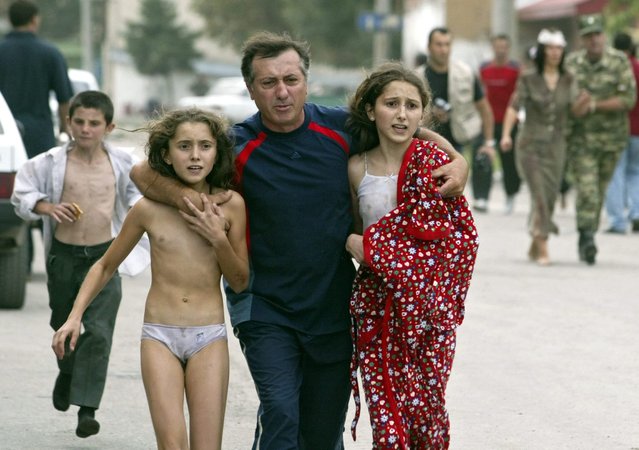
A man assists two young hostages who managed to escape from the school building after special forces entered the school in Beslan, North Ossetia, Friday 03 September 2004. Streams of hostages fled the besieged school in Beslan in southern Russia Friday amid intensive shooting and a series of powerful explosions that signalled a bloody end to the three-day stand-off with terrorists. (Photo by Yuri Kochetkov/EPA)

On September 1, 2004, Chechen militants stormed an elementary school in the town of Beslan in the Russian republic of North Ossetia. They took 1,100 teachers, children, and their relatives hostage, demanding the withdrawal of federal forces from Chechnya as a condition for their release. On September 3, 2004, Russian security forces stormed the building, resulting in a battle in which more than 330 hostages died, including 186 children. Here: A man assists two young hostages who managed to escape from the school building after special forces entered the school in Beslan, North Ossetia, Friday 03 September 2004. (Photo by Yuri Kochetkov/EPA)
Details
25 Sep 2017 06:41:00
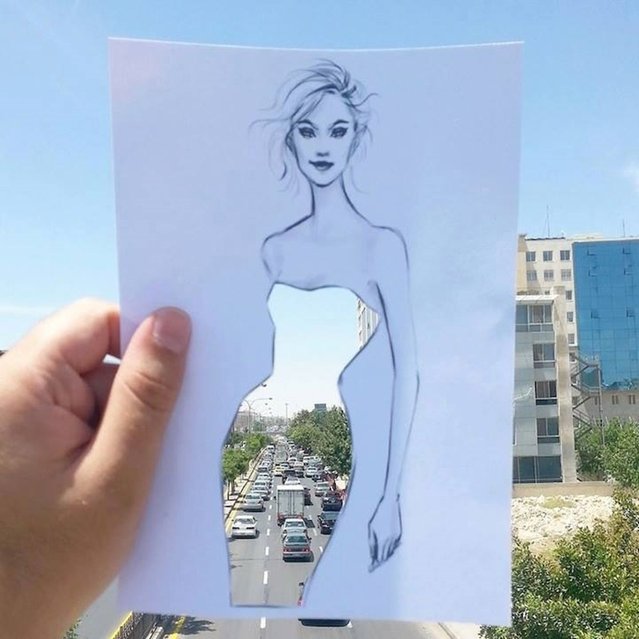
Fashion Illustrator Shamekh Bluwi

Shamekh Bluwi, an architect and fashion illustrator based in Amman, Jordan, creates beautiful paper cut-outs with women whose dresses become whatever you hold them up against. Besides being beautiful fashion drawings, they also seem like an excellent tool for coming up with inspiration for new fashion designs; simply hold up one of his drawings and see what sort of architectural lines, repeating patterns or images the women in his elegant cutouts would look good in.
Details
23 Jul 2015 10:30:00
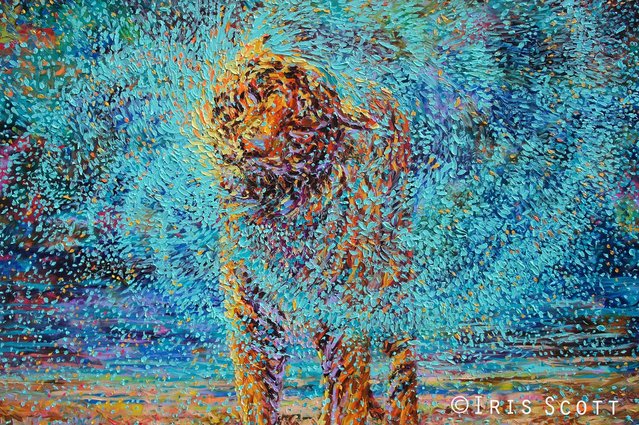
Iris Scott - Painting With Fingers

Though finger painting is normally associated with tempera paint and messy classroom art projects, Iris Scott is quickly changing what "finger painting" brings to mind. Wearing surgical gloves and painting with high grade oils, Iris achieves a whirlwind of crisscrossing color strokes and a vibrant impressionistic style. Since 2009, when Iris first began finger painting in Taiwan, her artistic career has caught her by surprise. Grateful for a new global market of online art collectors, Iris has shipped to Dubai, Ireland, and all over the USA.
Details
10 Jun 2013 09:15:00
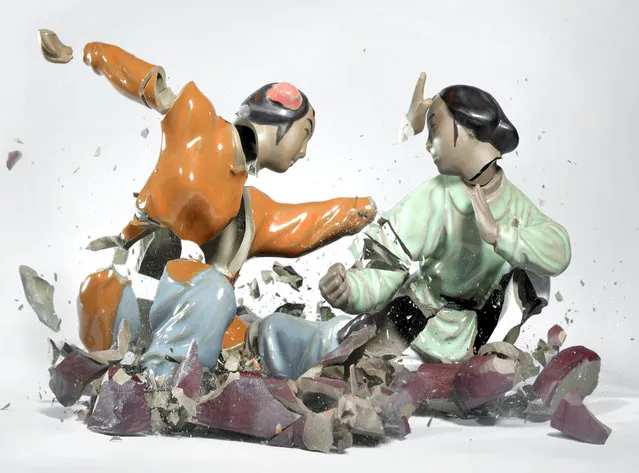
Porcelain Figurines By Martin Klimas

From a height of three meters, porcelain figurines are dropped on the ground, and the sound they make when they hit trips the shutter release. The result: razor-sharp images of disturbing beauty—temporary sculptures made visible to the human eye by high-speed photography technology. The porcelain statuette bursting into pieces isn't what really captures the attention; the fascination lies in the genesis of a dynamic figure that replaces the static pose. In contrast to the inertness of the intact kitsch figurines Klimas started out with, the photographs of their destruction possess a powerfully narrative character.
Details
21 Apr 2014 12:59:00
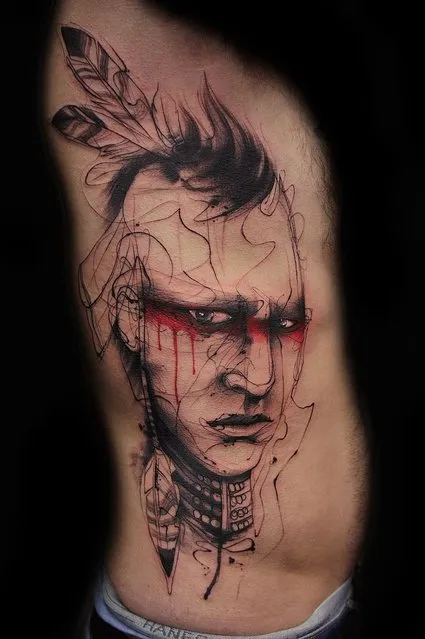
An amazing example of his mixed style. (Photo by Jay Freestyle/360 Media Solutions)

Tattooist Jay Freestyle, who is based in Amsterdam, creates what only can be described as works of art that last forever on his clients' skin. His style is freehand – without any sketch or stencil and he inks the incredible drawings straight onto body parts. They might look expertly planned, but the swashes of colour, detailed line work and geometric shapes are all the result of some clever improvisation. Photo: An amazing example of his mixed style. (Photo by Jay Freestyle/360 Media Solutions)
Details
26 May 2014 13:54:00