Loading...
Done
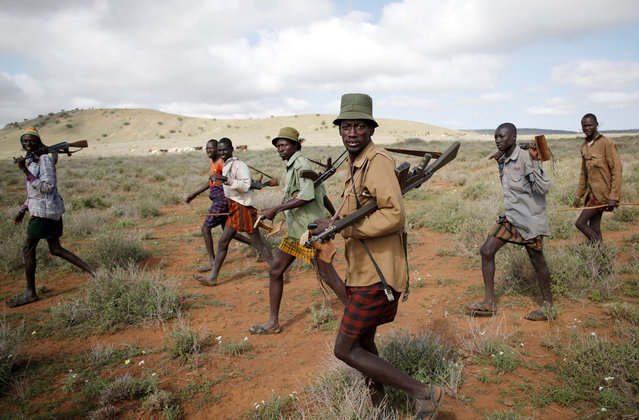
Turkana tribesmen walk with guns to protect their cattle from rival tribes near Baragoy, Kenya August 4, 2017. (Photo by Goran Tomasevic/Reuters)

Turkana tribesmen walk with guns to protect their cattle from rival tribes near Baragoy, Kenya August 4, 2017. (Photo by Goran Tomasevic/Reuters)
Details
05 Aug 2017 08:40:00
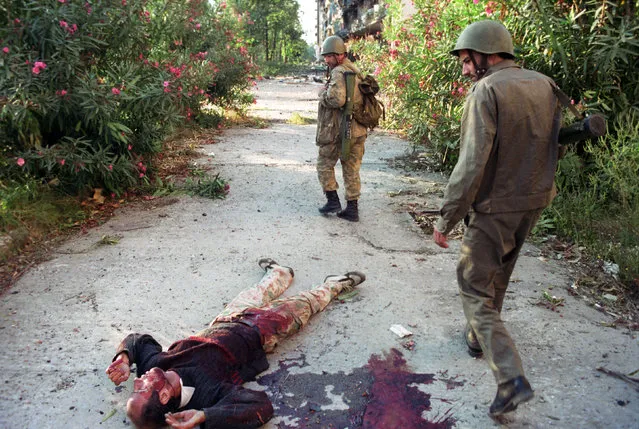
Abkhazia. Sukhumi, 1993. A house-to-house combat. (Photo by Andrei Solovyov/ITAR-TASS)

The War in Abkhazia from 1992 to 1993 was fought between Georgian government forces for the most part, and Abkhaz separatist forces, Russian armed forces and North Caucasian militants. Ethnic Georgians who lived in Abkhazia fought largely on the side of Georgian government forces. Ethnic Armenians and Russians within Abkhazia's population largely supported the Abkhazians, and many fought on their side. The separatists received support from thousands of North Caucasus and Cossack militants and from the Russian Federation forces stationed in and near Abkhazia. Here: Abkhazia. Sukhumi, 1993. A house-to-house combat. (Photo by Andrei Solovyov/ITAR-TASS)
Details
29 Sep 2017 07:31:00
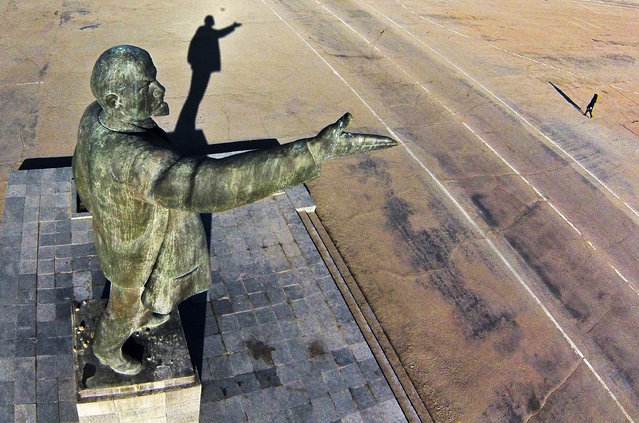
In this aerial file photo taken on Tuesday, October 31, 2017, a woman walks past a statue of Soviet Union founder Vladimir Lenin at the Russian leased Baikonur cosmodrome, in Kazakhstan. (Photo by Dmitri Lovetsky/AP Photo)

In this aerial file photo taken on Tuesday, October 31, 2017, a woman walks past a statue of Soviet Union founder Vladimir Lenin at the Russian leased Baikonur cosmodrome, in Kazakhstan. The thousands of statues of Vladimir Lenin spread across the vast region bring to mind poet Vladimir Mayakovsky's ringing line of devotion: “Lenin lived, Lenin lives, Lenin will live”. (Photo by Dmitri Lovetsky/AP Photo)
Details
06 Nov 2017 08:54:00
Women take part in an annual block party known as “Banda do Candinho e Mulatas” (Candinho Band and Mulatto Women), during carnival festivities at Bixiga neighbourhood in Sao Paulo, Brazil February 7, 2018. (Photo by Nacho Doce/Reuters)

Women take part in an annual block party known as “Banda do Candinho e Mulatas” (Candinho Band and Mulatto Women), during carnival festivities at Bixiga neighbourhood in Sao Paulo, Brazil February 7, 2018. (Photo by Nacho Doce/Reuters)
Details
09 Feb 2018 08:08:00
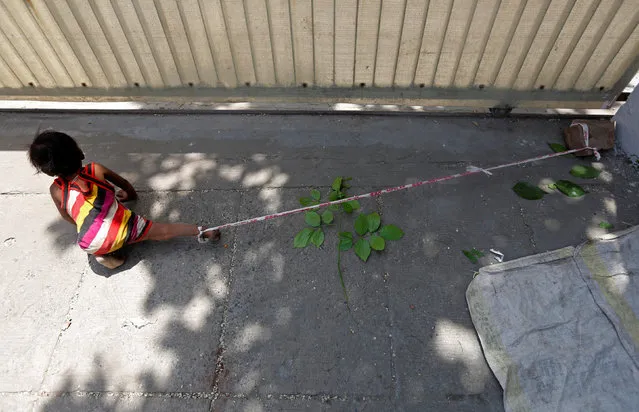
Barrier tape is tied around 15-month-old Shivani's ankle to prevent her from running away, while her mother Sarta Kalara works at a construction site nearby, in Ahmedabad, India, April 19, 2016. Kalara says she has no option but to tether her daughter Shivani to a stone despite her crying, while she and her husband work for 250 rupees ($3.8) each a shift digging holes for electricity cables in the city of Ahmedabad. (Photo by Amit Dave/Reuters)

Barrier tape is tied around 15-month-old Shivani's ankle to prevent her from running away, while her mother Sarta Kalara works at a construction site nearby, in Ahmedabad, India, April 19, 2016. Kalara says she has no option but to tether her daughter Shivani to a stone despite her crying, while she and her husband work for 250 rupees ($3.8) each a shift digging holes for electricity cables in the city of Ahmedabad. (Photo by Amit Dave/Reuters)
Details
23 May 2016 09:15:00
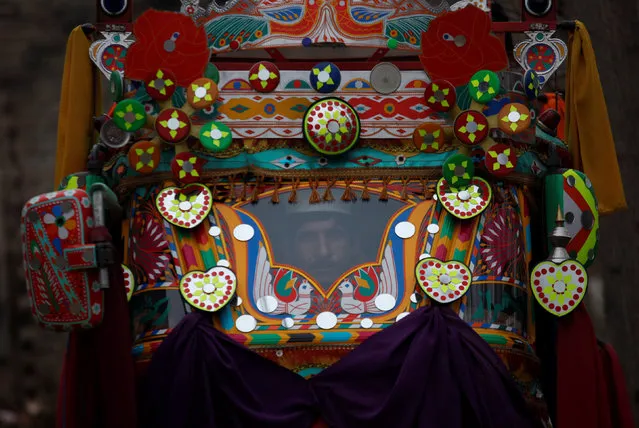
A rickshaw driver looks out the windshield as he drives onto the highway in Mardan, Pakistan January 30, 2017. (Photo by Fayaz Aziz/Reuters)

A rickshaw driver looks out the windshield as he drives onto the highway in Mardan, Pakistan January 30, 2017. (Photo by Fayaz Aziz/Reuters)
Details
01 Feb 2017 06:11:00
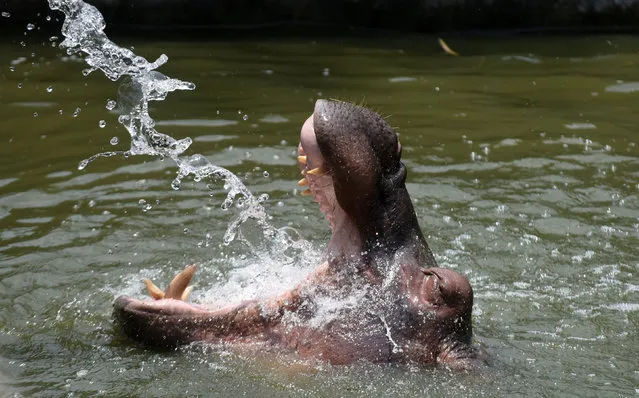
A hippopotamus is sprayed with water on a hot summer day at Anna National Zoological Park in Chennai, India on April 26, 2017. (Photo by Arun Sankar/AFP Photo)

A hippopotamus is sprayed with water on a hot summer day at Anna National Zoological Park in Chennai, India on April 26, 2017. (Photo by Arun Sankar/AFP Photo)
Details
30 Apr 2017 06:54:00
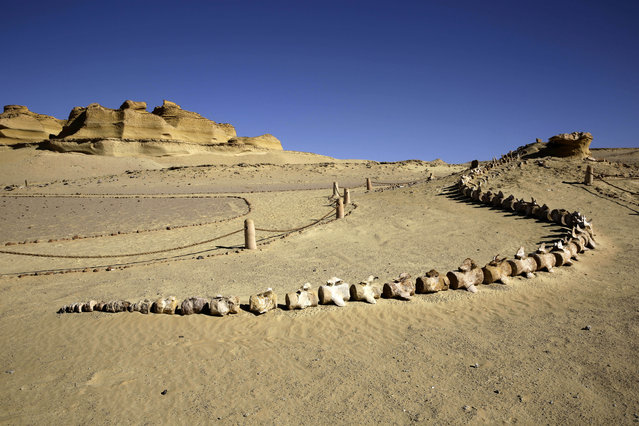
Fossilized whale bones are on display  outside the Wati El Hitan Fossils and Climate Change Museum, a UNESCO natural World Heritage site, on the opening day, in the Fayoum oasis, Egypt, Thursday, January 14, 2016. Egypt has cut the ribbon on the Middle East's first fossil museum housing the world's largest intact skeleton of a "walking whale" in an attempt to attract much-needed tourists driven off by recent militant attacks. The construction of the much-hyped Fossils and Climate Change Museum was covered a 2 billion euros (2. 17 billion dollars) grant from Italy, according to Italian Ambassador Maurizio Massari. (Photo by Thomas Hartwell/AP Photo)

Fossilized whale bones are on display outside the Wati El Hitan Fossils and Climate Change Museum, a UNESCO natural World Heritage site, on the opening day, in the Fayoum oasis, Egypt, Thursday, January 14, 2016. Egypt has cut the ribbon on the Middle East's first fossil museum housing the world's largest intact skeleton of a "walking whale" in an attempt to attract much-needed tourists driven off by recent militant attacks. The construction of the much-hyped Fossils and Climate Change Museum was covered a 2 billion euros (2. 17 billion dollars) grant from Italy, according to Italian Ambassador Maurizio Massari. Its centerpiece is an intact, 37-million-year-old and 20-meter-long skeleton of a legged form of whale that testifies to how modern-day whales evolved from land mammals. The sand-colored, dome-shaped museum is barely discernible in the breathtaking desert landscape that stretches all around. (Photo by Thomas Hartwell/AP Photo)
Details
16 Jan 2016 08:06:00