Loading...
Done


A group of young women have 'a bit of a do' for Oxfam at St Pancras International and enjoy a screening of the nation's favourite chick-flick Dirty Dancing on February 28, 2011 in London, England. Oxfam is calling on women across the UK to get together with their female friends in March to celebrate women's achievements for the 100th anniversary of International Women's Day (March 8, 2011) and raise money to support their work with women living in poverty. www.oxfam.org.uk/do (Photo by Ian Gavan/Getty Images for Oxfam). LONDON, ENGLAND – FEBRUARY 28
Details
07 Mar 2011 15:23:00
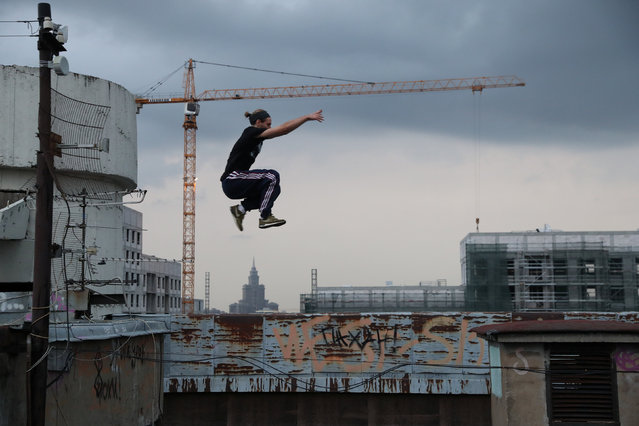
Urban explorer Vad Him of Rudex team jumps whilst on a rooftop in Moscow, Russia, August 14, 2017. (Photo by Maxim Shemetov/Reuters)

To an outsider, their passion is at times illegal and often on the verge of life and death. But climbing rooftops of high-rise buildings and exploring abandoned facilities is in the blood of these young Muscovites. The small group calls itself “Rudex”, which stands for “roof and decay exploration”, and is akin a Western youth craze known as urbex or “urban exploration” of man-made structures. Here: Urban explorer Vad Him of Rudex team jumps whilst on a rooftop in Moscow, Russia, August 14, 2017. (Photo by Maxim Shemetov/Reuters)
Details
25 Sep 2017 06:36:00
Hisakata says he never thought of street cats as particularly playful, and was surprised by the reactions of a selected few when he first tried to interact with them with a cat toy. (Photo by Hisakata Hiroyuki/Caters News Agency)

Hisakata Hiroyuki, a talented photographer from Japan, has managed to snap a group of mortal tomcats in a variety of high-flying kung fu poses. Using his own rapid-fire reactions, he photographs the lovable cats flying through the air, their legs and paws outstretched, like something out of an action movie. (Photo by Hisakata Hiroyuki/Caters News Agency)
Details
08 Nov 2017 09:05:00
A visitor poses inside a three story upside-down family sized house at the Huashan Creative Park in Taipei, Taiwan April 7, 2016. (Photo by Tyrone Siu/Reuters)

A visitor poses inside a three story upside-down family sized house at the Huashan Creative Park in Taipei, Taiwan April 7, 2016. Over 300 square meters of floor space of the upside-down house, filled with home furnishings, was created by a group of Taiwanese architects at a total cost of around US$600,000 and took 2 months to complete, according to the organisers. (Photo by Tyrone Siu/Reuters)
Details
09 Apr 2016 13:43:00
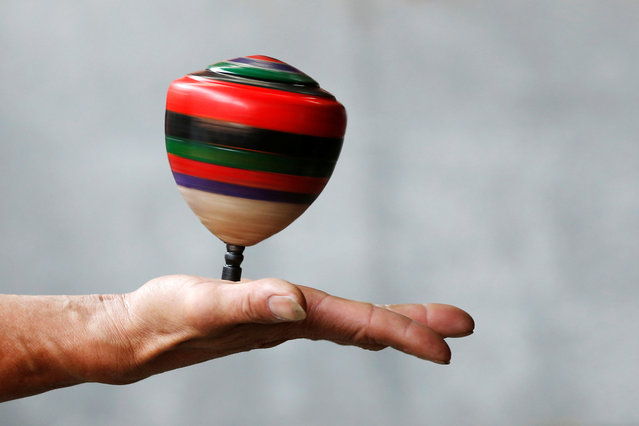
A spinning top is seen on a hand during a performance at Sanxia old street in New Taipei City, Taiwan May 8, 2016. (Photo by Tyrone Siu/Reuters)

A spinning top is seen on a hand during a performance at Sanxia old street in New Taipei City, Taiwan May 8, 2016. Taiwan's ancient folk art of spinning tops is kept alive by a group of enthusiasts who perform intricate tricks with the toys at a temple in Taipei, the capital. (Photo by Tyrone Siu/Reuters)
Details
11 May 2016 11:24:00
Participant rides a carousel at the women's-only Petrolettes motorcycle festival on July 21, 2018 in Milmersdorf, near Berlin in Germany. (Photo by Maja Hitij/Getty Images)

Participant rides a carousel at the women's-only Petrolettes motorcycle festival on July 21, 2018 in Milmersdorf, near Berlin in Germany. Around 300 bike women from across Europe come together for the third edition of the festival. Women connect their passion for high speed motorbikes with music, movies, races, yoga etc. Festival that goes for three days was initiated by a group of female motorbike riders called The Curves. (Photo by Maja Hitij/Getty Images)
Details
27 Jul 2018 00:05:00
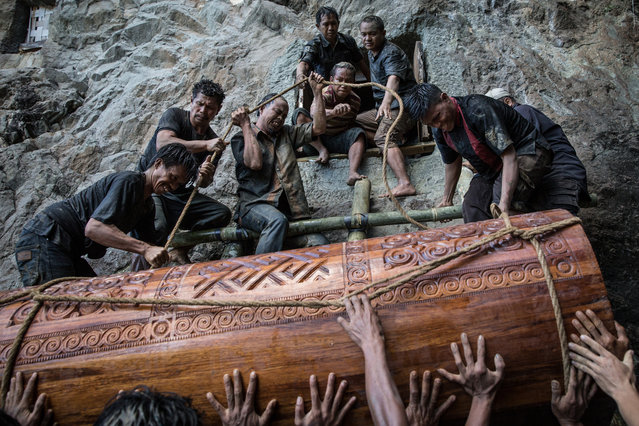
It is said that Torajans are people who “live to die”. For this Indonesian ethnic group, funerals are such extravagant events that they sometimes attract tourists. Families can postpone burials years (and the deceased are considered sick and hosted at home until the funeral) until the family can raise enough money and gather as many relatives as possible. And then it’s a jubilant multiday social event with a parade, dances and animal sacrifices. Agung Parameswara photographed these funerary practices when he traveled to South Sulawesi province, where the Torajans live. But often, their funeral isn’t the last time the dead are seen. In August, crypts are opened, coffins are slid back out and bodies delicately unsheathed. This tender ritual is known as Ma’Nene, which is customarily performed every few years. (Photo by Agung Parameswara/The Washington Post)

It is said that Torajans are people who “live to die”. For this Indonesian ethnic group, funerals are such extravagant events that they sometimes attract tourists. Families can postpone burials years (and the deceased are considered sick and hosted at home until the funeral) until the family can raise enough money and gather as many relatives as possible. And then it’s a jubilant multiday social event with a parade, dances and animal sacrifices. Agung Parameswara photographed these funerary practices when he traveled to South Sulawesi province, where the Torajans live. (Photo by Agung Parameswara/The Washington Post)
Details
06 Oct 2016 09:15:00
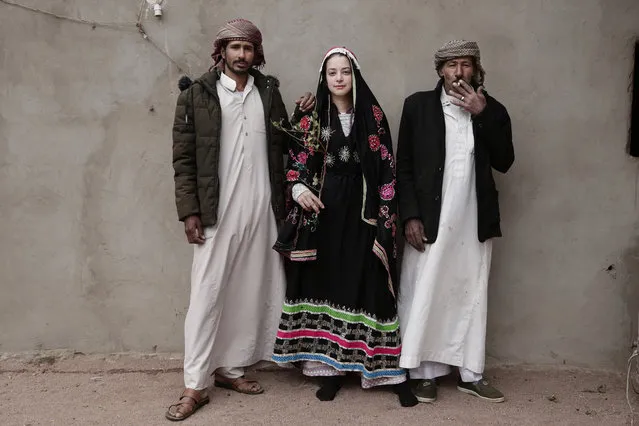
In this March 31, 2019 photo, an Egyptian student borrows a Bedouin wedding dress to pose for a photograph with Bedouin men from the Hamada tribe, in Wadi Sahw, Abu Zenima, in South Sinai, Egypt. Four Bedouin women are for the first time leading tours in Egypt’s Sinai Peninsula, breaking new ground in their deeply conservative community, where women almost never work outside the home or interact with outsiders.  The tourists can only be women, and the tours can’t go overnight. Each day before the sun sets, the group returns to the Hamada’s home village in Wadi Sahu, a narrow desert valley. (Photo by Nariman El-Mofty/AP Photo)

In this March 31, 2019 photo, an Egyptian student borrows a Bedouin wedding dress to pose for a photograph with Bedouin men from the Hamada tribe, in Wadi Sahw, Abu Zenima, in South Sinai, Egypt. Four Bedouin women are for the first time leading tours in Egypt’s Sinai Peninsula, breaking new ground in their deeply conservative community, where women almost never work outside the home or interact with outsiders. The tourists can only be women, and the tours can’t go overnight. Each day before the sun sets, the group returns to the Hamada’s home village in Wadi Sahu, a narrow desert valley. (Photo by Nariman El-Mofty/AP Photo)
Details
11 Apr 2019 00:01:00