Loading...
Done
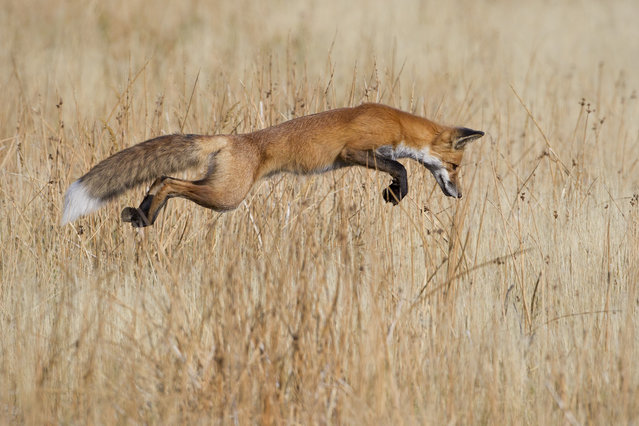
Canada: “Lucky pounce”. (Photo by Connor Stefanison/Wildlife Photographer of the Year 2013)

The winners of The London’s Natural History Museum's prestigious Wildlife Photographer of the Year for 2013 have finally been unveiled. Selected from almost 43,000 entries from 96 countries, the winners offer a glimpse of the stunning array of natural beauty on our planet. Photo: Canada: “Lucky pounce”. “Anticipating the pounce – that was the hardest part”, says Connor, who had come to Yellowstone National Park, Wyoming, USA, in search of wildlife as much as the spectacular landscape. He had found this fox, his first ever, on his last day in the park. It was so absorbed in hunting that Connor had plenty of time to get out of the car and settle behind a rock. It quartered the grassland, back and forth, and then started staring intently at a patch of ground, giving Connor just enough warning of the action to come. When it sprung up, Connor got his shot. And when it landed, the fox got his mouse. (Photo by Connor Stefanison/Wildlife Photographer of the Year 2013)
Details
17 Oct 2013 08:12:00
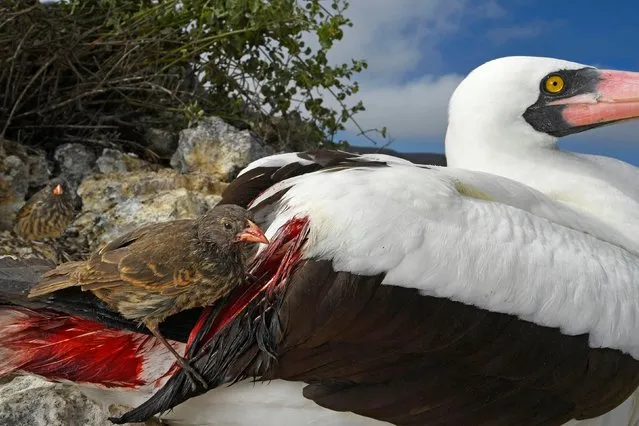
Bloodthirsty by Thomas P Peschak, Germany/South Africa — winner, Behaviour: birds. When rations run short on Wolf Island, in the remote northern Galápagos, the sharp-beaked ground finches become vampires. Their sitting targets are Nazca boobies and other large birds. The finches rely on a scant diet of seeds and insects, which regularly dries up, so they drink blood to survive. ‘I’ve seen more than half a dozen finches drinking from a single Nazca booby,’ says Tom. Rather than leave their nests the boobies tolerate the vampires, and the blood loss doesn’t seem to cause permanent harm. (Photo by Thomas P Peschak/2018 Wildlife Photographer of the Year)

Bloodthirsty by Thomas P. Peschak, Germany/South Africa — winner, Behaviour: birds. When rations run short on Wolf Island, in the remote northern Galápagos, the sharp-beaked ground finches become vampires. Their sitting targets are Nazca boobies and other large birds. The finches rely on a scant diet of seeds and insects, which regularly dries up, so they drink blood to survive. ‘I’ve seen more than half a dozen finches drinking from a single Nazca booby,’ says Tom. Rather than leave their nests the boobies tolerate the vampires, and the blood loss doesn’t seem to cause permanent harm. (Photo by Thomas P. Peschak/2018 Wildlife Photographer of the Year)
Details
19 Oct 2018 00:05:00
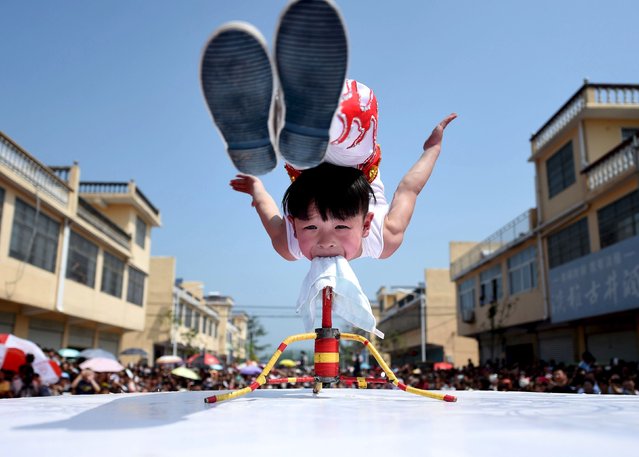
A six-year-old acrobat performs on the opening of a tourist festival in Bozhou, Anhui province, China May 3, 2015. (Photo by Reuters/China Daily)

A six-year-old acrobat performs on the opening of a tourist festival in Bozhou, Anhui province, China May 3, 2015. (Photo by Reuters/China Daily)
Details
05 May 2015 11:04:00
A woman doing yoga at a fountain, in downtown Stuttgart, Germany, Thursday, June 22, 2017. Weather forecasts predict hot summer weather as well as thunderstorms for some parts of Germany. (Photo by Marijan Murat/DPA via AP Photo)

A woman doing yoga at a fountain, in downtown Stuttgart, Germany, Thursday, June 22, 2017. Weather forecasts predict hot summer weather as well as thunderstorms for some parts of Germany. (Photo by Marijan Murat/DPA via AP Photo)
Details
25 Jun 2017 07:10:00
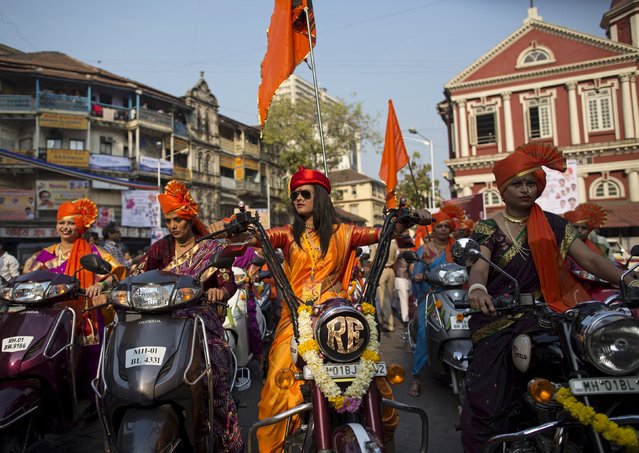
Maharashtrian women dressed in traditional costumes attend celebrations to mark the Gudi Padwa festival in Mumbai March 21, 2015. The festival marks the beginning of the new year for Maharashtrians and is celebrated widely in Maharashtra and in the Konkan region. (Photo by Danish Siddiqui/Reuters)

Maharashtrian women dressed in traditional costumes attend celebrations to mark the Gudi Padwa festival in Mumbai March 21, 2015. The festival marks the beginning of the new year for Maharashtrians and is celebrated widely in Maharashtra and in the Konkan region. (Photo by Danish Siddiqui/Reuters)
Details
02 Apr 2015 12:36:00
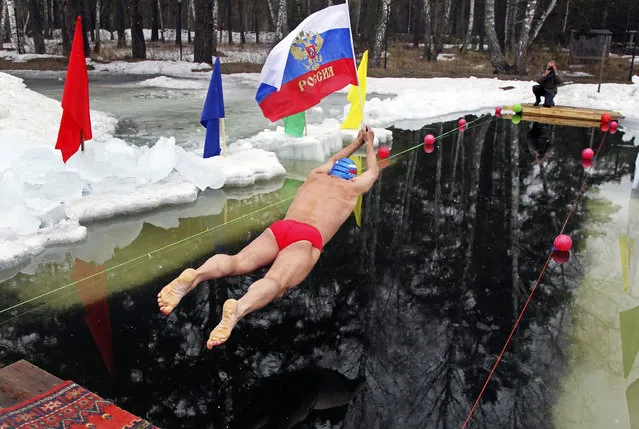
A member of a local swimming club holds a Russian national flag as he dives in at the start of a 24-hour swimming marathon near the western Siberian city of Barnaul March 29, 2014. Thirty members of the club will swim in turn during the event, held to mark Crimea becoming part of Russia, local media reported. (Photo by Andrei Kasprishin/Reuters)

A member of a local swimming club holds a Russian national flag as he dives in at the start of a 24-hour swimming marathon near the western Siberian city of Barnaul March 29, 2014. Thirty members of the club will swim in turn during the event, held to mark Crimea becoming part of Russia, local media reported. (Photo by Andrei Kasprishin/Reuters)
Details
05 Apr 2014 13:20:00
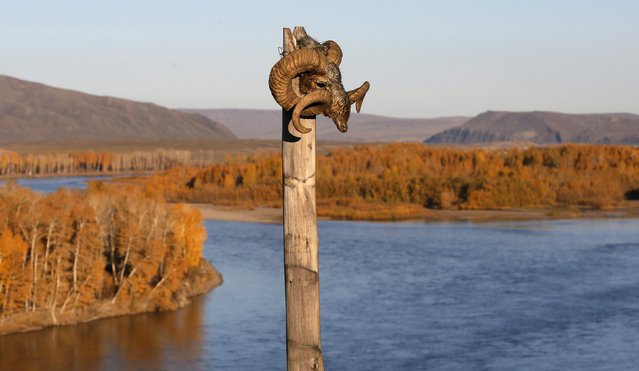
The head of a mountain ram is attached to a wooden column at the site used for shamans' rituals in the Aldyn Bulak area on the bank of the Yenisei River during sunset outside the village of Elegest, Tuva region, Southern Siberia, Russia, October 7, 2015. (Photo by Ilya Naymushin/Reuters)

The head of a mountain ram is attached to a wooden column at the site used for shamans' rituals in the Aldyn Bulak area on the bank of the Yenisei River during sunset outside the village of Elegest, Tuva region, Southern Siberia, Russia, October 7, 2015. The region is inhabited by Tuvans, historically cattle-herding nomads, who nowadays practise two main confessions – Buddhism and Shamanism. (Photo by Ilya Naymushin/Reuters)
Details
19 Oct 2015 08:05:00
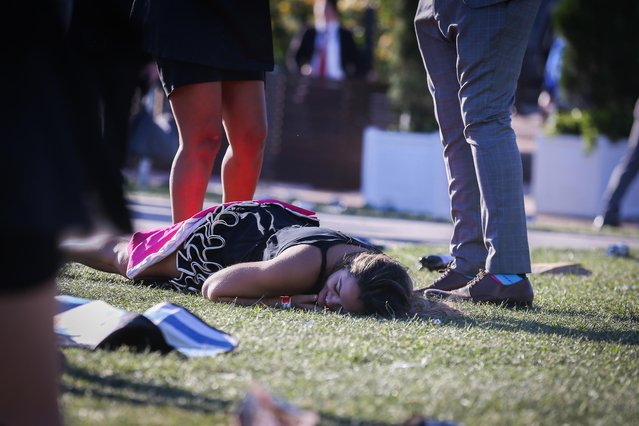
A woman lies face-down on the floor where other race-goers are standing on 2017 Derby Day at Flemington Racecourse on November 4, 2017 in Melbourne, Australia. (Photo by Splash News and Pictures)

A woman lies face-down on the floor where other race-goers are standing on 2017 Derby Day at Flemington Racecourse on November 4, 2017 in Melbourne, Australia. (Photo by Splash News and Pictures)
Details
06 Nov 2017 09:08:00