Loading...
Done
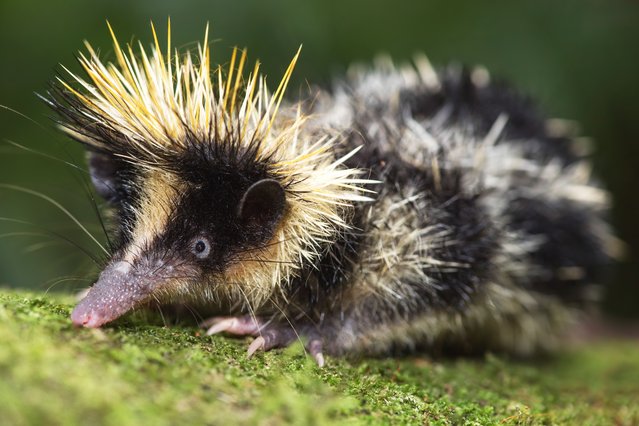
This spiky tenrec was spotted in Madagascar’s Mantadia National Park in the last decade of September 2025. Mostly nocturnal and rarely seen, it puffs out its spines when threatened. Spiky tenrecs are excellent swimmers — unlike most spiny mammals, some species of tenrec can forage in streams and rivers, using their spines for protection while hunting aquatic insects and small prey. (Photo by Dale Morris/Solent News & Photo Agency)

This spiky tenrec was spotted in Madagascar’s Mantadia National Park in the last decade of September 2025. Mostly nocturnal and rarely seen, it puffs out its spines when threatened. Spiky tenrecs are excellent swimmers — unlike most spiny mammals, some species of tenrec can forage in streams and rivers, using their spines for protection while hunting aquatic insects and small prey. (Photo by Dale Morris/Solent News & Photo Agency)
Details
05 Oct 2025 04:02:00
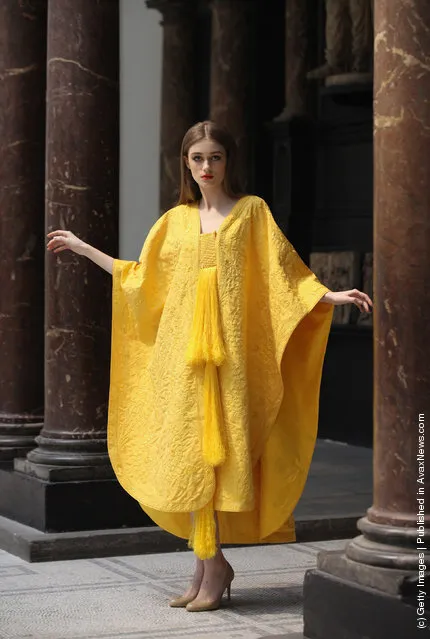
Model Bianca Gavrilas wears a a hand-embroidered cape made from the silk of the Golden Orb Spider in the V&A Museum's Medieval and Renaissance Gallery

Model Bianca Gavrilas wears a a hand-embroidered cape made from the silk of the Golden Orb Spider in the V&A Museum's Medieval and Renaissance Gallery on January 23, 2012 in London, England. The cape is one of two golden spider silk textiles that exist in the world, it was made in Madagascar over a period of 8 years and using the silk of silk of 1.2million spiders. (Photo by Oli Scarff/Getty Images)
Details
26 Jan 2012 12:02:00


“Chameleons (family Chamaeleonidae) are a distinctive and highly specialized clade of lizards. They are distinguished by their parrot-like zygodactylous feet, their separately mobile and stereoscopic eyes, their very long, highly modified, and rapidly extrudable tongues, their swaying gait, the possession by many of a prehensile tail, crests or horns on their distinctively shaped heads, and the ability of some to change color. Uniquely adapted for climbing and visual hunting, the approximately 160 species of chameleon range from Africa, Madagascar, Spain and Portugal, across south Asia, to Sri Lanka, have been introduced to Hawaii, California and Florida, and are found in warm habitats that vary from rain forest to desert conditions”. – Wikipedia

Photo: A woman with the latest fashion accessory, a chameleon. (Photo by Fox Photos/Getty Images). Circa 1926
Details
20 Mar 2011 15:45:00
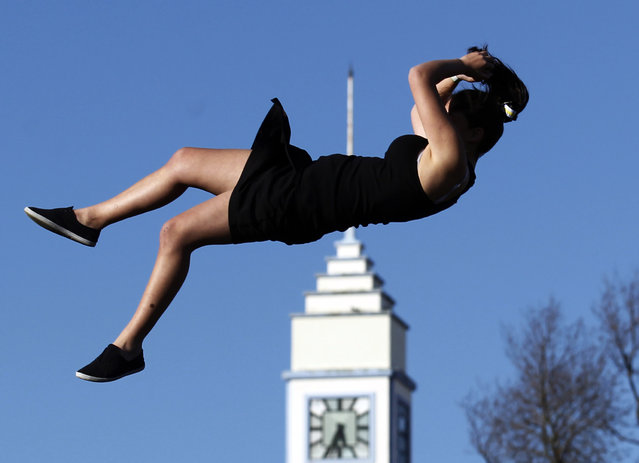
8. NEW ZEALAND: A woman dives from a platform into a giant air bed at a park in Palmerston North September 29, 2011. (Photo by Marcos Brindicci/Reuters)

The report, prepared by the Sustainable Development Solutions Network (SDSN) and the Earth Institute at Columbia University, showed Syria, Afghanistan and eight sub-Saharan countries as the 10 least happy places on earth to live. The top 10 this year were Denmark, Switzerland, Iceland, Norway, Finland, Canada, Netherlands, New Zealand, Australia, and Sweden. Denmark was in third place last year, behind Switzerland and Iceland. The bottom 10 were Madagascar, Tanzania, Liberia, Guinea, Rwanda, Benin, Afghanistan, Togo, Syria and Burundi. The United States came in at 13, the United Kingdom at 23, France at 32, and Italy at 50. Here: #8. NEW ZEALAND: A woman dives from a platform into a giant air bed at a park in Palmerston North September 29, 2011. (Photo by Marcos Brindicci/Reuters)
Details
26 Mar 2016 13:19:00


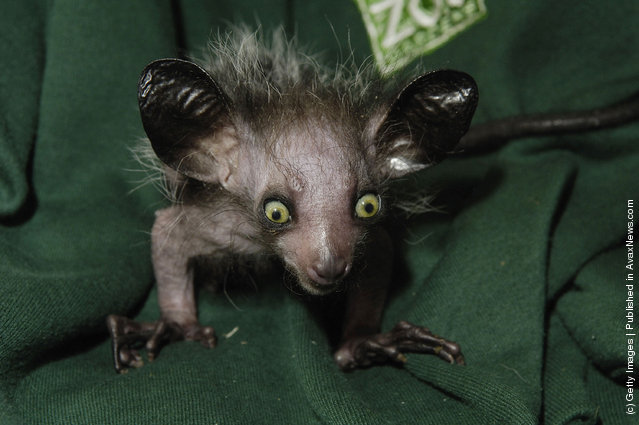
“The aye-aye (Daubentonia madagascariensis) is a lemur, a strepsirrhine primate native to Madagascar that combines rodent-like teeth and a special thin middle finger to fill the same ecological niche as a woodpecker. It is the world's largest nocturnal primate, and is characterized by its unusual method of finding food; it taps on trees to find grubs, then gnaws holes in the wood and inserts its narrow middle finger to pull the grubs out. The only other animal species known to find food in this way is the striped possum. From an ecological point of view the aye-aye fills the niche of a woodpecker as it is capable of penetrating wood to extract the invertebrates within”. – Wikipedia

Photo: In this handout image from Bristol Zoo is seen the first captive bred aye-aye in the UK named “Kintana” (meaning star in Malagasy) April 15, 2005 at Bristol Zoo Gardens, England. The zoo announced today only the second baby aye-aye to be hand-reared in the world (the first was in Jersey Zoo) and has now made his first public appearance since his birth on 11 February 2005. (Photo by Rob Cousins/Bristol Zoo via Getty Images)
Details
13 Apr 2011 13:33:00
Singers “Elle & The Pocket Belles” attend day 3 “Ladies Day” of the Qatar Goodwood Festival on August 3, 2017 in Chichester, England. (Photo by David Hartley/PA Wire)

Singers “Elle & The Pocket Belles” attend day 3 “Ladies Day” of the Qatar Goodwood Festival on August 3, 2017 in Chichester, England. (Photo by David Hartley/PA Wire)
Details
04 Aug 2017 09:19:00
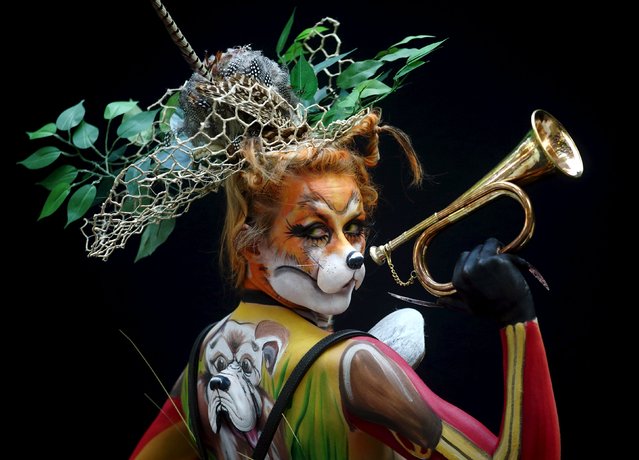
A model poses during the annual World Bodypainting Festival in Poertschach, Austria, July 3, 2015. (Photo by Heinz-Peter Bader/Reuters)

A model poses during the annual World Bodypainting Festival in Poertschach, Austria, July 3, 2015. The event takes place from July 3 to 5 at lake Woerthersee in Austria's southern Carinthia province. (Photo by Heinz-Peter Bader/Reuters)
Details
05 Jul 2015 11:06:00
Danila Shmelev, an artist from Moscow, Russia, works on a 3-D picture in Dubai, United Arab Emirates, Monday, February 27, 2017. Artists who focus on 3-D pictures have gathered in Dubai for the Dubai Canvas 3-D Art Festival, which runs from March 1 through March 7. (Photo by Jon Gambrell/AP Photo)

Danila Shmelev, an artist from Moscow, Russia, works on a 3-D picture in Dubai, United Arab Emirates, Monday, February 27, 2017. Artists who focus on 3-D pictures have gathered in Dubai for the Dubai Canvas 3-D Art Festival, which runs from March 1 through March 7. (Photo by Jon Gambrell/AP Photo)
Details
28 Feb 2017 11:18:00