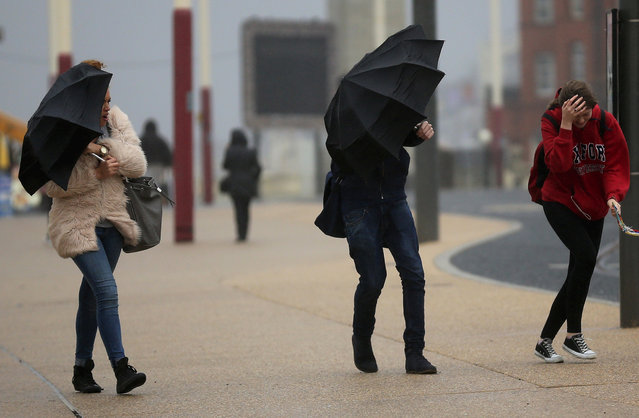
Students brave high winds and rain on Blackpool promenade as Britain prepares for high winds over the next two days on October 20, 2014 in Blackpool, England. (Photo by Christopher Furlong/Getty Images)
Martin Lacey Jr. with a lion during the premiere of the Circus Krone program “Circus der Preistraeger” at Circus Krone on February 2, 2016 in Munich, Germany. (Photo by Hannes Magerstaedt/Getty Images)
A participant in costume uses a mobile phone at a Halloween event in Kawasaki, south of Tokyo, Japan October 29, 2017. (Photo by Kim Kyung-Hoon/Reuters)
A follower of the Afro-Brazilian religion Umbanda pays tribute for Iemanja, goddess of the sea, in Copacabana Beach in Rio de Janeiro, Brazil December 29, 2017. Hundreds of practitioners of Brazil's Afro-Brazilian Candomble and Umbanda faiths have gathered at Rio de Janeiro's Copacabana beach to honor Yemanja. Worshippers were mostly dressed in white as they launched their offerings to Iemanja: small boats with flowers and bowls with candles and fruits. (Photo by Ricardo Moraes/Reuters)
A professional training in explosive disposal is held in Nanning, Guangxi, China on 18th February, 2021. (Photo by Top Photo Corporation/Rex Features/Shutterstock)
Festival goers attend Splendour In The Grass 2019 on July 20, 2019 in Byron Bay, Australia. Splendour is an annual Australian music festival, showcases popular and established musical artists, as well as emerging Australian artists. (Photo by Mark Metcalfe/Getty Images)
Luling, Louisiana, US. New evidence contradicts previous claims of the relative safety of glyphosate, the world’s most widely used herbicide, which is manufactured here. It is often used in conjunction with seeds that have been genetically modified to tolerate its application, meaning that anyone consuming these crops is eating a genetically modified plant, and whatever residue of the pesticide that remains. (Photo by J. Henry Fair/Industrial Scars/Papadakis Publisher)