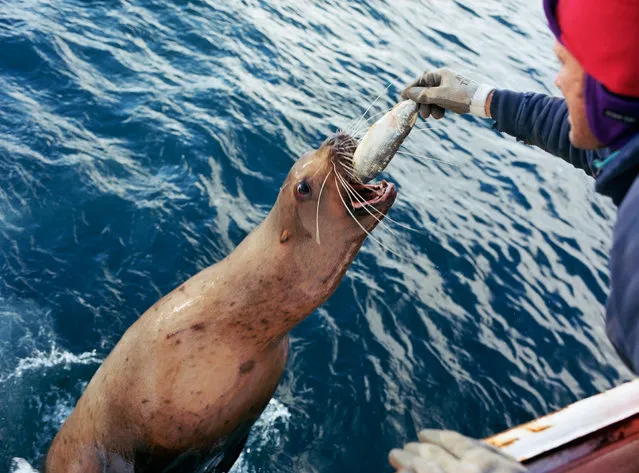
In 2002 photographer Corey Arnold left behind a poor economy in San Francisco and headed up to Alaska to try his luck at his longtime passion of fishing. Arnold, who had worked summers during college on a salmon boat in Alaska, signed onto the f/v Rollo, a crabbing boat that fishes in the dangerous Bering Sea. While working long, strenuous hours on the Rollo, Arnold often stole away with the captain’s permission to grab his camera and photograph the crew and the ship. Arnold eventually put together “Fish Work: Bering Sea”, a documentation of his seven adventurous and dicey crab seasons aboard the Rollo. (Photo by Corey Arnold)
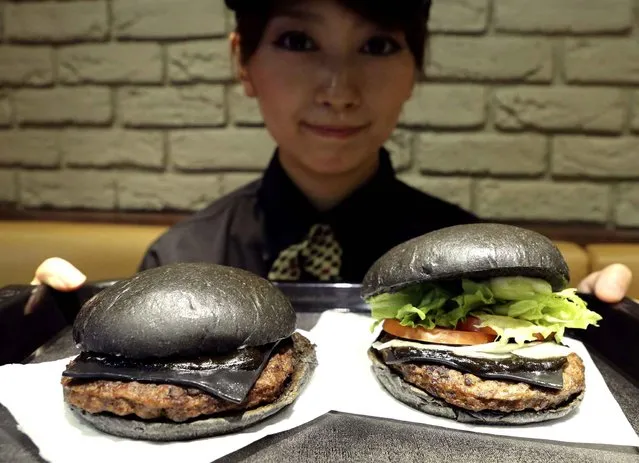
Burger King employee Rumi Sekine shows the Kuro Diamond burger, right, and the Kuro Pearl burger at its Shibuya restaurant in Tokyo Tuesday, September 16, 2014. The international hamburger chain in Japan will launch the two new “kuro burger”, or “black burger” menus that sport buns, cheese and sauce all in black color, starting on Friday, Sept. 19, for a limited period. The buns and cheese are darkened with bamboo charcoal while the beef patties made with black-pepper are topped with the garlic sauce using squid ink. (Photo by Koji Sasahara/AP Photo)
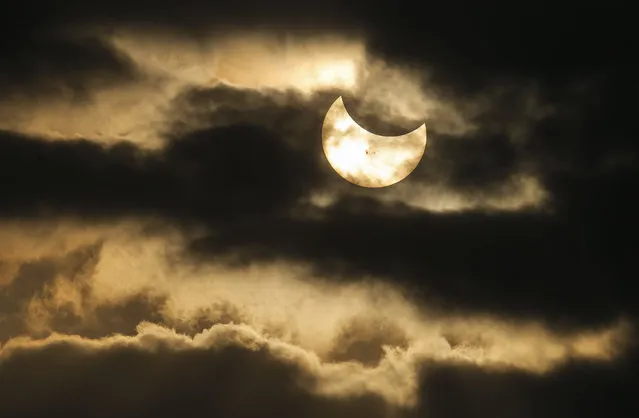
A partial solar eclipse is seen in a break in the clouds during rush hour in downtown Wichita Kan., Thursday, October 23, 2014. A partial eclipse occurs when the moon covers a portion of the sun as seen from the Earth. (AP Photo/The Wichita Eagle, Travis Heying)
Colombia fans celebrate a goal during the World Cup Group C soccer match between Colombia and Greece, at a park in Bogota June 14, 2014. (Photo by John Vizcaino/Reuters)
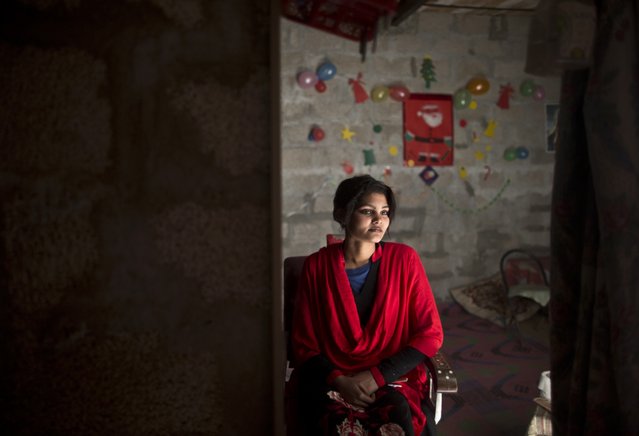
Pakistani Christian Maria Akbar, 15, checks herself in the mirror, after having her make up done by hairdresser Razia Rehmat, 39, in preparation for Christmas holiday, at a hair salon, in a slum that hosts Christian families, on the outskirts of Islamabad, Pakistan, Wednesday, December 24, 2014. (Photo by Muhammed Muheisen/AP Photo)
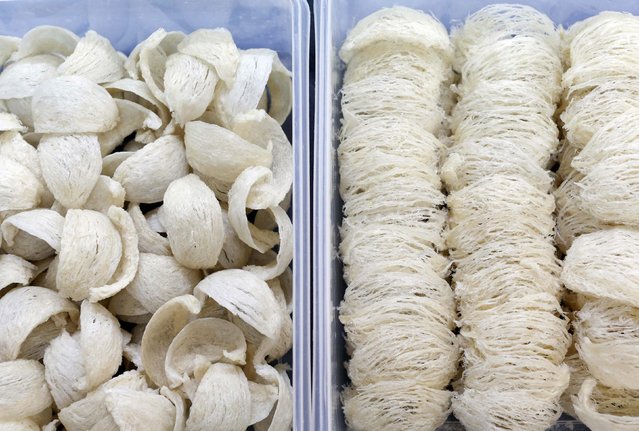
Two styles of cleaned bird's nest, Yan Zhan (L) and Su Zhan (R) await repacking at a processing plant in Kuala Lumpur, February 17, 2015. Prized in China for is alleged health benefits for hundreds of years, nests made from swiftlets' saliva are being mixed into coffee and cereal as the Southeast Asian producers of the delicacy seek to broaden its appeal, and their profit margins. The nests are among the world's most expensive foods, selling for up to $2,500 a kg and the swiftlets that weave them are indigenous to Indonesia, Malaysia, Thailand and Vietnam. (Photo by Olivia Harris/Reuters)