Loading...
Done
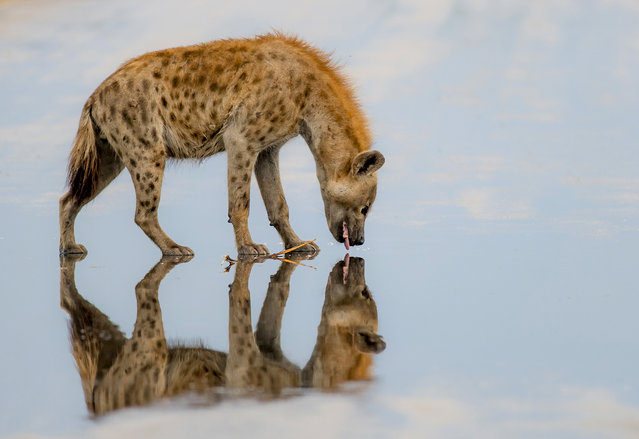
A hyena kisses his own reflection while appearing to walk on water. (Photo by Jake De Wet/Caters News Agency)

A hyena kisses his own reflection while appearing to walk on water. (Photo by Jake De Wet/Caters News Agency)
Details
07 Oct 2018 00:03:00
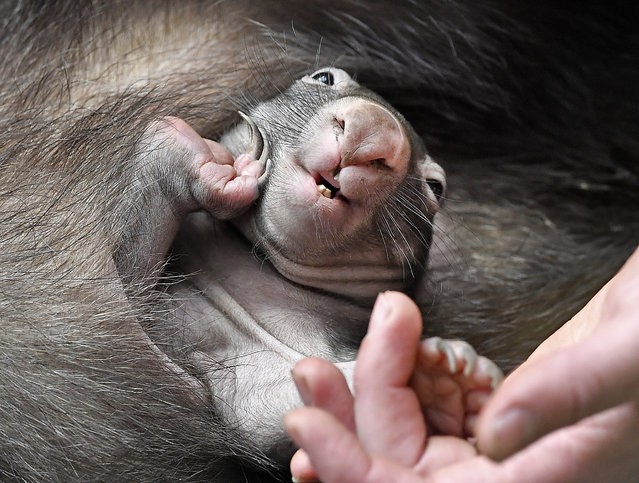
The little new born wombat baby APARI sitting in its mothers pouch at the zoo in Duisburg, Germany, Thursday, March 29, 2018. Wombat mother TINSEL once was found in the pouch of its dead mother on a street in Australia and was raised by zookeepers before she came to Germany. The zoo tried for 40 years in vain to breed a wombat, until APARI was born as the first one last week. (Photo by Martin Meissner/AP Photo)

The little new born wombat baby APARI sitting in its mothers pouch at the zoo in Duisburg, Germany, Thursday, March 29, 2018. Wombat mother TINSEL once was found in the pouch of its dead mother on a street in Australia and was raised by zookeepers before she came to Germany. The zoo tried for 40 years in vain to breed a wombat, until APARI was born as the first one last week. (Photo by Martin Meissner/AP Photo)
Details
01 Apr 2018 00:03:00
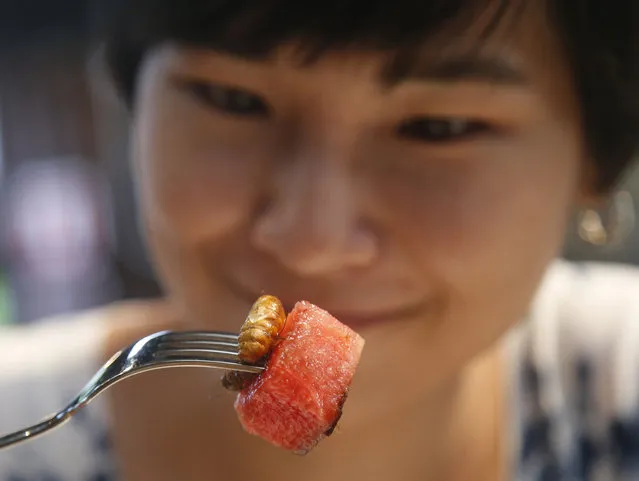
In this Tuesday, September 12, 2017 photo, Amornrat Simapsaisan, a local shop manager, watches before she ate watermelon salad with bamboo worms, at Inspects in the Backyard restaurant, Bangkok, Thailand. Tucking into insects is nothing new in Thailand, where street vendors pushing carts of fried crickets and buttery silkworms have long fed locals and adventurous tourists alike. But bugs are now fine-dining at the Bangkok bistro aiming to revolutionize views of nature’s least-loved creatures and what you can do with them. She tucked in quite happily to her watermelon and cricket salad on a recent evening.  “It’s tasty. It’s munchy”, she said. (Photo by Sakchai Lalit/AP Photo)

In this Tuesday, September 12, 2017 photo, Amornrat Simapsaisan, a local shop manager, watches before she ate watermelon salad with bamboo worms, at Inspects in the Backyard restaurant, Bangkok, Thailand. Tucking into insects is nothing new in Thailand, where street vendors pushing carts of fried crickets and buttery silkworms have long fed locals and adventurous tourists alike. But bugs are now fine-dining at the Bangkok bistro aiming to revolutionize views of nature’s least-loved creatures and what you can do with them. She tucked in quite happily to her watermelon and cricket salad on a recent evening. “It’s tasty. It’s munchy”, she said. (Photo by Sakchai Lalit/AP Photo)
Details
04 Oct 2017 06:54:00
A racegoers cheers on her horse in Race 4 ahead of the race of the Melbourne Cup at Flemington Racecourse in Melbourne, Australia, Tuesday, November 7, 2017. (Photo by Andy Brownbill/AP Photo)

A racegoers cheers on her horse in Race 4 ahead of the race of the Melbourne Cup at Flemington Racecourse in Melbourne, Australia, Tuesday, November 7, 2017. (Photo by Andy Brownbill/AP Photo)
Details
07 Nov 2017 08:17:00
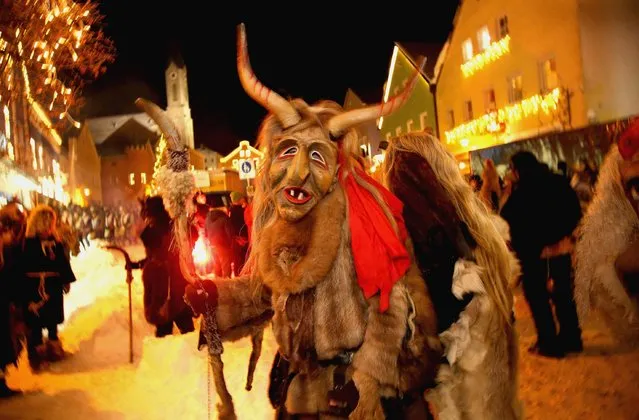
Locals dressed as “Perchten”, a traditional demonic creature in German and Austrian Alpine folklore, parade through the town center during the annual “Rauhnacht” gathering on January 5, 2017 in Waldkirchen, Germany. (Photo by Johannes Simon/Getty Images)

Locals dressed as “Perchten”, a traditional demonic creature in German and Austrian Alpine folklore, parade through the town center during the annual “Rauhnacht” gathering on January 5, 2017 in Waldkirchen, Germany. (Photo by Johannes Simon/Getty Images)
Details
07 Jan 2017 14:09:00
School children take photographs as Queen Elizabeth II arrives in Valentine's Park Redbridge as part of her Diamond Jubilee tour of the UK

School children take photographs as Queen Elizabeth II arrives in Valentine's Park Redbridge as part of her Diamond Jubilee tour of the UK on March 29, 2012 in London, England. (Photo by Chris Jackson/Getty Images)
Details
31 Mar 2012 09:38:00


A painting of a Trabant car bursting through a wall in post unification Berlin, August 1993. (Photo by Steve Eason/Hulton Archive/Getty Images)
Details
27 Mar 2011 11:02:00
Tibetan Mastiff

“The Tibetan Mastiff also known as Do-khyi (variously translated as “home guard”, “door guard”, “dog which may be tied”, “dog which may be kept”), reflects its use as a guardian of herds, flocks, tents, villages, monasteries, and palaces, much as the old English ban-dog (also meaning tied dog) was a dog tied outside the home as a guardian. However, in nomad camps and in villages, the Do-khyi is traditionally allowed to run loose at night and woe be unto the stranger who walks abroad after dark”. – Wikipedia

Photo: A man displays a Tibetan Mastiff he raised during the Tibetan Mastiff exposition on April 7, 2007 in Langfang of Hebei Province, China. (Photo by China Photos/Getty Images)
Details
05 Oct 2011 14:27:00