Loading...
Done
Ocean voyage

Do you think that history is a science? Well, not exactly. First, and foremost, history is the state's “legend of wars”, it’s official regalia. Of course, public historians are not interested in scientific truth – quite the opposite. In this respect, any attempt to present a state’s history as altruistic and benevolent as possible is welcomed and encouraged – as opposed to any revisionism attempts that may be more accurate. In this matter, Chinese have surpassed us all – they revised in highly creative manner (but rather shamelessly) the technology already invented by Europeans, a process that resulted in oldest state on the planet. Here is an interesting paradox: ask any sinologist about the Middle Kingdom during second century B.C., and he will describe it to you in such a vivid manner as if he has been living there all his life – but as soon as you will ask him to describe Chinese history in the 19-20th centuries… let's say, his eagerness will be greatly diminished. However, we will discuss China in a different article, and in the meantime we will try to understand how exactly historic “legend of wars” is formed and functions – based on a specific and well-known example. A great example is Ferdinand Magellan's first voyage around the world.
Details
14 Nov 2011 09:11:00
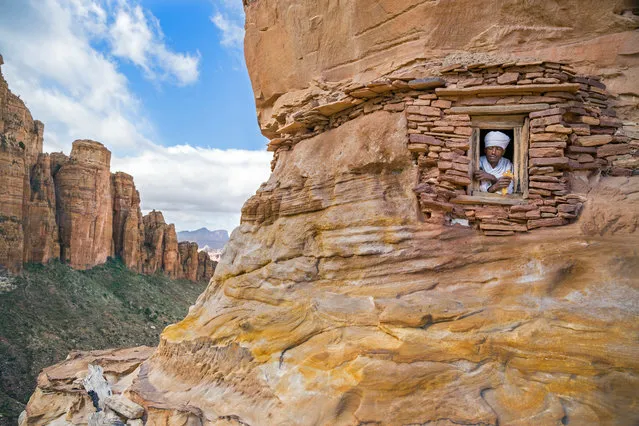
A priest is seen looking out of Abuna Yemata church’s only window. Priests cheerfully tell visitors that pregnant women, babies and old people attend Sunday services and no one has fallen off. (Photo by Ethiopia – The Living Churches of an Ancient Kingdom/The American University in Cairo Press/The Guardian)

A priest is seen looking out of Abuna Yemata church’s only window. Priests cheerfully tell visitors that pregnant women, babies and old people attend Sunday services and no one has fallen off. (Photo by Ethiopia – The Living Churches of an Ancient Kingdom/The American University in Cairo Press/The Guardian)
Details
15 Dec 2017 06:19:00
(L-R) Maria Silva, Milena Cortes, Maria Arteaga, Jackeline Bastidas and Gissy Abello pose for a picture at the Famproa dogs shelter where they work, in Los Teques, Venezuela, August 25, 2016. Venezuelans struggling to feed their families let alone their pets are dumping animals on the streets, in parks and at makeshift homes overrun with scrawny animals amid an economic crisis. An hour from Caracas in Los Teques, hundreds of dogs bark and run around the streets scavenging for food outside a makeshift shelter. People come by every few hours to hand over scrawny dogs which are fed by volunteers every day. Venezuela is undergoing a major economic and social crisis, with shortages of basic foods and medicines. Triple digit inflation is hitting everybody hard, including those who own pets. (Photo by Carlos Garcia Rawlins/Reuters)

(L-R) Maria Silva, Milena Cortes, Maria Arteaga, Jackeline Bastidas and Gissy Abello pose for a picture at the Famproa dogs shelter where they work, in Los Teques, Venezuela, August 25, 2016. Venezuelans struggling to feed their families let alone their pets are dumping animals on the streets, in parks and at makeshift homes overrun with scrawny animals amid an economic crisis. An hour from Caracas in Los Teques, hundreds of dogs bark and run around the streets scavenging for food outside a makeshift shelter. (Photo by Carlos Garcia Rawlins/Reuters)
Details
08 Sep 2016 10:01:00
A life-size interactive inflatable sculpture of Stonehenge called “Sacrilege 2012” by English contemporary artist Jeremy Deller on display as part of the “Inflation!” exhibition curated by Mobile M + on April 24, 2013 in Hong Kong. The inflatable artwork is one of six on display as part of the exhibition which is open from April 25, 2013 until June 9, 2013. (Photo by Jessica Hromas)

A life-size interactive inflatable sculpture of Stonehenge called “Sacrilege 2012” by English contemporary artist Jeremy Deller on display as part of the “Inflation!” exhibition curated by Mobile M + on April 24, 2013 in Hong Kong. The inflatable artwork is one of six on display as part of the exhibition which is open from April 25, 2013 until June 9, 2013. (Photo by Jessica Hromas)
Details
25 Apr 2013 11:33:00
Carlos Melendez prepares to feed his pet squirrel “Colita” in downtown San Salvador January 29, 2015. (Photo by Jose Cabezas/Reuters)

Carlos Melendez prepares to feed his pet squirrel “Colita” in downtown San Salvador January 29, 2015. (Photo by Jose Cabezas/Reuters)
Details
31 Jan 2015 13:35:00
Romanian military doctors and medical students sit on a bus behind steamy windows before the National Day parade in Bucharest, Romania, Thursday, December 1, 2016. (Photo by Vadim Ghirda/AP Photo)

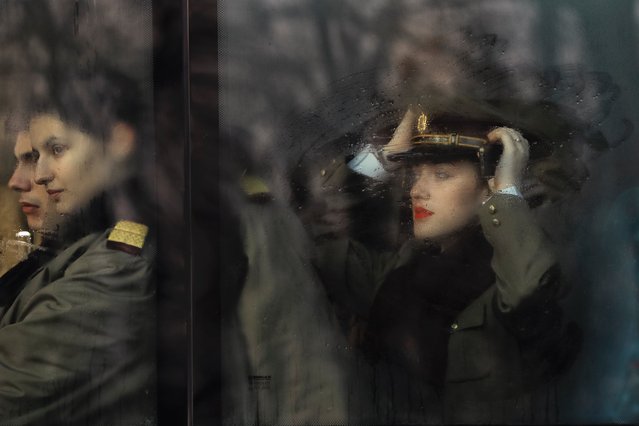
Romanian military doctors and medical students sit on a bus behind steamy windows before the National Day parade in Bucharest, Romania, Thursday, December 1, 2016. Military planes and helicopters flew over the Romanian capital Thursday as thousands turned out to celebrate the national day, marking the date when the country reunified with Transylvania in 1918. (Photo by Vadim Ghirda/AP Photo)
Details
02 Dec 2016 12:55:00
(L-R) Shiri Appleby and Kevin Zegers of “What Just Happened??! with Fred Savage” attend the Pizza Hut Lounge at 2019 Comic-Con International: San Diego on July 19, 2019 in San Diego, California. (Photo by Presley Ann/Getty Images for Pizza Hut)

(L-R) Shiri Appleby and Kevin Zegers of “What Just Happened??! with Fred Savage” attend the Pizza Hut Lounge at 2019 Comic-Con International: San Diego on July 19, 2019 in San Diego, California. (Photo by Presley Ann/Getty Images for Pizza Hut)
Details
28 Jul 2019 00:01:00
Professor Xie Yong works on an art installation of a beaver, which is made out of plastic and around 300,000 needles, in Shenyang, Liaoning province, July 23, 2013. The needles, according to Xie, represent the pain felt by animals when their fur is taken off to produce clothing. (Photo by Reuters/Stringer)

Professor Xie Yong works on an art installation of a beaver, which is made out of plastic and around 300,000 needles, in Shenyang, Liaoning province, July 23, 2013. The needles, according to Xie, represent the pain felt by animals when their fur is taken off to produce clothing. (Photo by Reuters/Stringer)
Details
27 Jul 2013 09:15:00