Loading...
Done
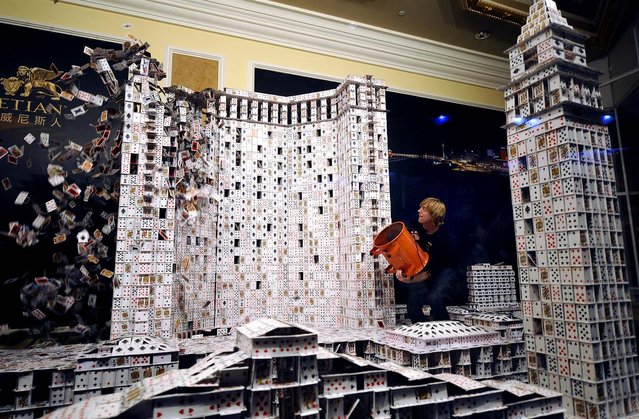
Cardstacker: Bryan Berg

Bryan Berg was introduced to card-stacking by his grandfather at the age of 8. He is a self-taught artist in all of the techniques he uses today. Berg's freestanding card structures are based on a grid-like arrangement, which Berg tested in a structural engineering lab to support 660 lbs per square foot―using no tape, no glue, no folding, and no tricks.
Details
05 Jun 2013 11:52:00
A man wearing a mask and dressed in a clown costume rides an electric tricycle while carrying a container in the shape of a rubber duck amid heavy smog in Beijing, China, December 29, 2015. (Photo by Jason Lee/Reuters)

A man wearing a mask and dressed in a clown costume rides an electric tricycle while carrying a container in the shape of a rubber duck amid heavy smog in Beijing, China, December 29, 2015. (Photo by Jason Lee/Reuters)
Details
12 Jan 2016 08:00:00
“Shanghai Tian Wai №26, 2014”. This series was an attempt to document an ever-changing city and the things it loses, as working-class neighbourhoods give way to ever-more modern urban development. (Photo by Liu Tao/The Guardian)

This 2014 series Shanghai Tian Wa saw Chinese photographer Liu Tao train his lens on two distinct districts in Shanghai. Here: “Shanghai Tian Wai №26, 2014”. (Photo by Liu Tao/The Guardian)
Details
25 May 2018 00:01:00
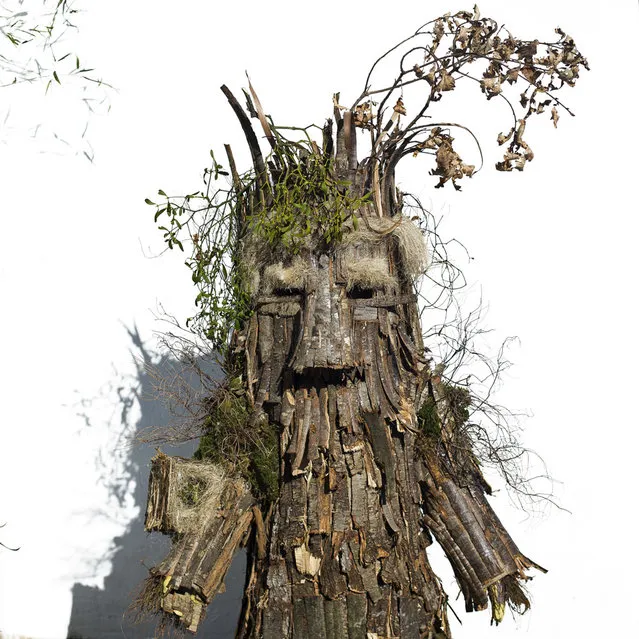
A man dressed as a  “Trapajon”, representing entities of nature, poses for a picture after taking part in the Vijanera Festival in Silio, northern Spain, Sunday, Jan. 6, 2013. The Vijanera masquerade, of pre-Roman origin, is the first carnival of the year in Europe symbolizing the triumph of good over evil and involving the participation of crowds of residents wearing different masks, animal skins and brightly colored clothing with its own complex function and symbolism and becoming the living example of the survival of archaic cults to nature. (Photo by Daniel Ochoa de Olza/AP Photo)

A man dressed as a “Trapajon”, representing entities of nature, poses for a picture after taking part in the Vijanera Festival in Silio, northern Spain, Sunday, Jan. 6, 2013. The Vijanera masquerade, of pre-Roman origin, is the first carnival of the year in Europe symbolizing the triumph of good over evil and involving the participation of crowds of residents wearing different masks, animal skins and brightly colored clothing with its own complex function and symbolism and becoming the living example of the survival of archaic cults to nature. (Photo by Daniel Ochoa de Olza/AP Photo)
Details
19 Jan 2013 13:01:00
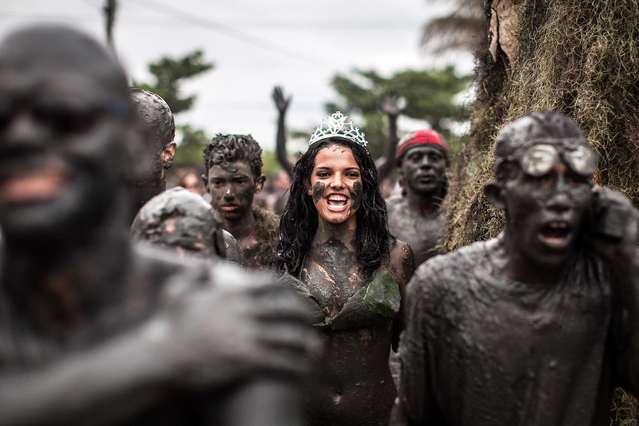
Revelers participate in the traditional Bloco da Lama (Mud block) carnival in Parati, Rio de Janeiro State, Brazil, on February 9, 2013. The event, which was begun by two men in a playful manner in 1986, has now become a traditional carnival in which participants disguised as primitives with rags, lianas or skulls and bones, dive in the mud. (Photo by Victor Moriyama/AFP Photo)

Revelers participate in the traditional Bloco da Lama (Mud block) carnival in Parati, Rio de Janeiro State, Brazil, on February 9, 2013. The event, which was begun by two men in a playful manner in 1986, has now become a traditional carnival in which participants disguised as primitives with rags, lianas or skulls and bones, dive in the mud. (Photo by Victor Moriyama/AFP Photo)
Details
12 Feb 2013 14:10:00
In this February 5, 2014 photo, Divaldo Aguiar, who plays the part of Pachencho, is carried in a mock coffin during the Burial of Pachencho celebration, through a cemetery in Santiago de Las Vegas, Cuba. Cuban villagers stage a mock funeral and burial of Pachencho, with a living man playing the part of Pachencho, in a boozy festival that has become an annual tradition in this small town near Havana, held each February 5 for the last 30 years. (Photo by Enric Marti/AP Photo)

In this February 5, 2014 photo, Divaldo Aguiar, who plays the part of Pachencho, is carried in a mock coffin during the Burial of Pachencho celebration, through a cemetery in Santiago de Las Vegas, Cuba. Cuban villagers stage a mock funeral and burial of Pachencho, with a living man playing the part of Pachencho, in a boozy festival that has become an annual tradition in this small town near Havana, held each February 5 for the last 30 years. (Photo by Enric Marti/AP Photo)
Details
10 Feb 2014 09:24:00
Revelers dance at a Jacarezinho samba school practice session ahead of Carnival celebrations on February 16, 2014 in Rio de Janeiro, Brazil. The Jacarezinho “favela” was previously controlled by drug traffickers and is now occupied by the city's Police Pacification Unit (UPP). Carnival officially begins February 28, but pre-Carnival celebrations are already underway. (Photo by Mario Tama/Getty Images)

Revelers dance at a Jacarezinho samba school practice session ahead of Carnival celebrations on February 16, 2014 in Rio de Janeiro, Brazil. The Jacarezinho “favela” was previously controlled by drug traffickers and is now occupied by the city's Police Pacification Unit (UPP). Carnival officially begins February 28, but pre-Carnival celebrations are already underway. (Photo by Mario Tama/Getty Images)
Details
19 Feb 2014 11:01:00


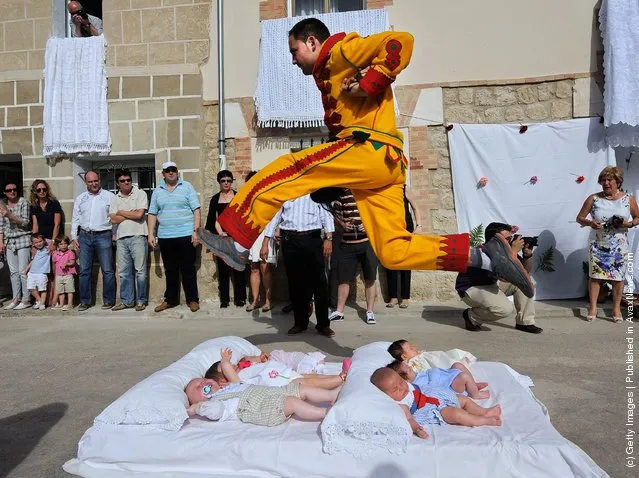
“Baby jumping (El Colacho) is a traditional Spanish practice dating back to 1620 that takes place annually to celebrate the Catholic feast of Corpus Christi in the village of Castrillo de Murcia near Burgos. During the act – known as El Salto del Colacho (the devil's jump) or simply El Colacho – men dressed as the Devil (known as the Colacho) jump over babies born during the previous twelve months of the year who lie on mattresses in the street. ... The festival has been rated as one of the most dangerous in the world”. – Wikipedia

Photo: A man representing the devil leaps over babies during the festival of El Colacho on June 26, 2011 in Castrillo de Murcia near Burgos, Spain. The festival, held on the first Sunday after Corpus Cristi, represents the devil taking away original sin from the newly born babies by leaping over them. (Photo by Denis Doyle/Getty Images)
Details
27 Jun 2011 09:20:00