Loading...
Done
Men stroll past roadside vendors as a painted truck makes its way through the busy street in Kabul, Afghanistan, November, 1961. (Photo by Henry S. Bradsher/AP Photo via The Atlantic)

Men stroll past roadside vendors as a painted truck makes its way through the busy street in Kabul, Afghanistan, November, 1961. (Photo by Henry S. Bradsher/AP Photo via The Atlantic)
Details
03 Jul 2013 11:04:00
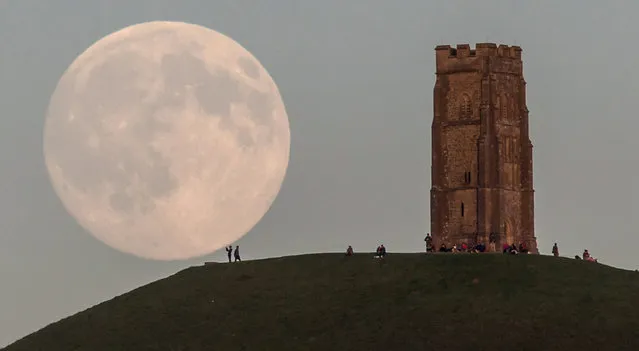
The moon rises over people gathered on Glastonbury Tor ahead of tomorrow's Blue Moon on July 30, 2015 in Somerset, England. The full moon appearing on July 31 will be what's called a Blue Moon, which refers to the second of two full moons appearing in the same calendar month. The last time this happened was in 2012 and there isn't due another until 2018. (Photo by Matt Cardy/Getty Images)

The moon rises over people gathered on Glastonbury Tor ahead of tomorrow's Blue Moon on July 30, 2015 in Somerset, England. The full moon appearing on July 31 will be what's called a Blue Moon, which refers to the second of two full moons appearing in the same calendar month. The last time this happened was in 2012 and there isn't due another until 2018. (Photo by Matt Cardy/Getty Images)
Details
02 Aug 2015 13:07:00
Health authority workers sanitise the rural community of Teocelo, Veracruz, Mexico on May 12, 2020 – in the hope of preventing the spread of COVID-19 infections. (Photo by Hector Adolfo Quintanar Perez/ZUMA Wire/Rex Features/Shutterstock)

Health authority workers sanitise the rural community of Teocelo, Veracruz, Mexico on May 12, 2020 – in the hope of preventing the spread of COVID-19 infections. (Photo by Hector Adolfo Quintanar Perez/ZUMA Wire/Rex Features/Shutterstock)
Details
14 May 2020 00:07:00
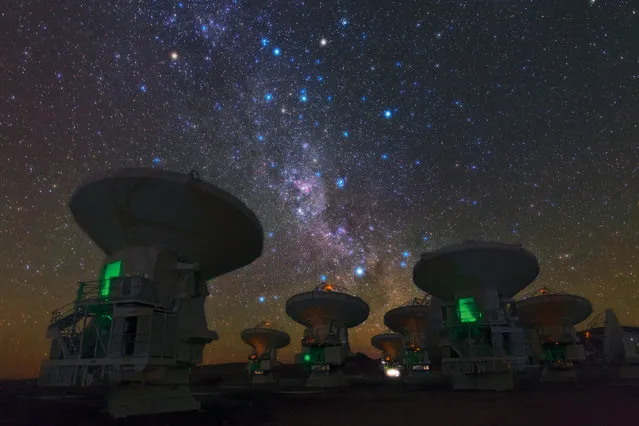
The antennas of the European Southern Observatory's Atacama Large Millimeter/Submillimeter Array, also known as ALMA, are set against the splendor of the Milky Way in this picture by Babak Tafreshi

The antennas of the European Southern Observatory's Atacama Large Millimeter/Submillimeter Array, also known as ALMA, are set against the splendor of the Milky Way in this picture by Babak Tafreshi. Construction of the full ALMA array is due to be completed in Chile's Atacama Desert in 2013, but the facility is already making scientific observations with a partial array of antennas. (Photo by ESO/B. Tafreshi/TWAN)
Details
03 Jun 2012 11:57:00
An alpaca chewing a leaf is pictured on November 18,  2014 in the zoo of  Frankfurt am Main, Germany. (Photo by Frank Rumpenhorst/AFP Photo/DPA)

An alpaca chewing a leaf is pictured on November 18, 2014 in the zoo of Frankfurt am Main, Germany. (Photo by Frank Rumpenhorst/AFP Photo/DPA)
Details
22 Nov 2014 14:07:00
Competitors in the Big Air challenge at the Proryv-2016 festival of extreme sports in Moscow, Russia on March 27, 2016. (Photo by Xinhua/Rex Features/Shutterstock)

Competitors in the Big Air challenge at the Proryv-2016 festival of extreme sports in Moscow, Russia on March 27, 2016. (Photo by Xinhua/Rex Features/Shutterstock)
Details
28 Mar 2016 11:15:00

Thomas jumps into the water from a spring board at a public swimming pool in Mengen, Germany, 28 August 2016. (Photo by Thomas Warnack/EPA)

Thomas jumps into the water from a spring board at a public swimming pool in Mengen, Germany, 28 August 2016. (Photo by Thomas Warnack/EPA)
Details
29 Aug 2016 07:45:00
On August 31, 2012, a long filament of solar material that had been hovering in the sun's atmosphere, the corona, erupted out into space at 4:36 p.m. EDT. The coronal mass ejection, or CME, traveled at over 900 miles per second. The CME did not travel directly toward Earth, but did connect with Earth's magnetic environment, or magnetosphere, causing aurora to appear on the night of Monday, September 3. (Photo by NASA/GSFC/SDO)

On August 31, 2012, a long filament of solar material that had been hovering in the sun's atmosphere, the corona, erupted out into space at 4:36 p.m. EDT. The coronal mass ejection, or CME, traveled at over 900 miles per second. The CME did not travel directly toward Earth, but did connect with Earth's magnetic environment, or magnetosphere, causing aurora to appear on the night of Monday, September 3. (Photo by NASA/GSFC/SDO via The Atlantic)

Details
14 Sep 2012 09:01:00