Loading...
Done
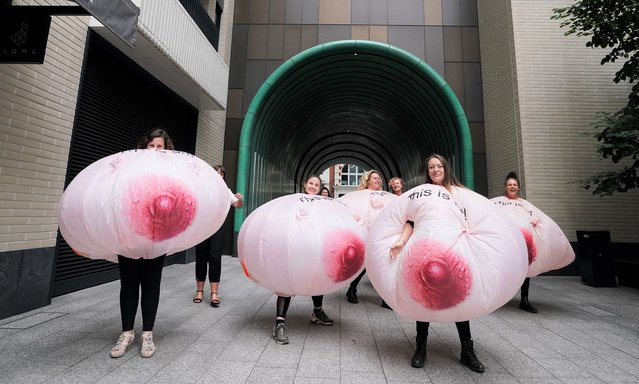
Protesters wearing inflatable breasts stand outside Facebook's headquarters in central London on Wednesday September 1, 2021, to complain about the social media giant's images algorithm. The aim of the event is for all medical tattoo artists and breast cancer survivors to be able to freely post images without the pictures being removed and the accounts blocked. (Photo by Ian West/PA Images via Getty Images)

Protesters wearing inflatable breasts stand outside Facebook's headquarters in central London on Wednesday September 1, 2021, to complain about the social media giant's images algorithm. The aim of the event is for all medical tattoo artists and breast cancer survivors to be able to freely post images without the pictures being removed and the accounts blocked. (Photo by Ian West/PA Images via Getty Images)
Details
03 Sep 2021 08:37:00
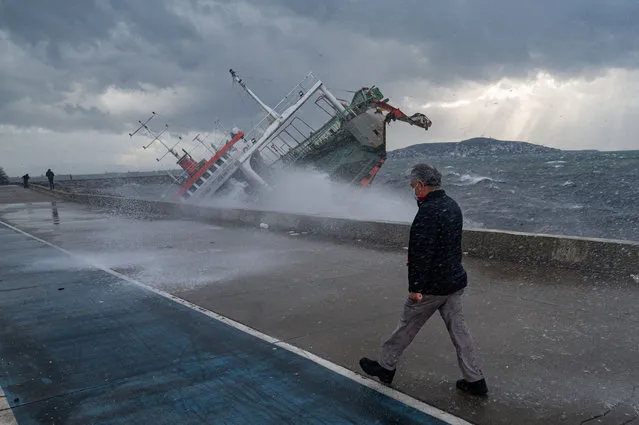
A man walks near a boat which has capsized due to strong winds in Istanbul on November 30, 2021. Strong winds continue to blow across Istanbul where the Bosphorus strait is temporarily closed to boat traffic. Four people were killed and dozens injured on Monday in Istanbul, which was hit by high winds. (Photo by Yasin Akgul/AFP Photo)

A man walks near a boat which has capsized due to strong winds in Istanbul on November 30, 2021. Strong winds continue to blow across Istanbul where the Bosphorus strait is temporarily closed to boat traffic. Four people were killed and dozens injured on Monday in Istanbul, which was hit by high winds. (Photo by Yasin Akgul/AFP Photo)
Details
25 Jul 2022 10:19:00
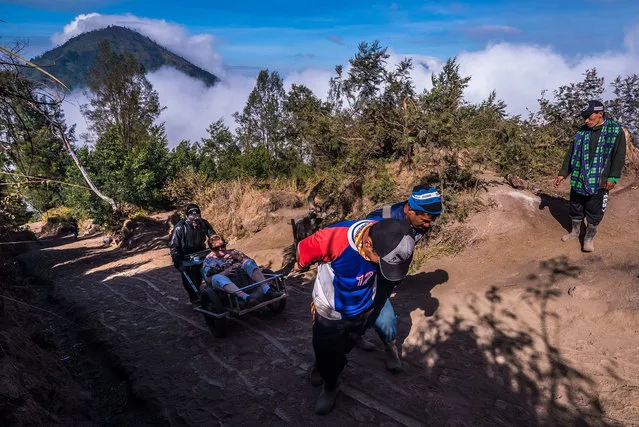
Miners pulling up lazy tourists to the rim of Kawah Ijen (Ijen Volcano), East Java, Indonesia on September 21, 2017. They will earn as much as they would bring down a load of sulfur. Nomadic Explorer, Cultural Lifestyle Photographer Claudio Sieber captured striking images of miners working at Ijen volcanic range in East Java, Indonesia. The sulphur miners risk their lives daily as they climb the active volcano carrying heavy loads, which they sell to sugar refineries. Shortly after midnight curious tourists are flocking in hundreds through the gate of Ijen's foothills to be right on time, driven by the images others took before them. Kawah Ijen is the one of the world's largest acidic volcanic crater lake; famous for its turquoise color as well as the unreal atmosphere it offers during darkness. A dusty path zigzags 3 kilometers up to the crater rim. This doesn't mean anything challenging; in particular, special sights have to be deserved anyway. The irritating smell of sulfur announces the near of the crater's existence. Arriving on the crater's rim the reward for the torture becomes visible. Blue fire darts its tongues through the fumes of sulfur dioxide. Somehow, the spectacle isn't as romantic as expected, since it is also the rough working space of approx. 150 sulfur miners who start their shift at 1 am. Lately, harvesting the abundance of devil's gold received international attention. This did obviously not really improve a miner's lifestyle; neither did it contribute to a better wage. (Photo by Claudio Sieber/Barcroft Images)

Miners pulling up lazy tourists to the rim of Kawah Ijen (Ijen Volcano), East Java, Indonesia on September 21, 2017. They will earn as much as they would bring down a load of sulfur. Nomadic Explorer, Cultural Lifestyle Photographer Claudio Sieber captured striking images of miners working at Ijen volcanic range in East Java, Indonesia. The sulphur miners risk their lives daily as they climb the active volcano carrying heavy loads, which they sell to sugar refineries. (Photo by Claudio Sieber/Barcroft Images)
Details
02 Oct 2017 08:31:00
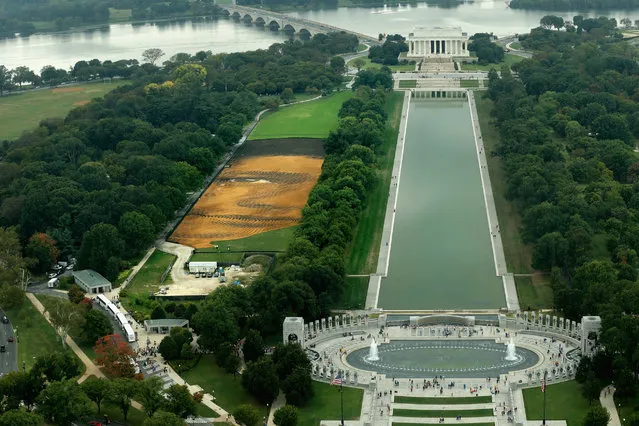
Cuban-American artist Jorge Rodriguez-Gerada's six-acre sand and soil “facescape” stretches across the JFK Hockey Field on the north side of the Reflecting Pool along the National Mall October 1, 2014 in Washington, DC. Titled “Out of Many, One” and composed of 2,500 tons of sand, 800 tons of top soil and eight miles of string, the piece is the artist's interpreative blending of 30 different men's faces. (Photo by Chip Somodevilla/Getty Images)

Cuban-American artist Jorge Rodriguez-Gerada's six-acre sand and soil “facescape” stretches across the JFK Hockey Field on the north side of the Reflecting Pool along the National Mall October 1, 2014 in Washington, DC. Titled “Out of Many, One” and composed of 2,500 tons of sand, 800 tons of top soil and eight miles of string, the piece is the artist's interpreative blending of 30 different men's faces. Rodriguez-Gereda used high-precision global positioning satellites to place 10,000 wood pegs as waypoints for the giant face. The piece will be open to the public beginning October 4 and will eventually be tilled back into the earth. (Photo by Chip Somodevilla/Getty Images)
Details
04 Oct 2014 11:39:00
Spectacular images offering insight into the lives of the Huaorani people in the Ecuadorian Amazon have been revealed showing how they use traditional methods to hunt monkeys for food. The stunning pictures were taken by conservation photographer Pete Oxford from Torquay, Devon in the Ecuadorian Amazon. “The Huaorani Indians are a forest people highly in tune with their environment. Many are now totally acculturated since the 1950s by missionaries”, said Pete. “Today they face radical change to their culture to the proximity of oil exploration within their territory and the Yasuni National Park and Biosphere Reserve, they are vastly changed. Some still live very traditionally and for this shoot, through my Huaorani friend, a direct relative of those photographed he wanted to depict them as close to their original culture as possible. They still largely hunt with blow pipes and spears eating a lot of monkeys and peccaries”. The Huaorani are also known as the Waorani, Waodani or the Waos and are native Amerindians. Their lands are located between the Curaray and Napo rivers and speak the Huaorani language. Pete says that during his visit he was welcomed into the group and hopes that ancient cultures can be saved. Here: The tribe were seen celebrating after a hunter returned to camp with a wild pig. (Photo by Pete Oxford/Mediadrumworld.com)

Spectacular images offering insight into the lives of the Huaorani people in the Ecuadorian Amazon have been revealed showing how they use traditional methods to hunt monkeys for food. The stunning pictures were taken by conservation photographer Pete Oxford from Torquay, Devon in the Ecuadorian Amazon. Here: The tribe were seen celebrating after a hunter returned to camp with a wild pig. (Photo by Pete Oxford/Mediadrumworld.com)
Details
20 Jan 2017 07:58:00
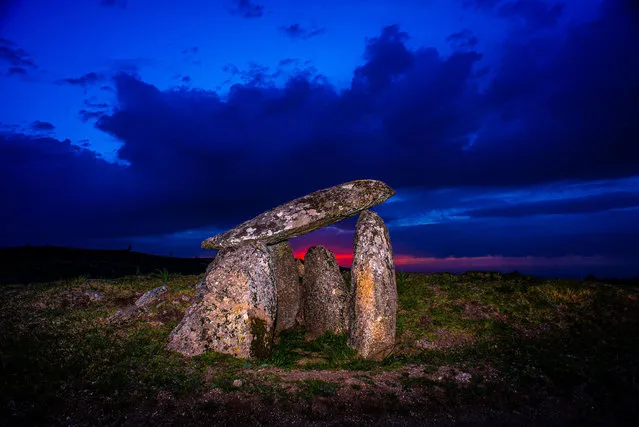
Serra da Aboboreira Megalithic Set (Meninas do Crasto) on September 24, 2023 in Baiao, Portugal. Since 1978 that Serra da Aboboreira (Aboboreira Mountains) has been the scene of a systematic study of its archeological values, among which are the monuments known as megalithic. These are funerary monuments designing the landscape. These dolmens were constructed with stones (lithos) of medium or large dimensions (mega), which were laid in a, more or less, vertical position. Over these, it was still placed a lid, also of stone. These containers were covered by an artificial mound of earth and stones (dolmen). (Photo by Octavio Passos/Getty Images)

Serra da Aboboreira Megalithic Set (Meninas do Crasto) on September 24, 2023 in Baiao, Portugal. Since 1978 that Serra da Aboboreira (Aboboreira Mountains) has been the scene of a systematic study of its archeological values, among which are the monuments known as megalithic. These are funerary monuments designing the landscape. These dolmens were constructed with stones (lithos) of medium or large dimensions (mega), which were laid in a, more or less, vertical position. Over these, it was still placed a lid, also of stone. These containers were covered by an artificial mound of earth and stones (dolmen). (Photo by Octavio Passos/Getty Images)
Details
28 Dec 2023 21:07:00
Miss Universe contestant Carolina Duran of Costa Rica, center, reacts to a TV network's drone as others prepare to pose from the deck of the yacht Happy Life prior to cruising to a beach resort in Batangas province Thursday, January 19, 2017 at the Philippine Navy headquarters in Manila, Philippines. Eighty-six candidates from around the world are vying for the title to succeed Pia Wurtzbach from the Philippines. The competition takes place on Jan. 30. They are, from left, Cherell Williamson of Bahamas, Rebecca Rath of Belize, Hildur Maria of Iceland, and Chanelle de Lau of Curacao. (Photo by Bullit Marquez/AP Photo)

Miss Universe contestant Carolina Duran of Costa Rica, center, reacts to a TV network's drone as others prepare to pose from the deck of the yacht Happy Life prior to cruising to a beach resort in Batangas province Thursday, January 19, 2017 at the Philippine Navy headquarters in Manila, Philippines. Eighty-six candidates from around the world are vying for the title to succeed Pia Wurtzbach from the Philippines. The competition takes place on Jan. 30. They are, from left, Cherell Williamson of Bahamas, Rebecca Rath of Belize, Hildur Maria of Iceland, and Chanelle de Lau of Curacao. (Photo by Bullit Marquez/AP Photo)
Details
20 Jan 2017 07:53:00
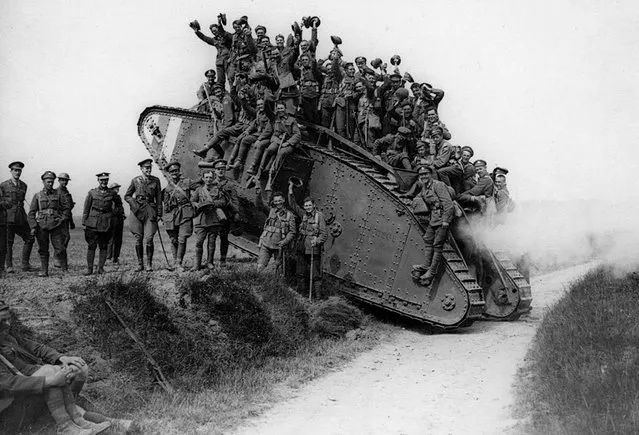
These black-and-white photos are taken from the new book “Armoured Warfare in the First World War 1916 – 1918” by Anthony Tucker-Jones and published by Pen & Sword Military. “Interestingly the British, French and Germans took completely different approaches with varying results”. The British military produced “Little Willie” in Autumn 1915 weighing 18 tonnes, which had a crew of two plus four gunners. “Inspired by a tracked artillery tractor “Little Willie” was referred to as a water tank – hence the name tank – to ensure secrecy”, said Anthony. “This led to the strange looking Mark I with its peculiar rhomboid shape, designed to cross trenches with guns in sponsons on either side. The Germans saw the tank as unchivalrous and were slow to grasp its utility. They favoured the Stormtrooper (specialist soldiers used to infiltrate enemy trenches) and artillery, not the tank”, said Anthony. “However, they didn’t hesitate to make use of captured British tanks. Although the tank helped secure victory and German soldiers dubbed it “Germany’s Downfall” the country was ultimately brought to its knees by the Allies blockade”. Here: British troops hitch a ride on a Mark IV after the massed tank fleet spearheading attack at Cambrai on November 20, 1917. (Photo by Anthony Tucker-Jones/Mediadrumworld.com)

These black-and-white photos are taken from the new book “Armoured Warfare in the First World War 1916 – 1918” by Anthony Tucker-Jones and published by Pen & Sword Military. Here: British troops hitch a ride on a Mark IV after the massed tank fleet spearheading attack at Cambrai on November 20, 1917. (Photo by Anthony Tucker-Jones/Mediadrumworld.com)
Details
23 Feb 2017 00:02:00