Loading...
Done
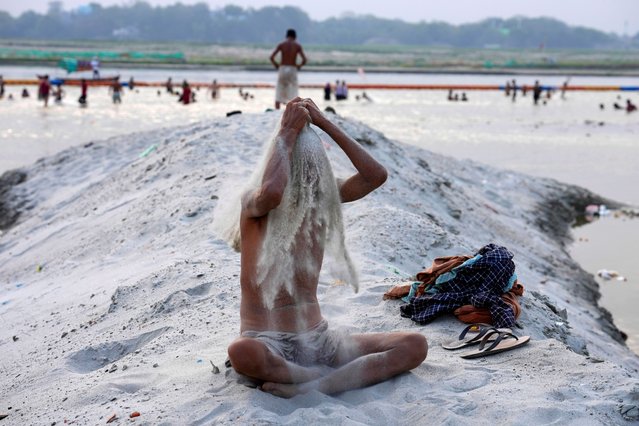
A Hindu devotee takes sand bath at Sangam, the confluence of the rivers Ganges and Yamuna, in Prayagraj, in the northern Indian state of Uttar Pradesh, Monday, June 5, 2023. Prayagraj in the northern Uttar Pradesh state is an important Hindu pilgrimage center. (Photo by Rajesh Kumar Singh/AP Photo)

A Hindu devotee takes sand bath at Sangam, the confluence of the rivers Ganges and Yamuna, in Prayagraj, in the northern Indian state of Uttar Pradesh, Monday, June 5, 2023. Prayagraj in the northern Uttar Pradesh state is an important Hindu pilgrimage center. (Photo by Rajesh Kumar Singh/AP Photo)
Details
13 Jun 2023 02:43:00
Medical workers walk by a police robot at the Wuhan Tianhe International Airport after travel restrictions to leave Wuhan, the capital of Hubei province and China's epicentre of the novel coronavirus disease (COVID-19) outbreak, were lifted, April 8, 2020. (Photo by Aly Song/Reuters)

Medical workers walk by a police robot at the Wuhan Tianhe International Airport after travel restrictions to leave Wuhan, the capital of Hubei province and China's epicentre of the novel coronavirus disease (COVID-19) outbreak, were lifted, April 8, 2020. (Photo by Aly Song/Reuters)
Details
12 Apr 2020 00:01:00
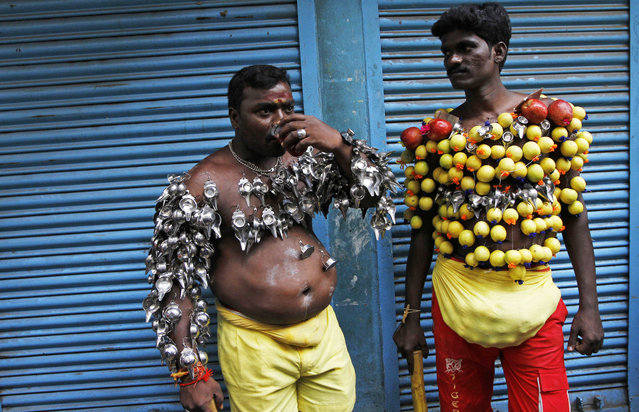
Hindu devotees, their bodies pierced with lemon and paladai, or bowl with a spout mainly used to feed milk to infants, wait to participate in a procession to mark Shivratri, or the night of Shiva, in Chennai, India, Wednesday, February 18, 2015. (Photo by Arun Sankar K./AP Photo)

Hindu devotees, their bodies pierced with lemon and paladai, or bowl with a spout mainly used to feed milk to infants, wait to participate in a procession to mark Shivratri, or the night of Shiva, in Chennai, India, Wednesday, February 18, 2015. Such processions are held as an offering and show of devotion by devotees on the day dedicated to the worship of Lord Shiva, the Hindu god of destruction. (Photo by Arun Sankar K./AP Photo)
Details
21 Feb 2015 11:41:00
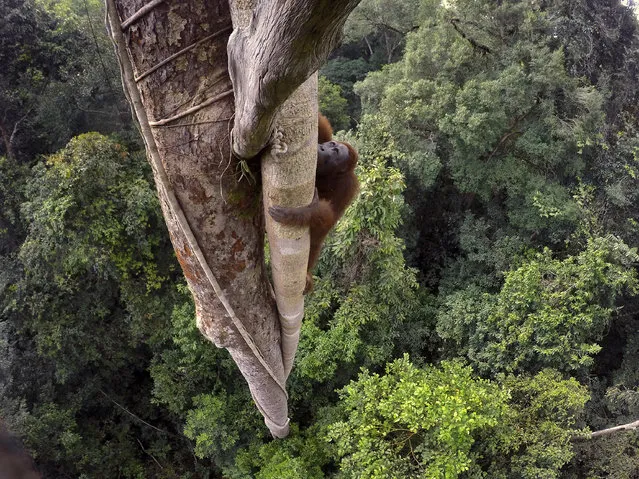
“Tough Times for Orangutans”. Nature, first prize stories. Tim Laman, USA. Location: West Kalimantan, Indonesia. A Bornean orangutan climbs over 30 meters up a tree in the rain forest of Gunung Palung National Park, West Kalimantan, Indonesia, August 12, 2015. The lives of wild orangutans are brought to light. Threats to these orangutans from fires, the illegal animal trade and loss of habitat due to deforestation have resulted in many orphan orangutans ending up at rehabilitation centers. (Photo by Tim Laman/World Press Photo Contest)

“Tough Times for Orangutans”. Nature, first prize stories. Tim Laman, USA. Location: West Kalimantan, Indonesia. A Bornean orangutan climbs over 30 meters up a tree in the rain forest of Gunung Palung National Park, West Kalimantan, Indonesia, August 12, 2015. The lives of wild orangutans are brought to light. Threats to these orangutans from fires, the illegal animal trade and loss of habitat due to deforestation have resulted in many orphan orangutans ending up at rehabilitation centers. (Photo by Tim Laman/World Press Photo Contest)
Details
19 Feb 2016 13:06:00
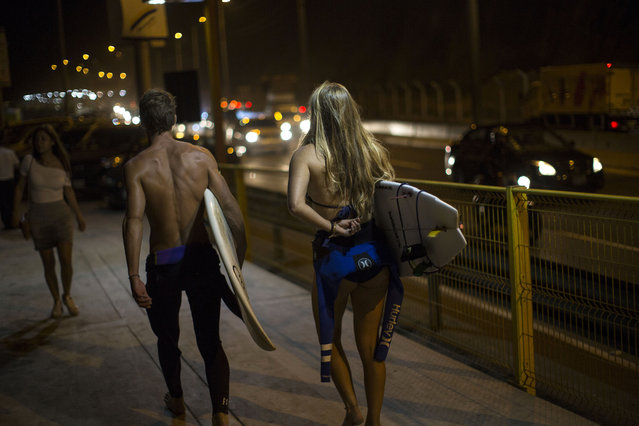
In this Feb. 17, 2017 photo, surfers walk to La Pampilla beach in Lima, Peru. Night surfing apparently came about in Lima because of a dispute with the capital municipality that in 2015 increased the width of a road that runs along the coast. The surfers protested the construction for months by camping on the asphalted beach area, but in the end the municipality prevailed, with support from the police. At the end of 2016, perhaps to win over the surfers, Lima's mayor set up beach lights that allows for night surfing. (Photo by Rodrigo Abd/AP Photo)

In this Feb. 17, 2017 photo, surfers walk to La Pampilla beach in Lima, Peru. Night surfing apparently came about in Lima because of a dispute with the capital municipality that in 2015 increased the width of a road that runs along the coast. The surfers protested the construction for months by camping on the asphalted beach area, but in the end the municipality prevailed, with support from the police. At the end of 2016, perhaps to win over the surfers, Lima's mayor set up beach lights that allows for night surfing. (Photo by Rodrigo Abd/AP Photo)
Details
04 May 2017 09:23:00
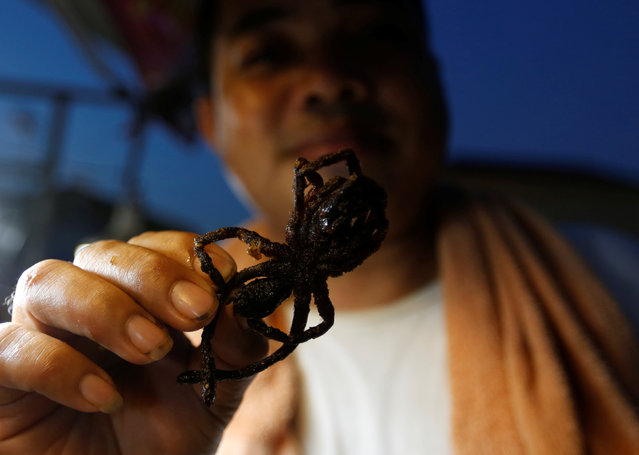
A vendor holds a fried spider along a street in Phnom Penh, Cambodia, April 10, 2017. (Photo by Samrang Pring/Reuters)

A vendor holds a fried spider along a street in Phnom Penh, Cambodia, April 10, 2017. (Photo by Samrang Pring/Reuters)
Details
29 May 2017 06:41:00
The crowd watches as stunt pilots Melissa Pemberton, Jurgis Kairys and Skip Stewart of The Immortals fly past pyrotechnics as they perform at The Australian International Airshow on March 1, 2015 in Avalon, Australia. (Photo by Scott E. Barbour/Getty Images)

The crowd watches as stunt pilots Melissa Pemberton, Jurgis Kairys and Skip Stewart of The Immortals fly past pyrotechnics as they perform at The Australian International Airshow on March 1, 2015 in Avalon, Australia. (Photo by Scott E. Barbour/Getty Images)
Details
11 May 2015 12:05:00
Galapagos – Rocking the Cradle: Four major ocean currents converge along the Galapagos archipelago, creating the conditions for an extraordinary diversity of animal life, April 25, 2016. The islands are home to at least 7,000 flora and fauna species, of which 97 percent of the reptiles, 80 percent of the land birds, 50 percent of the insects and 30 percent of the plants are endemic. The local ecosystem is highly sensitive to the changes in temperature, rainfall and ocean currents that characterize the climatic events known as El Niño and La Niña. These changes cause marked fluctuations in weather and food availability. Many scientists expect the frequency of El Niño and La Niña to increase as a result of climate change, making the Galapagos a possible early-warning location for its effects. (Photo by Thomas P. Peschak for National Geographic/World Press Photo)

Galapagos – Rocking the Cradle: Four major ocean currents converge along the Galapagos archipelago, creating the conditions for an extraordinary diversity of animal life, April 25, 2016. The islands are home to at least 7,000 flora and fauna species, of which 97 percent of the reptiles, 80 percent of the land birds, 50 percent of the insects and 30 percent of the plants are endemic. (Photo by Thomas P. Peschak for National Geographic/World Press Photo)
Details
16 Apr 2018 00:01:00