Loading...
Done


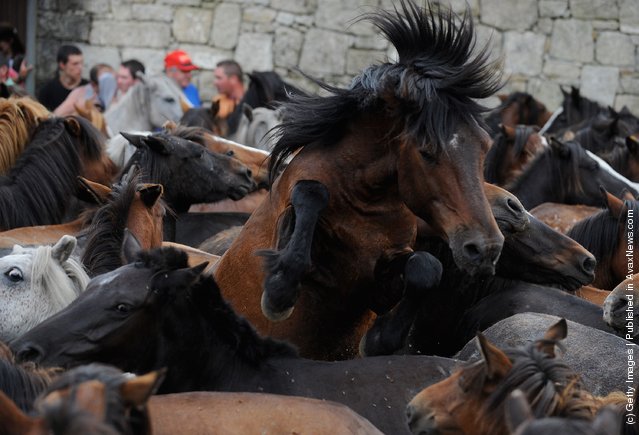
“Rapa das Bestas is the name of an operation that involves cutting the manes of the horses that are performed in the curros (enclosed which retain the horses) held in various locations in Galicia (Spain).

The best known is the Rapa das Bestas of Sabucedo, in the city hall of A Estrada, which lasts three days: the First Saturday, Sunday and Monday in July. In fact, the name given to the celebration (Rapa das Bestas of Sabucedo), while in most places speaking about curros, including curros de Valga, etc”. – Wikipedia

Photo: A wild horse leaps up during the Rapa das Bestas (shearing of the beasts) festival on July 2, 2011 in Sabucedo, Spain. Hundreds of wild horses are rounded up from the mountains and trimmed and marked in the corral. (Photo by Denis Doyle/Getty Images)
Details
03 Jul 2011 12:30:00
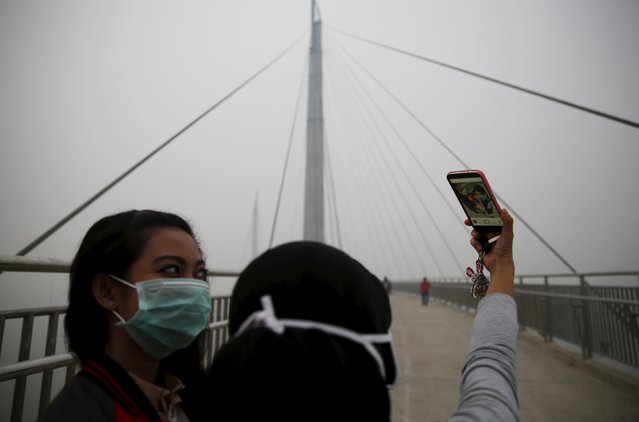
Girls take a selfie at the haze shrouded Batanghari River bridge in Jambi, Indonesia Sumatra island, September 14, 2015. Indonesian islands are blanketed in the so-called “haze”, caused by slash-and-burn clearances on the islands of Sumatra and Borneo, which makes thousands sick, delays flights and pushes air quality to unhealthy levels in neighboring Singapore and Malaysia. (Photo by Reuters/Beawiharta)

Girls take a selfie at the haze shrouded Batanghari River bridge in Jambi, Indonesia Sumatra island, September 14, 2015. Indonesian islands are blanketed in the so-called “haze”, caused by slash-and-burn clearances on the islands of Sumatra and Borneo, which makes thousands sick, delays flights and pushes air quality to unhealthy levels in neighboring Singapore and Malaysia. (Photo by Reuters/Beawiharta)
Details
15 Sep 2015 14:32:00
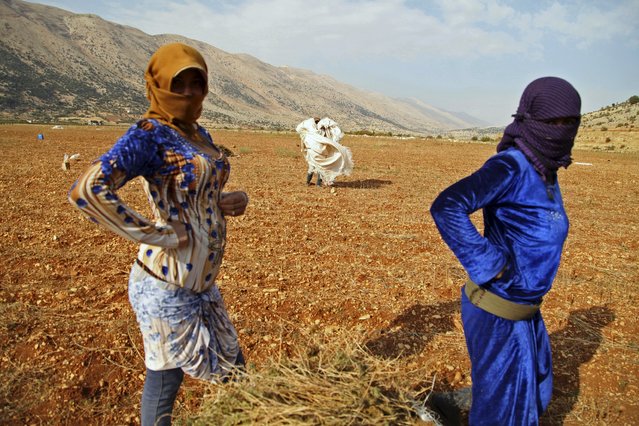
Aisha, 15, (L) (who asked to withhold her last name), a Syrian refugee from Raqqa, waits with a fellow refugee while harvesting cannabis in the Bekaa valley, Lebanon October 19, 2015. Syrian refugees work to harvest and process spiky-leafed cannabis plants in neighbouring Lebanon’s Bekaa Valley. (Photo by Alia Haju/Reuters)

Aisha, 15, (L) (who asked to withhold her last name), a Syrian refugee from Raqqa, waits with a fellow refugee while harvesting cannabis in the Bekaa valley, Lebanon October 19, 2015. Syrian refugees work to harvest and process spiky-leafed cannabis plants in neighbouring Lebanon’s Bekaa Valley. Often farmers of cotton and wheat back home in Raqqa province – now the de facto capital of Islamic State – the conflict in Syria drove them to seek safety in a region where Syrian migrant workers used to spend a few months a year before returning home. (Photo by Alia Haju/Reuters)
Details
24 Dec 2015 08:03:00
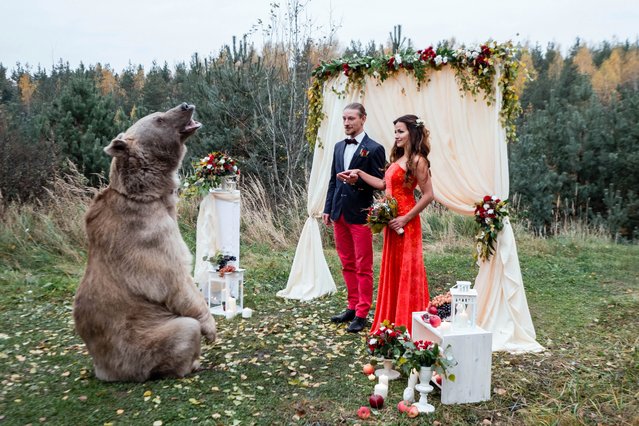
Denis and Nelya, both 30, from Moscow, Russia invited brown bear Stepan along to their very special ceremony. As well as witnessing the couple exchange vows, the bear also played the role of registrar at one point. Denis said: “We both knew Stepan is a very kind bear but still it is a huge, unpredictable animal so we were a bit scared, but still happy to be able to make our dream come true. It was a fantastic experience to have this photoshoot with Stepan”. (Photo by Olga Barantseva/Caters News)

Denis and Nelya, both 30, from Moscow, Russia invited brown bear Stepan along to their very special ceremony. As well as witnessing the couple exchange vows, the bear also played the role of registrar at one point. Denis said: “We both knew Stepan is a very kind bear but still it is a huge, unpredictable animal so we were a bit scared, but still happy to be able to make our dream come true. It was a fantastic experience to have this photoshoot with Stepan”. (Photo by Olga Barantseva/Caters News)
Details
01 Nov 2016 12:14:00
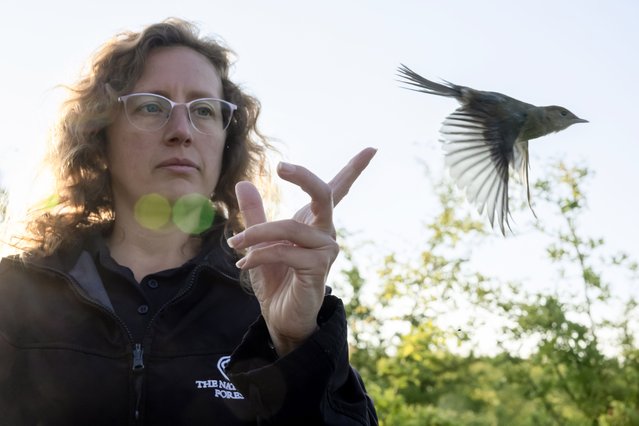
A juvenile blackcap is recorded in the soft light of morning at Minorca, UK, a former open-cast mine near Moira in the National Forest on June 18, 2025. Dr Heather Gilbert, research and evidence manager, checks mist nets among wildflowers and young trees as part of long-term monitoring that shows bird numbers have increased by 48 per cent over 30 years. (Photo by Rod Kirkpatrick/RKP Photography)

A juvenile blackcap is recorded in the soft light of morning at Minorca, UK, a former open-cast mine near Moira in the National Forest on June 18, 2025. Dr Heather Gilbert, research and evidence manager, checks mist nets among wildflowers and young trees as part of long-term monitoring that shows bird numbers have increased by 48 per cent over 30 years. (Photo by Rod Kirkpatrick/RKP Photography)
Details
29 Jun 2025 03:58:00
A model presents a creation during a catwalk presentation for the Paul Costelloe Spring/Summer 2024 collection, at London Fashion Week in London, on September 13, 2024. (Photo by Henry Nicholls/AFP Photo)

A model presents a creation during a catwalk presentation for the Paul Costelloe Spring/Summer 2024 collection, at London Fashion Week in London, on September 13, 2024. (Photo by Henry Nicholls/AFP Photo)
Details
13 Jan 2026 11:54:00
Black women in Brazil sit at the intersection of racism and misogyny, and have in recent years been at the forefront of a movement that challenges issues ranging from sexual and domestic violence to police brutality and stereotyping. Kolor Collective considers itself to be a part of this movement and questions expectations imposed on black women with satirical and subversive images, as seen here. (Photo by Kolor Art Collective/The Guardian)

Photographer Pol Kurucz’s vivid collection of photos explores issues faced by black Brazilian women, from political misrepresentation to unrealistic beauty standards. Kolor Collective is a Rio de Janeiro-based creative group that challenges the struggle faced by black women in Brazil through theatrical and provocative art. It was founded in 2015 by Franco-Hungarian photographer Pol Kurucz, who often touches on his own experiences of discrimination to call out sensitive social problems. (Photo by Kolor Art Collective/The Guardian)
Details
28 Dec 2016 07:24:00
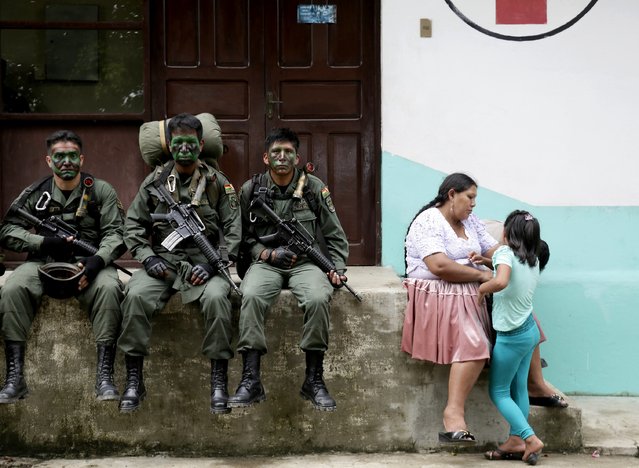
Members of the Bolivian combined forces of army and police rest at their headquarters at the end of their ceremony for the task of fighting against drugs and the eradication of coca leaves in Chimore, east of La Paz, December 10, 2014. The government of Bolivia's President Evo Morales eradicated some 11,000 hectares of illegal coca plants and confiscated nearly 192 tons of drugs in 2014, according to the local media. (Photo by David Mercado/Reuters)

Members of the Bolivian combined forces of army and police rest at their headquarters at the end of their ceremony for the task of fighting against drugs and the eradication of coca leaves in Chimore, east of La Paz, December 10, 2014. The government of Bolivia's President Evo Morales eradicated some 11,000 hectares of illegal coca plants and confiscated nearly 192 tons of drugs in 2014, according to the local media. (Photo by David Mercado/Reuters)
Details
12 Dec 2014 13:10:00