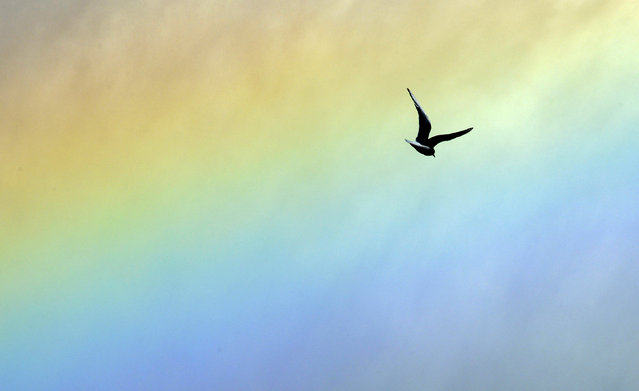
A seagull flies through a rainbow near the Savannah River and the open spillway at Thurmond Dam in Clarks Hill, SC, Monday, January 4, 2016. (Photo by Michael Holahan/Augusta Chronicle via AP Photo)
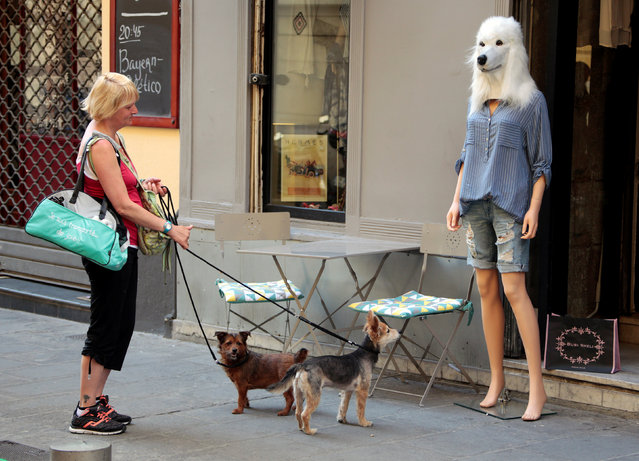
A woman and her dogs stop and look at a store mannequin wearing a dog's head mask outside a fashion shop in Nice, France, May 3, 2016. (Photo by Eric Gaillard/Reuters)
A passenger (L) gets inside a decorated matatu as other passengers wait for it to fill at night in the streets of Nairobi, Kenya, 24 March 2018. The Matatu culture is very big in Kenya, the minibuses are decorated with colorful graffiti inside and outside and most of them are equipped with TV screens, high-speed internet, and power sockets. (Photo by Daniel Irungu/EPA/EFE)
A girl walks along former railway tracks in the so- called “Tunnel of Love”, surrounded by arches of intertwined trees, near the Ukrainian village of Klevan, Rivno region, on August 6, 2018. The tunnel of about five kilometres in length is a botanical phenomenon, which became a cult place for tourists and couples in love. The tourist legend says that wishes of couples in love will come true, if the couple passes through the tunnel. (Photo by Sergei Supinsky/AFP Photo)
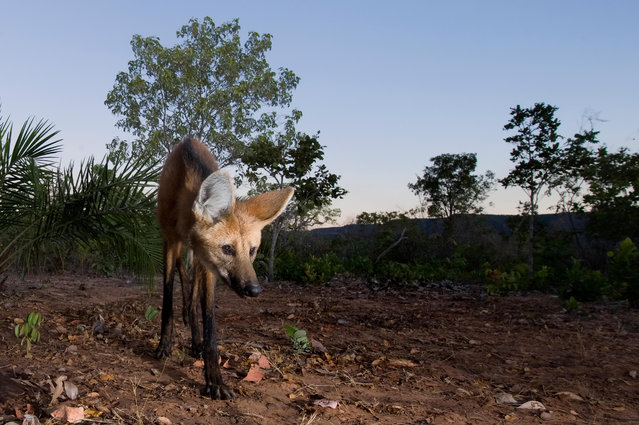
Global wildlife populations will decline by 67% by 2020 unless urgent action is taken to reduce human impact on species and ecosystems, warns the biennial Living Planet Index report from WWF (World Wide Fund for Nature) and ZSL (Zoological Society of London). From elephants to eels, here are some of the wildlife populations most affected by human activity. Here: The maned wolf is among the large mammals in the Brazilian Cerrado that are threatened by the increasing conversion of grasslands into farmland for grazing and growing crops. (Photo by Ben Cranke/Nature Picture Library/Alamy Stock Photo)
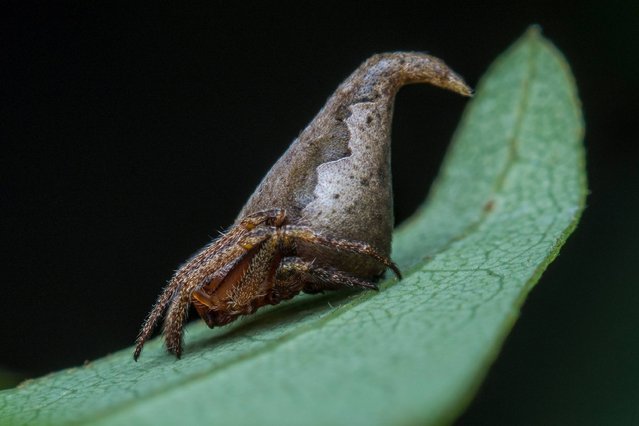
In this handout photograph received from Sumukha J.N on December 15, 2016, the newly-discovered spider Eriovixia Gryffindori sits on a leaf in the Kans in India's Western Ghats. (Photo by Sumukha J.N./AFP Photo)
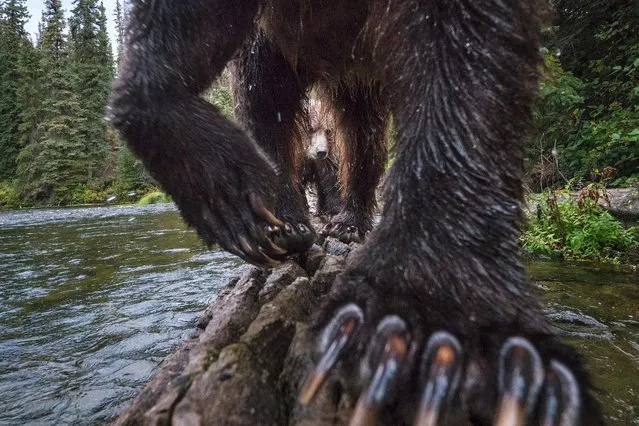
The fourth annual BigPicture Natural World Photography Competition aims to celebrate the diversity of life on Earth, and encourages people to protect and conserve it. Here: “The Salmon Catchers”. Terrestrial Wildlife. To capture this view of a mother grizzly bear and her cub, photographer Peter Mather set up a camera trap on a log that he knew the bears tended to traverse while fishing for salmon, in the Yukon River watershed in Canada. (Photo by Peter Mather/BigPicture Natural World Photography Competition 2017)