Loading...
Done
A couple of monkeys look from inside their cage at a rescue and rehabilitation center in Santiago, Chile, Saturday, November 22, 2014. (Photo by Luis Hidalgo/AP Photo)

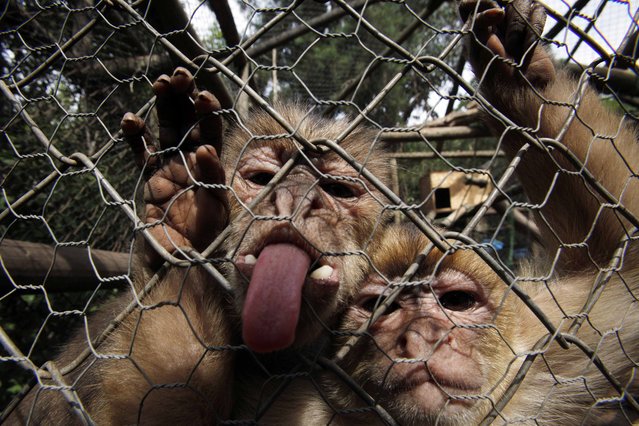
A couple of monkeys look from inside their cage at a rescue and rehabilitation center in Santiago, Chile, Saturday, November 22, 2014. Elba Munoz who runs the center, says that one of the goals of the Center for the Rescue and Rehabilitation of Primates is to stop the trafficking of the animals. (Photo by Luis Hidalgo/AP Photo)
Details
29 Nov 2014 13:16:00
“Thunderstruck”. Summer stom. A super cell formed off the coast of New Zealand, intensified and swept across Christchurch and North Canterbury, February 23, 2014. Photo location: Christchurch, New Zealand. (Photo and caption by David Hardy/National Geographic Photo Contest)

“Thunderstruck”. Summer stom. A super cell formed off the coast of New Zealand, intensified and swept across Christchurch and North Canterbury, February 23, 2014. Photo location: Christchurch, New Zealand. (Photo and caption by David Hardy/National Geographic Photo Contest)
Details
15 Apr 2014 11:46:00
What the World Eats By Peter Menzel And Faith D'Aluisio Part 2

A stunning photographic collection featuring portraits of people from 30 countries and the food they eat in one day. In this fascinating study of people and their diets, 80 profiles are organized by the total number of calories each person puts away in a day. Featuring a Japanese sumo wrestler, a Massai herdswoman, world-renowned Spanish chef Ferran Adria, an American competitive eater, and more, these compulsively readable personal stories also include demographic particulars, including age, activity level, height, and weight. Essays from Harvard primatologist Richard Wrangham, journalist Michael Pollan, and others discuss the implications of our modern diets for our health and for the planet. This compelling blend of photography and investigative reportage expands our understanding of the complex relationships among individuals, culture, and food.
Details
02 May 2014 09:20:00
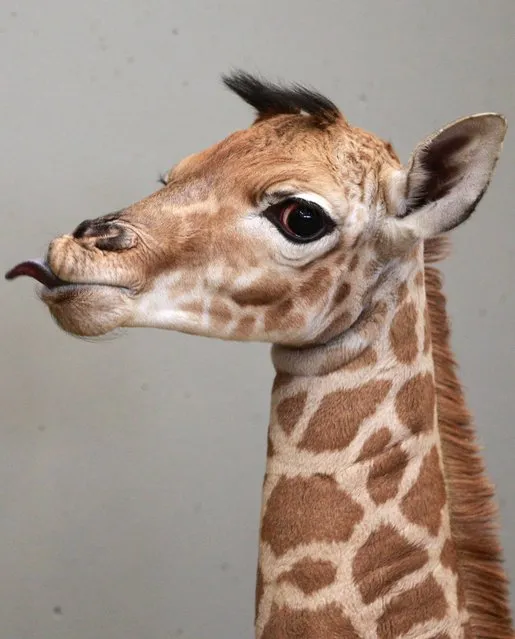
A newborn baby giraffe shows its tongue at the Planckendael zoo in Mechelen, 25 kilometers North of Brussels, Tuesday, February 18, 2014. The calf was born on Valentines day, February 14, and has a heart shaped spot on the hip. (Photo by Yves Logghe/AP Photo)

A newborn baby giraffe shows its tongue at the Planckendael zoo in Mechelen, 25 kilometers North of Brussels, Tuesday, February 18, 2014. The calf was born on Valentines day, February 14, and has a heart shaped spot on the hip. (Photo by Yves Logghe/AP Photo)
Details
22 Feb 2014 13:36:00
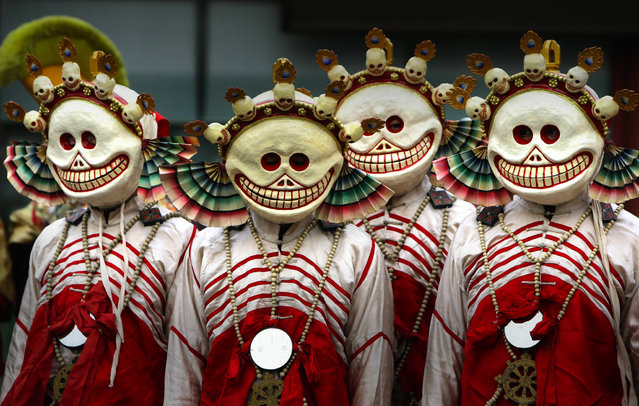
Monks dressed as Tibetan Buddhism characters attend a religious ceremony, known as “Da Gui” or beating ghost, to celebrate the upcoming Tibetan New Year which starts on March 1 at Yonghegong Lama Temple, in Beijing February 28, 2014. This Tibetan ceremony is held annually at the end of the first lunar month with mask dancing to expel ghosts, according to a press release. (Photo by Jason Lee/Reuters)

Monks dressed as Tibetan Buddhism characters attend a religious ceremony, known as “Da Gui” or beating ghost, to celebrate the upcoming Tibetan New Year which starts on March 1 at Yonghegong Lama Temple, in Beijing February 28, 2014. This Tibetan ceremony is held annually at the end of the first lunar month with mask dancing to expel ghosts, according to a press release. (Photo by Jason Lee/Reuters)
Details
01 Mar 2014 13:07:00
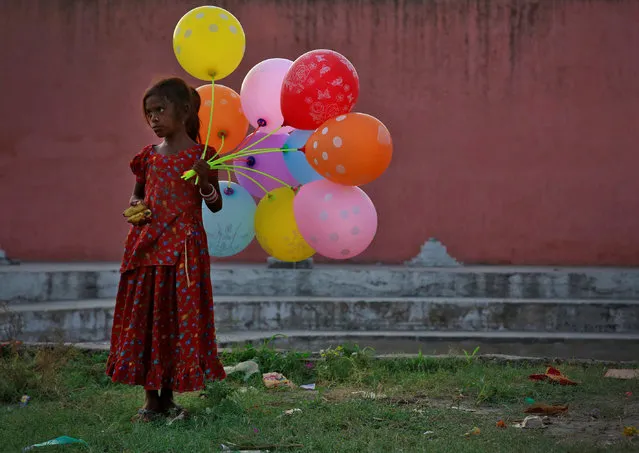
A young girl sells balloons by the Yamuna River as devotees carrying idols of the Hindu god Ganesh, the deity of prosperity, immerse the idol on the last day of the ten-day-long Ganesh Chaturthi festival in Delhi, India, September 15, 2016. (Photo by Cathal McNaughton/Reuters)

A young girl sells balloons by the Yamuna River as devotees carrying idols of the Hindu god Ganesh, the deity of prosperity, immerse the idol on the last day of the ten-day-long Ganesh Chaturthi festival in Delhi, India, September 15, 2016. (Photo by Cathal McNaughton/Reuters)
Details
16 Sep 2016 10:49:00
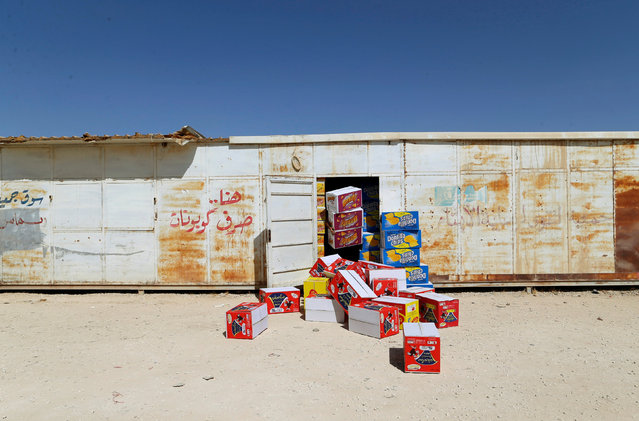
A Syrian refugee man (obscured) moves boxes of goods at his shop in Zaatari refugee camp near the border with Syria, in Mafraq, Jordan October 15, 2016. (Photo by Ammar Awad/Reuters)

A Syrian refugee man (obscured) moves boxes of goods at his shop in Zaatari refugee camp near the border with Syria, in Mafraq, Jordan October 15, 2016. (Photo by Ammar Awad/Reuters)
Details
23 Nov 2016 11:54:00
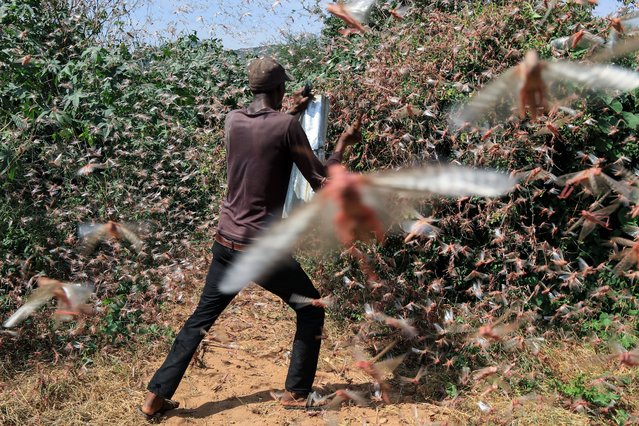
A man uses iron sheet to make noises, as a way of trying to disperse desert locusts that had invaded their farms during the second wave invasion in Kakongo village, in Nuu-Mwingi East, in Kitui, Kenya, 06 February 2021. The second wave invasion of the desert locusts in the country comes at a time where most famers are expecting to harvest their farm produce in the country. According to the United Nations Food and Agriculture Organization (FAO), on 04 February, warned numerous immature desert locust swarms persist in southern Ethiopia and Kenya. Some of the swarms are in community areas and therefore cannot be treated. In Kenya, immature swarms continue to spread westwards across northern and central counties where there are currently about 20 small swarms present, mostly about 50 hectares in size, it said. (Photo by Daniel Irungu/EPA/EFE)

A man uses iron sheet to make noises, as a way of trying to disperse desert locusts that had invaded their farms during the second wave invasion in Kakongo village, in Nuu-Mwingi East, in Kitui, Kenya, 06 February 2021. The second wave invasion of the desert locusts in the country comes at a time where most famers are expecting to harvest their farm produce in the country. (Photo by Daniel Irungu/EPA/EFE)
Details
25 Feb 2021 08:17:00