Loading...
Done


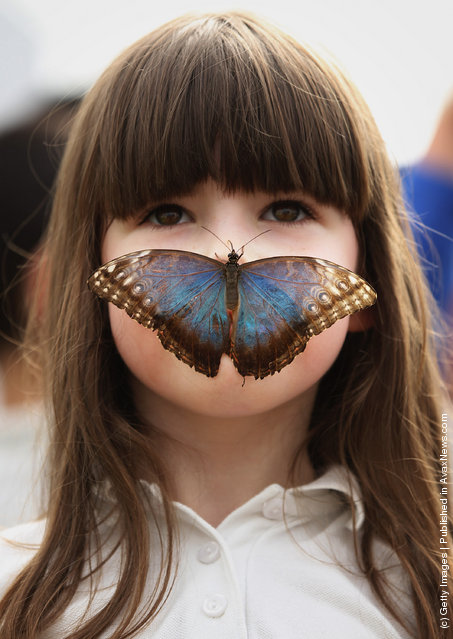
A girl allows a butterfly to be placed on her nose at the Sensational Butterflies exhibition at the Natural History Museum on April 6, 2011 in London, England. The exhibition is divided up into five sensory zones exploring how butterflies see, hear, taste, smell and touch. The display containing hundreds of butterflies runs from April 12 to September 11, 2011. (Photo by Peter Macdiarmid/Getty Images)
Details
07 Apr 2011 08:02:00


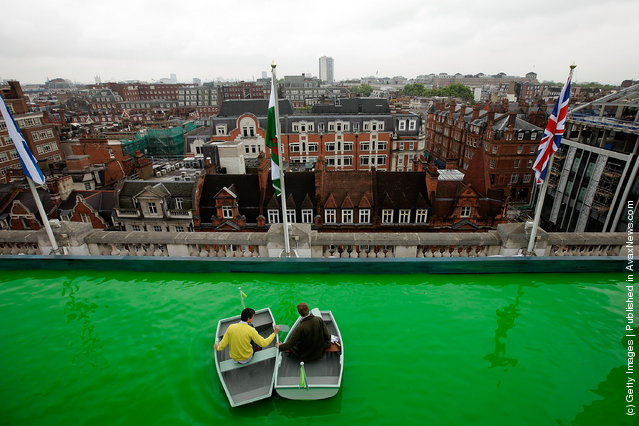
Event curators Harry Parr (L) and Sam Bompas (R) sit in paddle boats in the Truvia Voyage of Discovery installation on the roof of Selfridges department shop on July 21, 2011 in London, England. Selfridges is opening its roof to the public for only the second time since WW2 to host the installation, which includes a boating lake with dyed water and bar. (Photo by Matthew Lloyd/Getty Images)
Details
22 Jul 2011 10:42:00
Protestors Demonstrate Against The UN Intervention In Libya

A muslim woman protests opposite Downing street against the military action taken by the UK, USA and France against Libya on March 21, 2011 in London, England. The Pentagon says that United States and United Kingdom military forces have fired more than 110 missiles, with French planes attacking pro-Gaddafi forces near rebel-held Benghazi. (Photo by Oli Scarff/Getty Images)
Details
21 Mar 2011 18:40:00
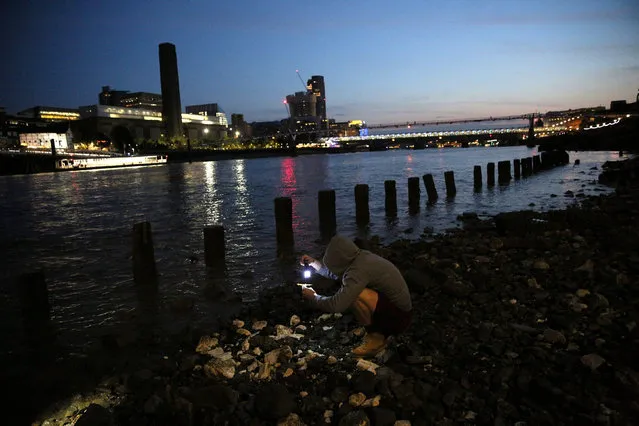
A mudlark uses a torch to look for items on the bank of the River Thames in London, Britain June 06, 2016. Mudlarking is believed to trace its origins to the 18th and 19th century, when scavengers searched the Thames' shores for items to sell. These days, history and archaeology fans are the ones hoping to find old relics such as coins, ceramics, artifacts or everyday items from across centuries. They wait for the low tide and then scour specific areas of exposed shores. "If you're in a field you could be out all day long, with the river you're restricted to about two or three hours," mudlark Nick Stevens said. While many just use the naked eye for their searches, others rely on metal detectors for which a permit from the Port of London Authority is needed. Digging also requires consent. (Photo by Neil Hall/Reuters)

A mudlark uses a torch to look for items on the bank of the River Thames in London, Britain June 06, 2016. Mudlarking is believed to trace its origins to the 18th and 19th century, when scavengers searched the Thames' shores for items to sell. These days, history and archaeology fans are the ones hoping to find old relics such as coins, ceramics, artifacts or everyday items from across centuries. their finds with the Portable Antiquities Scheme. Any item over 300 years old must be recorded. (Photo by Neil Hall/Reuters)
Details
27 Aug 2016 10:43:00
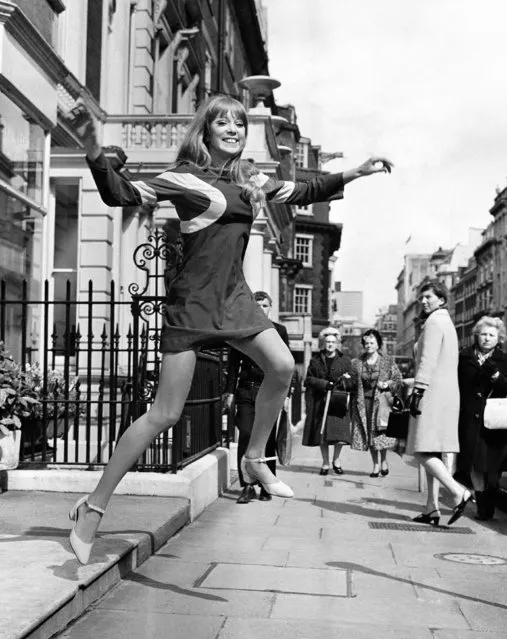
File photo dated 21/04/66 of Pattie Boyd in London's West End wearing a mini skirt, as the British designer Mary Quant, widely credited with popularising the mini skirt has recalled its “feeling of freedom and liberation” 50 years after she took the fashion world by storm. (Photo by PA Wire)

File photo dated 21/04/66 of Pattie Boyd in London's West End wearing a mini skirt, as the British designer Mary Quant, widely credited with popularising the mini skirt has recalled its “feeling of freedom and liberation” 50 years after she took the fashion world by storm. Quant, who named the skirt after her favourite make of car, said she “couldn't have imagined” in 1964 that it would become a staple of women's clothing, but added: “It seemed then to be obvious, and so right”. (Photo by PA Wire)
Details
29 Jan 2015 11:33:00
Pedestrians and workers pass an upside down car art installation in a car park on the South Bank in London, February 19, 2015. British artist Alex Chinneck's illusory piece, entitled “Pick yourself up and pull yourself together”, and on display in the working car park for a week, sees a Vauxhall car suspended upside down, appearing to be gripping onto a peeled back length of tarmac. (Photo by Toby Melville/Reuters)

Pedestrians and workers pass an upside down car art installation in a car park on the South Bank in London, February 19, 2015. British artist Alex Chinneck's illusory piece, entitled “Pick yourself up and pull yourself together”, and on display in the working car park for a week, sees a Vauxhall car suspended upside down, appearing to be gripping onto a peeled back length of tarmac. (Photo by Toby Melville/Reuters)
Details
20 Feb 2015 12:39:00
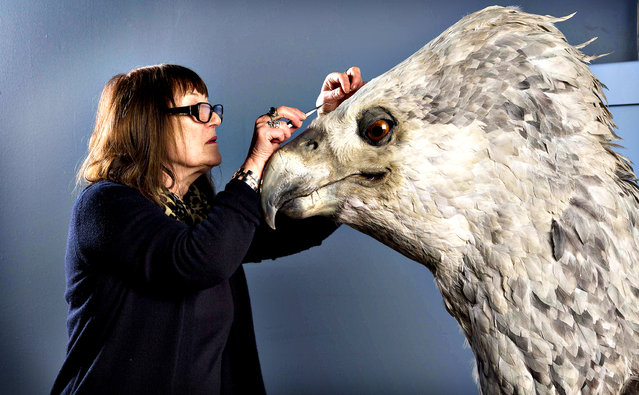
Undated handout photo of Buckbeak, a Hippogriff that lived with Rubeus Hagrid in the Harry Potter series, has his feathers preened and replenished by featherologist Val Jones, as he will feature in the the Feathers and Flight event at Warner Bros. Studio Tour London. (Photo credit should read: Tim Anderson/PA Wire)

Undated handout photo of Buckbeak, a Hippogriff that lived with Rubeus Hagrid in the Harry Potter series, has his feathers preened and replenished by featherologist Val Jones, as he will feature in the the Feathers and Flight event at Warner Bros. Studio Tour London. This is the first make-over Buckbeak has received since the hugely popular Harry Potter film series was made. His intricate coat is created from thousands of individually airbrushed chicken and goose feathers that Val will carefully clean and replenish in time for the start of Feathers and Flight. Val will lead an expert team to demonstrate the techniques that made winged wonders such as Buckbeak and Fawkes the Phoenix a reality on screen. (Photo by Tim Anderson/PA Wire)
Details
22 Mar 2014 13:56:00
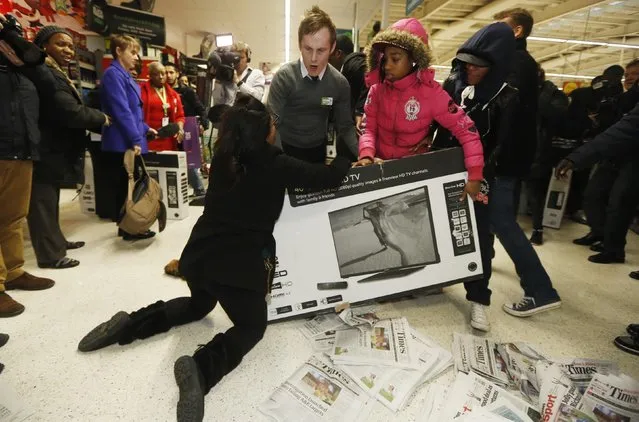
Shoppers wrestle over a television as they compete to purchase retail items on “Black Friday” at an Asda superstore in Wembley, north London November 28, 2014. Britain's high streets, malls and online sites were awash with discounts on Friday as more retailers than ever embraced U.S.-style “Black Friday” promotions, seeking to kickstart trading in the key Christmas period. (Photo by Luke MacGregor/Reuters)

Shoppers wrestle over a television as they compete to purchase retail items on “Black Friday” at an Asda superstore in Wembley, north London November 28, 2014. Britain's high streets, malls and online sites were awash with discounts on Friday as more retailers than ever embraced U.S.-style “Black Friday” promotions, seeking to kickstart trading in the key Christmas period. In the United States the Friday following the Thanksgiving Day holiday is called Black Friday because spending usually surges and indicates the point at which American retailers begin to turn a profit for the year, or go “into the black”. (Photo by Luke MacGregor/Reuters)
Details
29 Nov 2014 12:48:00