Loading...
Done
Chief priest Gbenga Saala raises a cutlass to kill a dog during an annual prayer and sacrifice celebration of the iron god Ogun in Abuja, Nigeria, June 23, 2015. (Photo by Afolabi Sotunde/Reuters)

Chief priest Gbenga Saala raises a cutlass to kill a dog during an annual prayer and sacrifice celebration of the iron god Ogun in Abuja, Nigeria, June 23, 2015. Every year worshippers offer a dog as sacrifice to Ogun, a traditional Nigerian deity, in hope of an auspicious year ahead. Taxi drivers, blacksmiths, panel beaters and mechanics – trades that depend on metal for their livelihood – pay homage to Ogun, led by high priest Gbenga Saala. As part of the ceremony, the priest pours the dog’s blood on symbols of these workers’ trade: keys, spanners and other tools piled up in a metal barrel. (Photo by Afolabi Sotunde/Reuters)
Details
15 Sep 2015 13:56:00
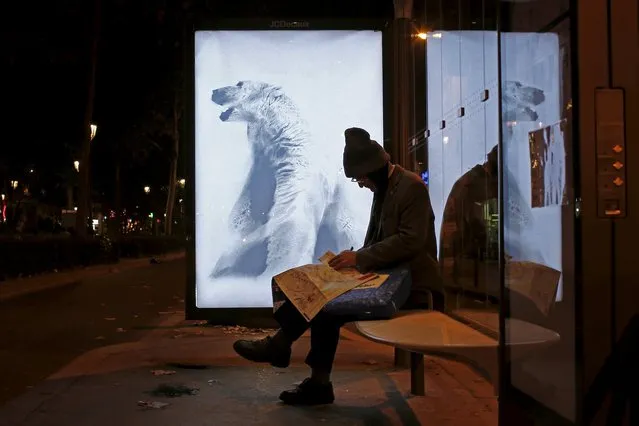
A poster by street artist Aaron Li-Hill as part of the "Brandalism" project is displayed at a bus stop in Paris, France, November 28, 2015, ahead of the United Nations COP21 Climate Change conference in Paris. (Photo by Benoit Tessier/Reuters)

A poster by street artist Aaron Li-Hill as part of the "Brandalism" project is displayed at a bus stop in Paris, France, November 28, 2015, ahead of the United Nations COP21 Climate Change conference in Paris. Brandalism is a revolt against corporate control of the visual realm. Following on in the guerilla art traditions of the 20th Century and taking inspiration from Agitprop, Situationist and Street Art movements, the Brandalism project sees artists from around the world collaborate to challenge the authority and legitimacy of commercial images within public space and within our culture. (Photo by Benoit Tessier/Reuters)
Details
30 Nov 2015 08:03:00
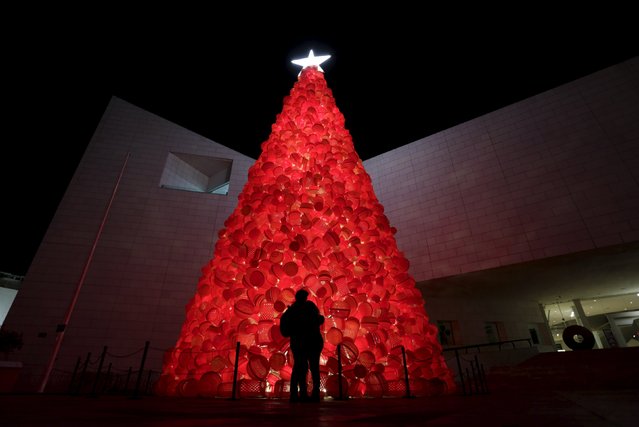
A couple hugs while standing near a Christmas tree made out of plastic bins and plastic hampers outside the Museum of History in Monterrey, Mexico, December 4, 2015. (Photo by Daniel Becerril/Reuters)

A couple hugs while standing near a Christmas tree made out of plastic bins and plastic hampers outside the Museum of History in Monterrey, Mexico, December 4, 2015. The humble Christmas tree has a rich history, from evergreen trees used to symbolise eternal life in Ancient Egypt to tree worship among pagan Europeans. The modern version has its origins in Germany, where the song “O Tannenbaum” is still a festive favourite. Today the traditional tree with lights and decorations appears in cities including Washington, Moscow and Beirut. Alternative constructions range from recycled rubbish in Mexico City to old window frames in Rakvere, Estonia. Whatever the shape or size, the message is the same: Merry Christmas. (Photo by Neil Hall/Reuters)
Details
23 Dec 2015 08:01:00
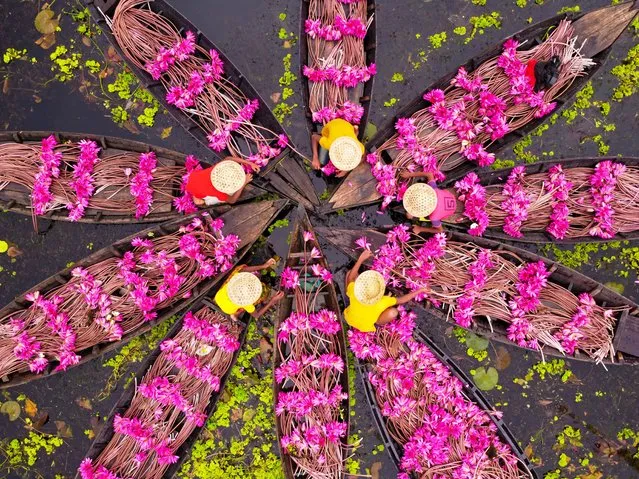
Farmers arrange bunches of water lilies after harvesting them from the wetlands in Barishal, Bangladesh on March 21, 2023. Floating through 10,000 acres of canal, farmers use their little boats to fetch the flowers. They break through the layer of water lilies on the surface of the water as they practice the traditional craft of picking water lilies by hand. Every flower is carefully hand-picked, collected inside the farmers' little wooden boat, tied in bundles, and sold to markets. After working for an entire day, a farmer can pick around 80 to 120 bundles of water lilies. Water lily harvesting is a major source of income for more than 250 families in the area. (Photo by Joy Saha/Cover Images)

Farmers arrange bunches of water lilies after harvesting them from the wetlands in Barishal, Bangladesh on March 21, 2023. Floating through 10,000 acres of canal, farmers use their little boats to fetch the flowers. (Photo by Joy Saha/Cover Images)
Details
01 May 2023 04:00:00
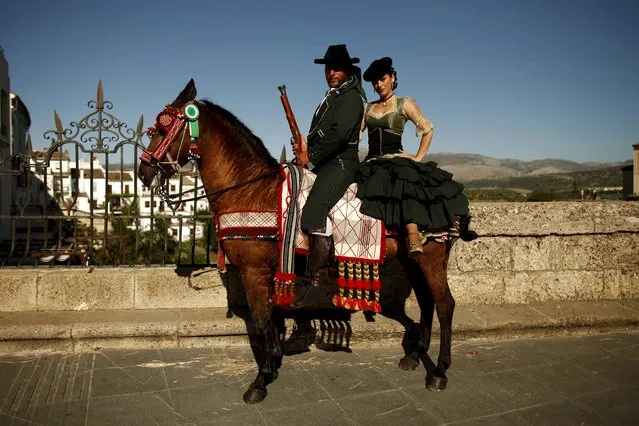
Francisco Javier Moreno (L), 35, and his wife Maria Auxiliadora Canca, 34, dressed as bandits pose for a photo with their horse as they participate in the third edition of “Ronda Romantica” (Romantic Ronda) in Ronda, southern Spain, May 16, 2015. (Photo by Jon Nazca/Reuters)

Francisco Javier Moreno (L), 35, and his wife Maria Auxiliadora Canca, 34, dressed as bandits pose for a photo with their horse as they participate in the third edition of “Ronda Romantica” (Romantic Ronda) in Ronda, southern Spain, May 16, 2015. Ronda Romantica is a cultural, historical and tourist event during the three days where thousands of people of Ronda and about fifty towns around of “Serrania de Ronda” (Ronda Mountain Ranges), dressed in traditional costumes, recreate the era of the bandits, drovers and romantic travelers in the nineteenth century. (Photo by Jon Nazca/Reuters)
Details
18 May 2015 11:32:00
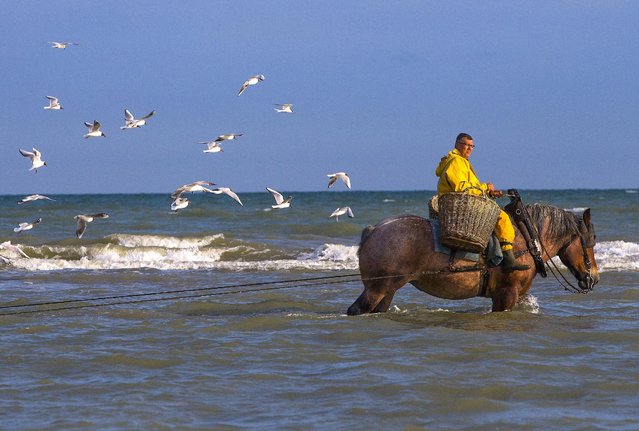
A Belgian shrimp fisherman rides a carthorse to haul a net out in the sea to catch shrimps during low tide at the coastal town of Oostduinkerke, Belgium July 3, 2015. (Photo by Yves Herman/Reuters)

A Belgian shrimp fisherman rides a carthorse to haul a net out in the sea to catch shrimps during low tide at the coastal town of Oostduinkerke, Belgium July 3, 2015. At the end of each fishing session, the fishermen and their mounts leave the water to empty the net's contents into two wicker baskets fixed on each side of the horse. This traditional method of catching shrimps along the North Sea coast, which dates back to some 500 years, attracts tourists every summer. In 2013, Unesco recognized shrimp fishing on horseback as an intangible cultural heritage. (Photo by Yves Herman/Reuters)
Details
04 Jul 2015 11:29:00


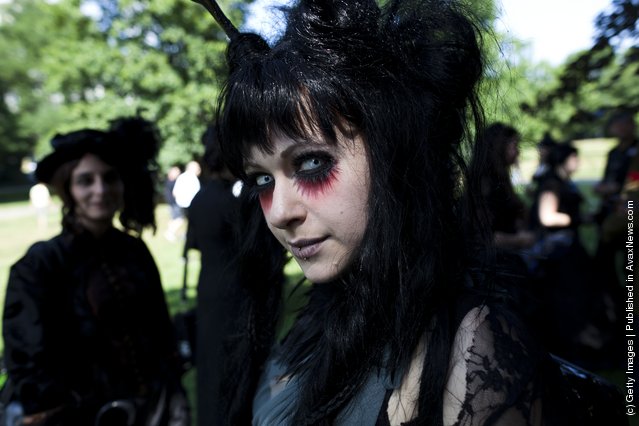
Gothic rock music enthusiasts walk the streets between venues during the annual Wave Gotik music festival on June 11, 2011 in Leipzig, Germany. The festival began in the 1990s and has since grown into one of the biggest gatherings of Goth scene followers in Europe with around 20,000 participants. Many of those attending wear elaborate outfits and make-up for which they require hours of painstaking preparation and that also show a departure from the traditional black of the Goth scene. Punk remains a strong influence in today's Goth style as witnessed in Leipzig, but newer trends, with names like Cybergoth and Steampunk, have emerged that blend bold colors, Victorian fashion elegance and 19th and 20th century factory accessories into a look reminiscent of a mutated Venetian carnival. The five-day festival includes performances by around 200 bands. (Photo by Carsten Koall/Getty Images)
Details
13 Jun 2011 08:31:00
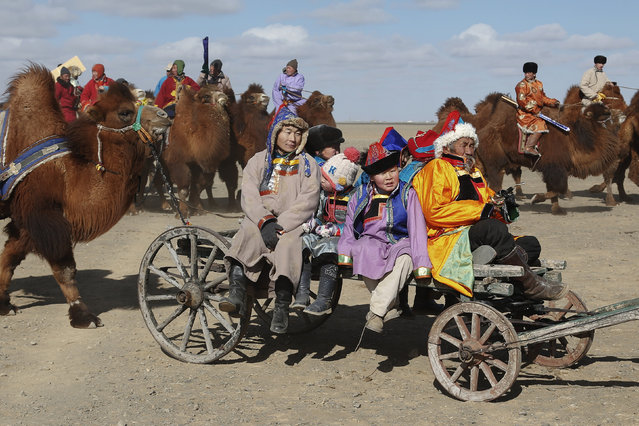
People sit on a cart with a camel tied to it during “Temeenii bayar”, the Camel Festival, in Dalanzadgad, Umnugobi aimag, Mongolia, March 6, 2016. (Photo by B. Rentsendorj/Reuters)

People sit on a cart with a camel tied to it during “Temeenii bayar”, the Camel Festival, in Dalanzadgad, Umnugobi aimag, Mongolia, March 6, 2016. On the steppes of the Gobi Desert, the crowd urges on Bactrian camels laden down with all that's needed to build and live in a traditional Mongolian tent. Guinness World Records classes the 15 km race thatÕs part of the two-day festival as the largest camel race in the world, drawing 1,108 participants. The winning camel romped home in 35 minutes and 12 seconds, according to the records website. (Photo by B. Rentsendorj/Reuters)
Details
30 Mar 2016 11:13:00