Loading...
Done
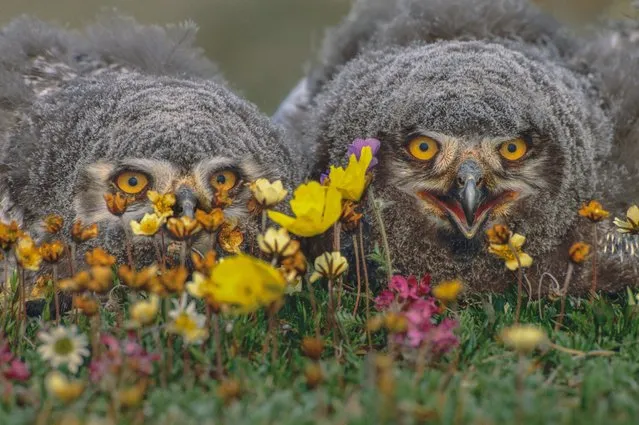
Snowy owlets (Bubo scandiacus), Arctic National Wildlife Refuge, Alaska, USA. “A pair of gray-feathered snowy owlets hunker down in the abundant flowers that flourish in the dropping-enriched soil of their nest mound”. (Photo by Art Wolfe/Art Wolfe Stock)

The photography of Art Wolfe covers the globe, capturing landscapes, wildlife, and cultures from every continent; here he talks through a selection of his favourite images. Art Wolfe is an American photographer and conservationist. His photographs have been noted by environmental advocacy groups for their “stunning” visual impact. Here: Snowy owlets (Bubo scandiacus), Arctic National Wildlife Refuge, Alaska, USA. (Photo by Art Wolfe/Art Wolfe Stock)
Details
19 Mar 2018 00:05:00
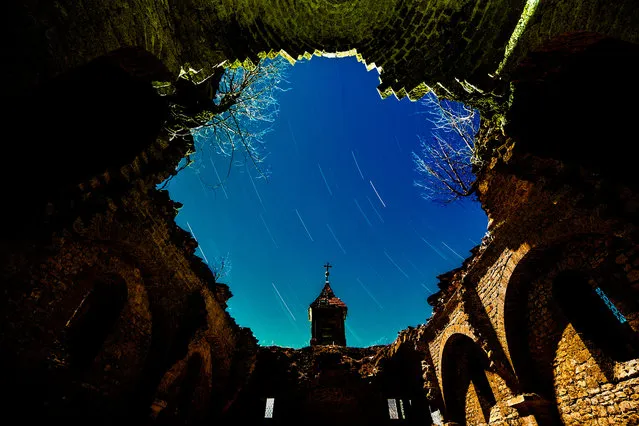
A long exposure image shows star trails from the abandoned submerged orthodox church of St. Nicholas without roof, submerged in the Mavrovo Lake, near Mavrovi Anovi, North Macedonia, 17 March 2019. Constructed in 1850 and submerged in 1952 due to the construction of the hydro system Mavrovo, the church St. Nicholas continues to attract the attention of almost every visitor as it peaks from the water. (Photo by Georgi Licovski/EPA/EFE)

A long exposure image shows star trails from the abandoned submerged orthodox church of St. Nicholas without roof, submerged in the Mavrovo Lake, near Mavrovi Anovi, North Macedonia, 17 March 2019. Constructed in 1850 and submerged in 1952 due to the construction of the hydro system Mavrovo, the church St. Nicholas continues to attract the attention of almost every visitor as it peaks from the water. (Photo by Georgi Licovski/EPA/EFE)
Details
19 Mar 2019 00:03:00
Migrant workers and their families board an overcrowded passenger train, after government imposed restrictions on public gatherings in attempts to prevent spread of coronavirus disease (COVID-19), in Mumbai, India, March 21, 2020. (Photo by Prashant Waydande/Reuters)

Migrant workers and their families board an overcrowded passenger train, after government imposed restrictions on public gatherings in attempts to prevent spread of coronavirus disease (COVID-19), in Mumbai, India, March 21, 2020. (Photo by Prashant Waydande/Reuters)
Details
29 Mar 2020 00:01:00
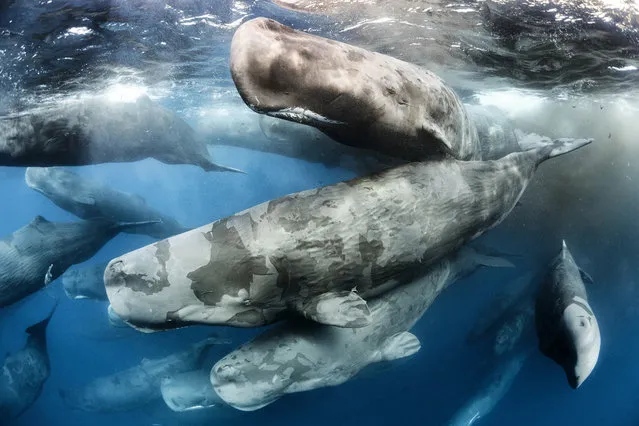
Giant gathering by Tony Wu. “The first indication that something extraordinary was going on were the blows, huge numbers of them – the exhalations of huge numbers of whales. Entering the water, the photographer witnessed an extraordinary scene. Hundreds, possibly thousands, of sperm whales were twirling and twisting through the water, bumping and rubbing against each other, and there was a cacophony of sound – the pulsation, buzz, creak and crackle of whale communication. The picture shows just a fraction of the scene, with the whales stacked up below. Undoubtedly, this was a clan gathering”. (Photo by Tony Wu/Unforgettable Underwater Photography/NHM)

A new book published by the UK Natural History Museum showcases some of the most memorable underwater photographs taken over the last few decades in its annual wildlife photographer of the year competition. Here: Giant gathering by Tony Wu. “The first indication that something extraordinary was going on were the blows, huge numbers of them – the exhalations of huge numbers of whales. Entering the water, the photographer witnessed an extraordinary scene”. (Photo by Tony Wu/Unforgettable Underwater Photography/NHM)
Details
17 Apr 2018 00:03:00
Astronomy Photographer Of The Year 2013 Part1

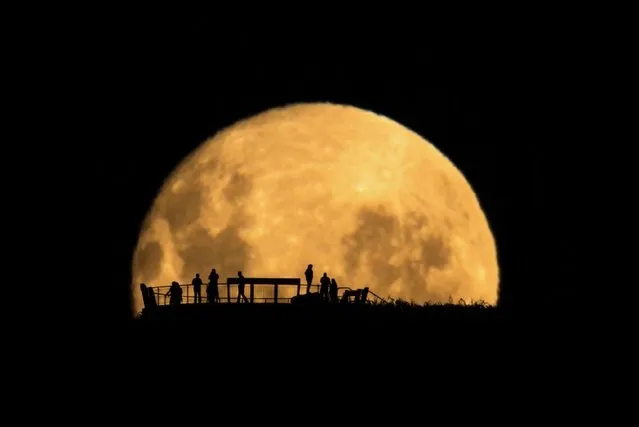
The Royal Observatory just announced its Astronomy Photographer Of The Year 2013 winners. Australian photographer Mark Gee was chosen among a thousand amateur and professional photographers around the globe to win the top title. His work is part of an exhibition of the winning photographers, which opened on Sept. 19 at the Royal Observatory Greenwich. The Royal Observatory shared with us the winners and notable mentions of the competition. Their descriptions of the prizewinners can be found below the images.
Details
04 Oct 2013 11:45:00
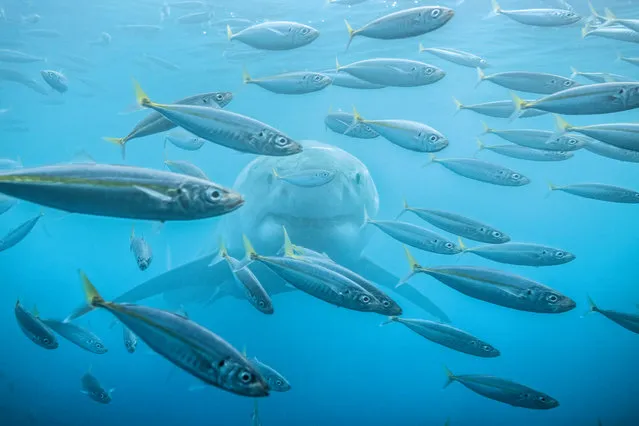
Under Exposed: Pekka Tuuri (Finland) – Great white shark, Isla Guadalupe, Mexico. Isla Guadalupe is the world capital when it comes to observing great white sharks, but cage diving seriously limits the possibilities to take ‘fresh’ pictures. When I took this, the water close to the surface was quite milky, making photography very challenging. From out of the ‘mist’, I saw this great white shark lurking behind a school of fusiliers. I quickly focused on the shark and set a wide aperture to get focus blur on the fish, along with a fast shutter to avoid excessive motion blur. (Photo by Pekka Tuuri/The Outdoor Photographer of the Year/The Guardian)

Under Exposed: Pekka Tuuri (Finland) – Great white shark, Isla Guadalupe, Mexico. “Isla Guadalupe is the world capital when it comes to observing great white sharks, but cage diving seriously limits the possibilities to take ‘fresh’ pictures. When I took this, the water close to the surface was quite milky, making photography very challenging. From out of the “mist”, I saw this great white shark lurking behind a school of fusiliers. I quickly focused on the shark and set a wide aperture to get focus blur on the fish, along with a fast shutter to avoid excessive motion blur”. (Photo by Pekka Tuuri/The Outdoor Photographer of the Year/The Guardian)
Details
25 Jan 2018 07:37:00
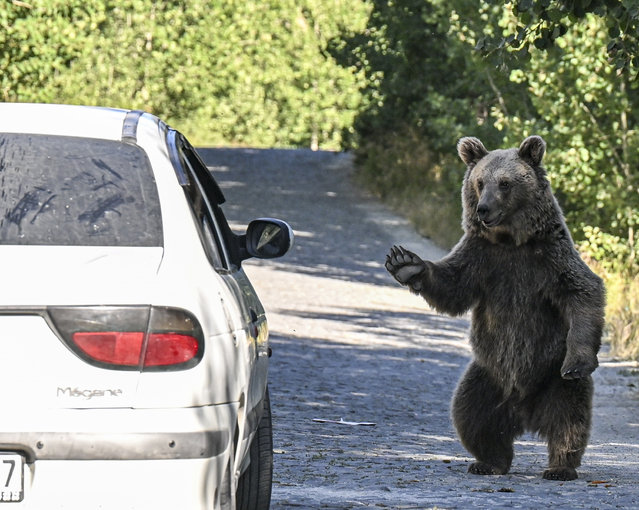
A grizzly bear waves its paw at a vehicle on the road to Nemrut Crater Lake in Tatvan district of Bitlis, Turkiye on August 24, 2023. (Photo by Muhammed Selim Korkutata/Anadolu Agency via Getty Images)

A grizzly bear waves its paw at a vehicle on the road to Nemrut Crater Lake in Tatvan district of Bitlis, Turkiye on August 24, 2023. (Photo by Muhammed Selim Korkutata/Anadolu Agency via Getty Images)
Details
19 Sep 2023 02:53:00
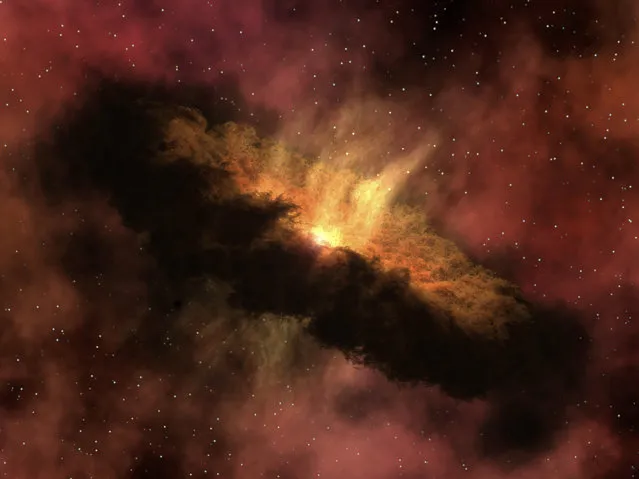
A fledgling solar system containing deep within it enough water vapor to fill all the oceans on Earth five times, located in our Milky Way galaxy about 1,000 light years from Earth in the constellation Perseus. (Photo by Reuters/NASA/JPL-Caltech)

A fledgling solar system containing deep within it enough water vapor to fill all the oceans on Earth five times, located in our Milky Way galaxy about 1,000 light years from Earth in the constellation Perseus. (Photo by Reuters/NASA/JPL-Caltech)
Details
28 Sep 2016 11:01:00