Loading...
Done
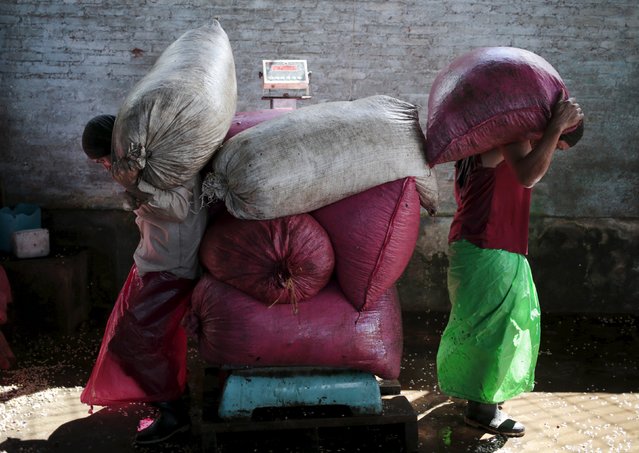
Workers carry sacks of coffee beans at a warehouse at the Nogales farm in Jinotega, Nicaragua January 7, 2016. (Photo by Oswaldo Rivas/Reuters)

Workers carry sacks of coffee beans at a warehouse at the Nogales farm in Jinotega, Nicaragua January 7, 2016. Soaring temperatures in Central America due to climate change are forcing farmers to pull up coffee trees and replace them with cocoa, spurring a revival in the cultivation of a crop once so essential to the region's economy. (Photo by Oswaldo Rivas/Reuters)
Details
20 Jan 2016 08:00:00
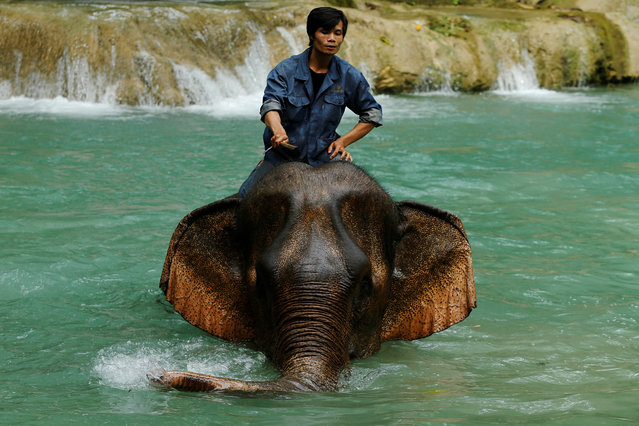
A mahout rides an elephant at Tad Sae Waterfall outside Luang Prabang, Laos July 31, 2016. (Photo by Jorge Silva/Reuters)

A mahout rides an elephant at Tad Sae Waterfall outside Luang Prabang, Laos July 31, 2016. Protected by the United Nations cultural heritage agency UNESCO, Luang Prabang is one of the most alluring places in the region – a city that evokes old-world romance that has gained a reputation as a travellers' Shangri La. (Photo by Jorge Silva/Reuters)
Details
04 Sep 2016 09:05:00
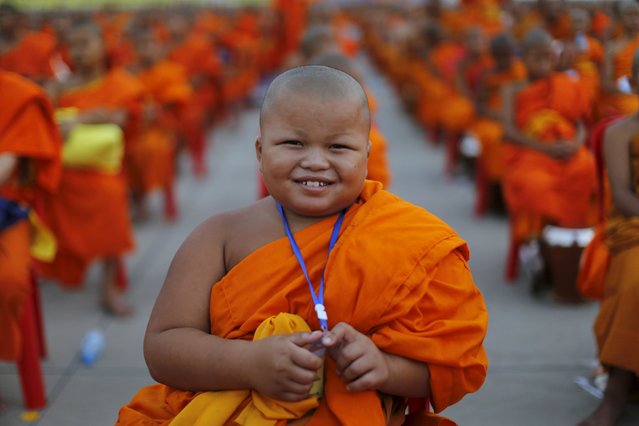
Buddhist novice poses for a picture while monks gather to receive alms at Wat Phra Dhammakaya temple, in what organizers said was a meeting of over 100,000 monks, in Pathum Thani, outside Bangkok April 22, 2016. (Photo by Jorge Silva/Reuters)

Buddhist novice poses for a picture while monks gather to receive alms at Wat Phra Dhammakaya temple, in what organizers said was a meeting of over 100,000 monks, in Pathum Thani, outside Bangkok April 22, 2016. (Photo by Jorge Silva/Reuters)
Details
23 Apr 2016 13:27:00
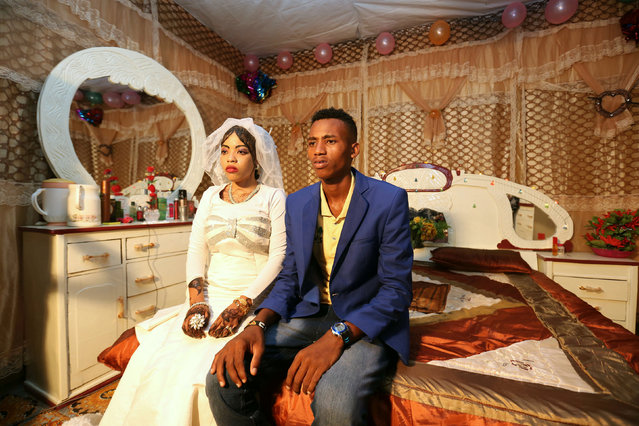
Somali couple Mohamed Noor (L) and Huda Omar pose for a photograph at their makeshift home during their wedding ceremony in Mogadishu's Rajo camp, Somalia August 17, 2016. Having met two years ago, the pair have just married at Rajo camp, where some 400 families live. Most, like Noor's parents, came here in the early 1990s to flee famine. They stayed on as years of conflict ravaged the Horn of Africa nation. As at any wedding, there is plenty of dancing and sweet treats for the young couple as they start married life in Noor's simple home, made of iron and plastic sheets. Noor works as a mason with his father. Others here are builders or sell sweets, nuts and stick toothbrushes to make money. Some beg around the seaside city, which like the rest of Somalia has been gripped by violence since the toppling of dictator Mohamed Siad Barre in 1991. (Photo by Feisal Omar/Reuters)

Somali couple Mohamed Noor (L) and Huda Omar pose for a photograph at their makeshift home during their wedding ceremony in Mogadishu's Rajo camp, Somalia August 17, 2016. Having met two years ago, the pair have just married at Rajo camp, where some 400 families live. Most, like Noor's parents, came here in the early 1990s to flee famine. (Photo by Feisal Omar/Reuters)
Details
14 Sep 2016 10:35:00
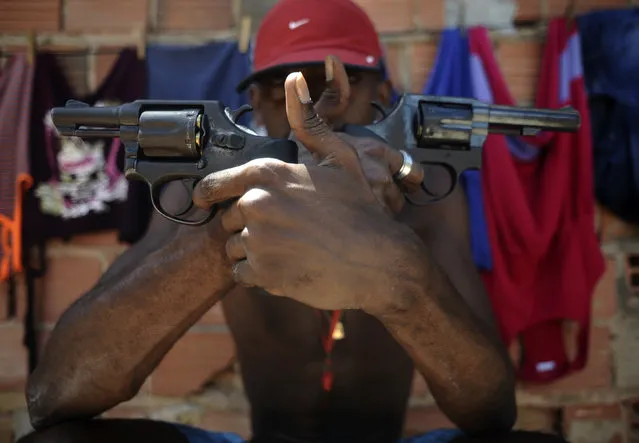
A Brazilian drug gang member nicknamed Pilintra, 26, poses with a gun atop a hill overlooking a slum in Salvador, Bahia State, April 11, 2013. One of Brazil's main tourist destinations and a 2014 World Cup host city, Salvador suffers from an unprecedented wave of violence with an increase of over 250% in the murder rate, according to the Brazilian Center for Latin American Studies (CEBELA). (Photo by Lunae Parracho/Reuters)

A Brazilian drug gang member nicknamed Pilintra, 26, poses with a gun atop a hill overlooking a slum in Salvador, Bahia State, April 11, 2013. One of Brazil's main tourist destinations and a 2014 World Cup host city, Salvador suffers from an unprecedented wave of violence with an increase of over 250% in the murder rate, according to the Brazilian Center for Latin American Studies (CEBELA). (Photo by Lunae Parracho/Reuters)
Details
04 May 2013 11:12:00
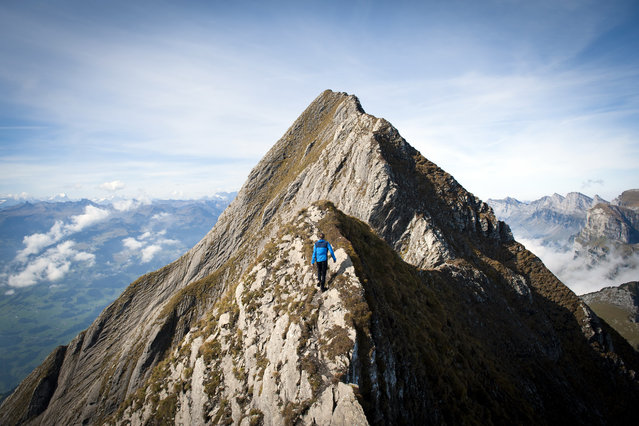
A climber walks on the ridge beneath the eastern peak of the Gamsberg (2385 meters above sea level) near Grabs, Switzerland, Friday, October 3, 2014. (Photo by Gian Ehrenzeller/AP Photo/Keystone)

A climber walks on the ridge beneath the eastern peak of the Gamsberg (2385 meters above sea level) near Grabs, Switzerland, Friday, October 3, 2014. (Photo by Gian Ehrenzeller/AP Photo/Keystone)
Details
28 Jan 2015 12:38:00
A girl paddles on her stand-up board on the waters of Guanabara bay at Bica beach in Rio de Janeiro Brazil, January 10, 2016. (Photo by Ricardo Moraes/Reuters)

A girl paddles on her stand-up board on the waters of Guanabara bay at Bica beach in Rio de Janeiro Brazil, January 10, 2016. Few features capture the beauty, or the problems, of one of the world's most dramatic urban landscapes like Guanabara Bay - the finger-like inlet that forms the shoreline and harbor for Rio de Janeiro. The bay, which carves into southeast Brazil from the Atlantic Ocean, literally gave Rio its name when Portuguese mariners mistook it for a “rio”, or “river”. Four centuries later, the bay is preparing to welcome another sort of seafarer – Olympic sailors, who will navigate the bay when the 2016 Rio Olympics kick off in August. (Photo by Ricardo Moraes/Reuters)
Details
28 Apr 2016 12:13:00
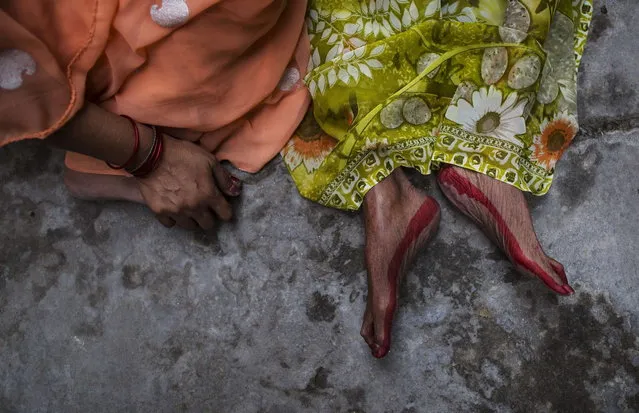
A relative (L) of Champa Devi, 88, sits next to her body, minutes after her death at Mukti Bhavan (Salvation House) at Varanasi, in the northern Indian state of Uttar Pradesh, June 21, 2014. (Photo by Danish Siddiqui/Reuters)

A relative (L) of Champa Devi, 88, sits next to her body, minutes after her death at Mukti Bhavan (Salvation House) at Varanasi, in the northern Indian state of Uttar Pradesh, June 21, 2014. The city of Varanasi, on the banks of the River Ganges, is widely considered Hinduism's holiest city and many Hindus believe that dying there and having their remains scattered in the Ganges allows their soul to escape a cycle of death and rebirth, attaining “moksha” or salvation. “Mukti Bhavan” or “Salvation House”, is a charity-run hostel that caters for people who wish to come to Varanasi to die. Guests can normally stay up to two weeks after which, if they haven't yet passed away, they are gently asked to leave. (Photo by Danish Siddiqui/Reuters)
Details
24 Jul 2014 12:32:00