Loading...
Done
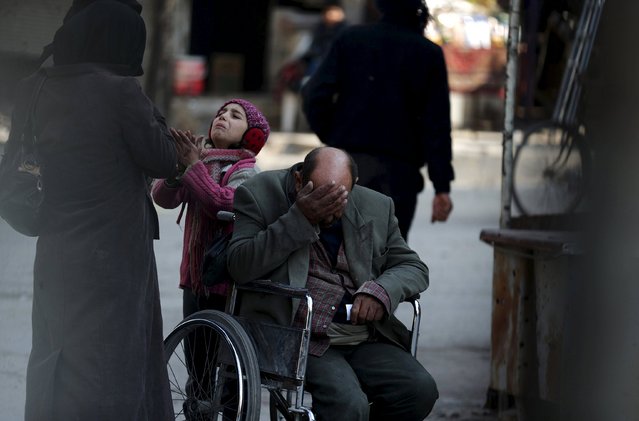
A girl asks a passerby for help to pay a medical bill as her father sits in his wheelchair in the Douma neighbourhood of Damascus Syria February 3, 2016. (Photo by Bassam Khabieh/Reuters)

Hadeel, 10, asks a passerby for help to pay a medical bill as her father Shahrour, 54, sits in his wheelchair in the Douma neighbourhood of Damascus Syria February 3, 2016. Shahrour said he developed diabetes at the beginning of the war in Syria. A lack of insulin led to his medical condition worsening and his right foot had to be amputated. Recently he also suffered a stroke that paralysed half his face. He and part of his extended family, a total of 18 people, live together and struggle to get by. (Photo by Bassam Khabieh/Reuters)
Details
12 Feb 2016 12:46:00
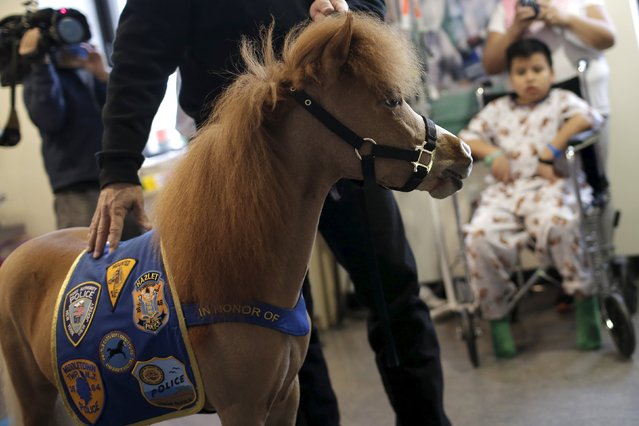
Handler Jorge Garcia-Bengochea holds Honor, a miniature therapy horse from Gentle Carousel Miniature Therapy Horses, as they visit with patients at the Kravis Children's Hospital at Mount Sinai in the Manhattan borough of New York City, March 16, 2016. (Photo by Mike Segar/Reuters)

Handler Jorge Garcia-Bengochea holds Honor, a miniature therapy horse from Gentle Carousel Miniature Therapy Horses, as they visit with patients at the Kravis Children's Hospital at Mount Sinai in the Manhattan borough of New York City, March 16, 2016. Some of the most powerful medicine delivered to young patients at Mount Sinai Hospital in New York on Wednesday came in a package less than 32 inches tall and with a tail. Honor, a 10-month-old colt with Gentle Carousel Miniature Therapy Horses, trotted into the hearts of dozens of children and teens being treated at the Manhattan hospital. (Photo by Mike Segar/Reuters)
Details
18 Mar 2016 11:51:00
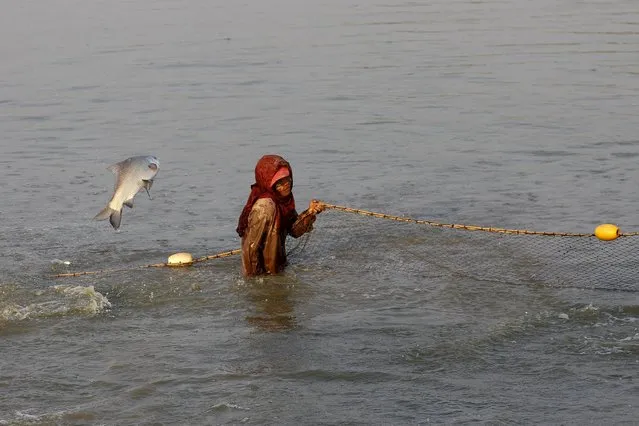
A fish jumps over a net as a boy works in a fish farm at Htantapin township, outside Yangon, Myanmar February 18, 2016. (Photo by Soe Zeya Tun/Reuters)

A fish jumps over a net as a boy works in a fish farm at Htantapin township, outside Yangon, Myanmar February 18, 2016. One in five children in Myanmar aged 10-17 go to work instead of school, according to figures from a census report on employment published last month, and the opening up of the economy since 2011 has triggered a spike in demand for labour. Many children work in fish farming and processing. At Yangon's San Pya fish market, the country's largest, girls and boys as young as nine clean and process fish and unload boats and trucks during 12-hour overnight shifts. (Photo by Soe Zeya Tun/Reuters)
Details
20 Apr 2016 12:18:00
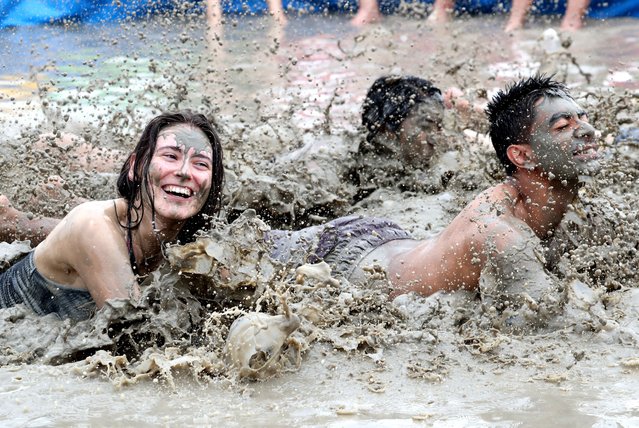
Foreign tourists who visited the “Boryeong Mud Festival” venue in Boryeong-si, Chungcheongnam-do on the July 19th, 2024 are having fun rolling around in a mud bath. The 27th Boryeong Mud Festival this year will be held until the 4th of next month. Last year, more than 1.6 million tourists visited the festival. (Phoot by Shin Hyeon-jong)

Foreign tourists who visited the “Boryeong Mud Festival” venue in Boryeong-si, Chungcheongnam-do on the July 19th, 2024 are having fun rolling around in a mud bath. The 27th Boryeong Mud Festival this year will be held until the 4th of next month. Last year, more than 1.6 million tourists visited the festival. (Phoot by Shin Hyeon-jong)
Details
09 Aug 2024 04:29:00
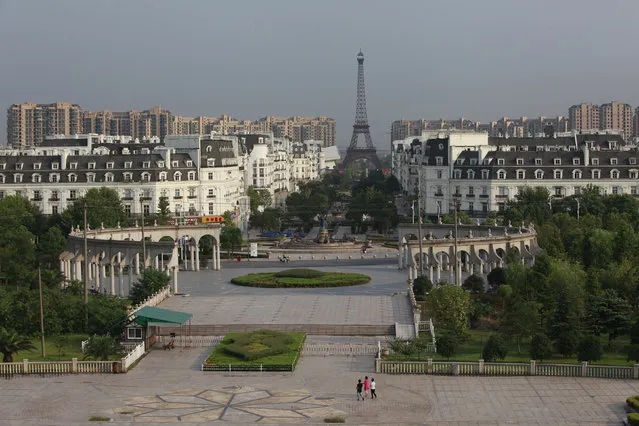
A view of the Tianducheng development in Hangzhou, Zhejiang Province August 1, 2013. Tianducheng, developed by Zhejiang Guangsha Co. Ltd., started constructing in 2007 and was known as a knockoff of Paris with a scaled-replica of the Eiffel Tower, standing 108 metres, and Parisian houses. Although designed to accommodate at least ten thousand people, Tianducheng remains sparsely populated and is now considered as a “ghost town”, according to local media. (Photo by Aly Song/Reuters)

A view of the Tianducheng development in Hangzhou, Zhejiang Province August 1, 2013. Tianducheng, developed by Zhejiang Guangsha Co. Ltd., started constructing in 2007 and was known as a knockoff of Paris with a scaled-replica of the Eiffel Tower, standing 108 metres, and Parisian houses. Although designed to accommodate at least ten thousand people, Tianducheng remains sparsely populated and is now considered as a “ghost town”, according to local media. (Photo by Aly Song/Reuters)
Details
06 Aug 2013 07:48:00


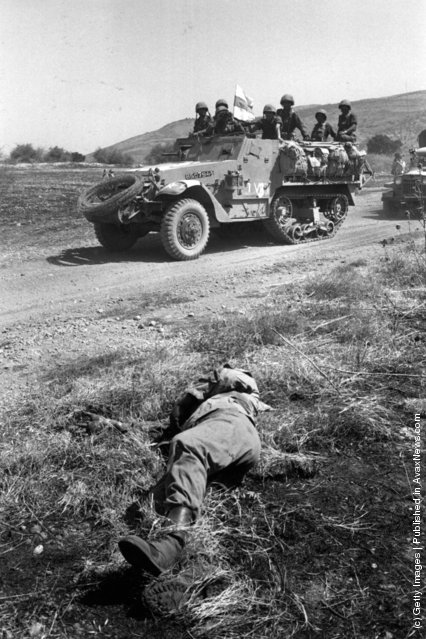
“The Six-Day War or June War, also known as the 1967 Arab-Israeli War or the Third Arab-Israeli War, was fought between June 5 and June 10, 1967, by Israel and the neighboring states of Egypt (known then as the United Arab Republic [UAR]), Jordan, and Syria. The war began with a large-scale surprise air strike by Israel on Egypt. The outcome was a swift and decisive Israeli victory. Israel took effective control of the Gaza Strip and the Sinai Peninsula from Egypt, the West Bank and East Jerusalem from Jordan, and the Golan Heights from Syria. Opinions are divided on whether Israel's attack was an act of aggression or a preemptive strike of a defensive nature”. – Wikipedia

Photo: The corpse of a soldier lying on the line of the Israeli advance into Syria during the Six-Day War. (Photo by Terry Fincher/Getty Images). 1967
Details
21 May 2011 08:29:00


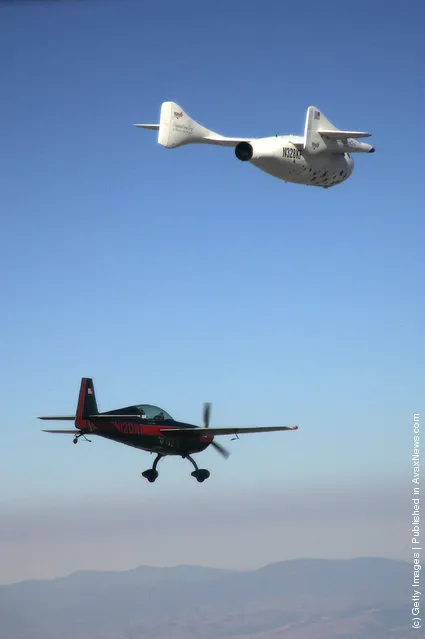
“SpaceShipOne was a suborbital air-launched spaceplane that completed the first manned private spaceflight in 2004. That same year, it won the US$10 million Ansari X Prize and was immediately retired from active service. Its mothership was named “White Knight”. Both craft were developed and flown by Mojave Aerospace Ventures, which was a joint venture between Paul Allen and Scaled Composites, Burt Rutan's aviation company. Allen provided the funding of approximately US$25 million”. – Wikipedia

Photo: A chase plane follows SpaceShipOne after it reached a height of 62 miles in the first non-governmental flight to leave the Earth's atmosphere on June 21, 2004 in Mojave, California. SpaceShipOne spacecraft was carried to a height of 50,000 by the twin-turbojet high-altitude research aircraft, “White Knight”, where it was launched for its final climb. The space effort was funded by Microsoft co-founder Paul Allen and headed by aerospace engineer Burt Rutan. (Photo by Jim Campbell-Pool/Getty Images)
Details
26 Jun 2011 09:56:00
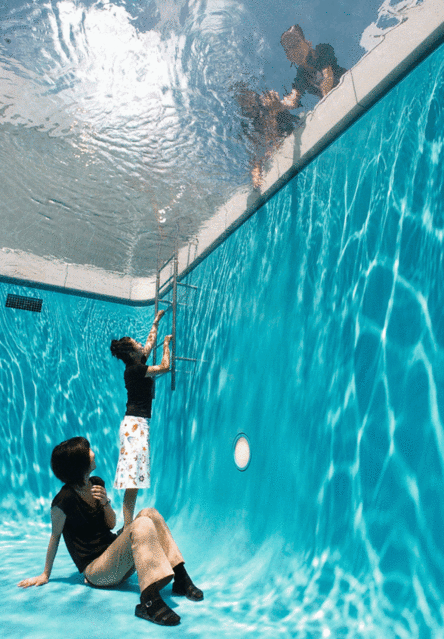
Swimming Pool Art Installation by Leandro Erlich

In one of the Museum’s courtyards is a swimming pool framed by a limestone deck. When seen from the deck, the pool appears to be filled with deep, shimmering water. In fact, however, a layer of water only some 10 centimeters deep is suspended over transparent glass. Below the glass is an empty space with aquamarine walls that viewers can enter. The work sets up an unfolding sequence of experiences—we view the pool through the glass wall enclosing the courtyard; from the deck, looking down into the pool; and from the interior of the pool, looking up. The Swimming Pool might hence be considered a place where, slowly, with time, different perspectives and perceptions of self and others all come to intersect.
Details
25 Aug 2012 07:31:00