Loading...
Done
Myanmar punks walk in the downtown area as they take part in a punk gathering ahead of the Thingyan water festival in Yangon, Myanmar, 12 April 2017. Myanmar punks have been gathering in Yangon on the day ahead of Thingyan water festival to celebrate every year. The annual water festival is marked with large groups of people congregating to celebrate by splashing water and throwing powder at each others faces as a symbolic sign of cleansing and washing away the sins from the old year to mark the traditional New Year in countries such as Myanmar, Thailand, Laos and Cambodia. This year, the Myanmar Thingyan water festival falls on 13 April and ends on 16 April. (Photo by Lynn Bo Bo/EPA)

Myanmar punks walk in the downtown area as they take part in a punk gathering ahead of the Thingyan water festival in Yangon, Myanmar, 12 April 2017. Myanmar punks have been gathering in Yangon on the day ahead of Thingyan water festival to celebrate every year. The annual water festival is marked with large groups of people congregating to celebrate by splashing water and throwing powder at each others faces as a symbolic sign of cleansing and washing away the sins from the old year to mark the traditional New Year in countries such as Myanmar, Thailand, Laos and Cambodia. This year, the Myanmar Thingyan water festival falls on 13 April and ends on 16 April. (Photo by Lynn Bo Bo/EPA)
Details
13 Apr 2017 09:28:00
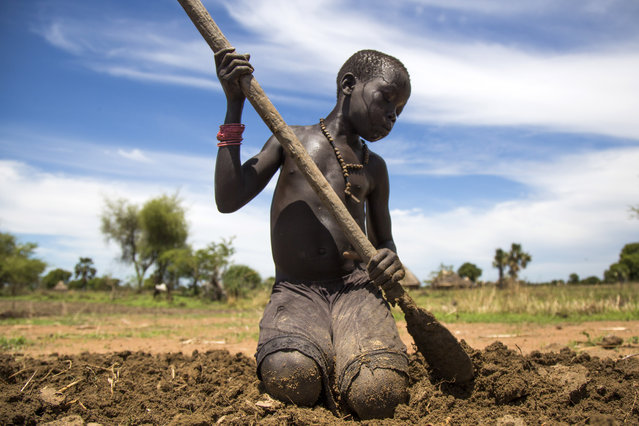
Nyibol Lual, 13 years old, helps her family to prepare the land for cultivation on May 31, 2017, in Panthau, Northern Bahr al Ghazal, South Sudan. The family has a small land where they cultivate sorghum. An estimated 63 per cent of the population in Northern Bahr al Ghazal is experiencing severe food insecurity, according to the latest Integrated Food Security Phase Classification (IPC) report. The situation is particularly bad in Aweil West and Aweil South counties, where the exhaustion of household food stocks and growing dependence on financially inaccessible markets have left the population facing Emergency levels of food insecurity. (Photo by Albert Gonzalez Farran/AFP Photo)

Nyibol Lual, 13 years old, helps her family to prepare the land for cultivation on May 31, 2017, in Panthau, Northern Bahr al Ghazal, South Sudan. The family has a small land where they cultivate sorghum. An estimated 63 per cent of the population in Northern Bahr al Ghazal is experiencing severe food insecurity, according to the latest Integrated Food Security Phase Classification (IPC) report. The situation is particularly bad in Aweil West and Aweil South counties, where the exhaustion of household food stocks and growing dependence on financially inaccessible markets have left the population facing Emergency levels of food insecurity. (Photo by Albert Gonzalez Farran/AFP Photo)
Details
01 Jun 2017 10:10:00
In this Friday, August 9, 2019, file photo, Pakistan Rangers soldiers face Indian Border Security Force soldiers at a daily closing ceremony on the Indian side of the Attari-Wagah border. India's recent clampdown has a long history in Kashmir and the conflict has existed since the late 1940s, when India and Pakistan won independence from the British empire and began fighting over rival claims to the Muslim-majority territory. India and Pakistan have fought two of their three subsequent wars over Kashmir, and each administers a portion of the region. India has long seen the Kashmiri struggle for self-determination as Islamabad's proxy war against New Delhi. (Photo by Prabhjot Gill/AP Photo/File)

In this Friday, August 9, 2019, file photo, Pakistan Rangers soldiers face Indian Border Security Force soldiers at a daily closing ceremony on the Indian side of the Attari-Wagah border. India's recent clampdown has a long history in Kashmir and the conflict has existed since the late 1940s, when India and Pakistan won independence from the British empire and began fighting over rival claims to the Muslim-majority territory. India and Pakistan have fought two of their three subsequent wars over Kashmir, and each administers a portion of the region. India has long seen the Kashmiri struggle for self-determination as Islamabad's proxy war against New Delhi. (Photo by Prabhjot Gill/AP Photo/File)
Details
02 Oct 2019 00:01:00
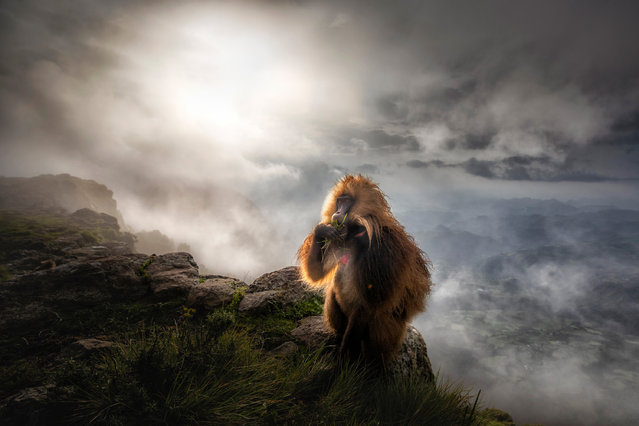
Highly commended, mammals: Gelada after the storm – Marco Gaiotti (Italy). “Gelada baboons are the only monkey species in the world that feed on grasses. They are native to the tableland of Ethiopia. Every morning large family groups wander from their sleeping places in the steep rock face, up to 1,000 metres high, to the feeding grounds at the tablelands. This image clearly depicts their feeding strategy: they pull out bunches of grass, sort the stalks and then lift them to their mouth. This shot was taken towards the end of the rainy season after a heavy storm”. (Photo by Marco Gaiotti/2019 GDT European Wildlife Photographer of the Year)

Highly commended, mammals: Gelada after the storm – Marco Gaiotti (Italy). “Gelada baboons are the only monkey species in the world that feed on grasses. They are native to the tableland of Ethiopia. Every morning large family groups wander from their sleeping places in the steep rock face, up to 1,000 metres high, to the feeding grounds at the tablelands. This image clearly depicts their feeding strategy: they pull out bunches of grass, sort the stalks and then lift them to their mouth. This shot was taken towards the end of the rainy season after a heavy storm”. (Photo by Marco Gaiotti/2019 GDT European Wildlife Photographer of the Year)
Details
31 Oct 2019 00:03:00
Shooting star by Tony Wu, US/Japan. Winner, underwater. The electrifying reproductive dance of a giant sea star. As the surrounding water filled with sperm and eggs from spawning sea stars, Wu faced several challenges. Stuck in a small, enclosed bay with only a macro lens for photographing small subjects, he backed up to squeeze the undulating sea star into his field of view. The dancing posture of spawning sea stars rising and swaying may help release eggs and sperm, or may help sweep the eggs and sperm into the currents where they fertilise together in the water. Kinko Bay, Japan. (Photo by Tony Wu/Wildlife Photographer of the Year)

Shooting star by Tony Wu, US/Japan. Winner, underwater. The electrifying reproductive dance of a giant sea star. As the surrounding water filled with sperm and eggs from spawning sea stars, Wu faced several challenges. Stuck in a small, enclosed bay with only a macro lens for photographing small subjects, he backed up to squeeze the undulating sea star into his field of view. The dancing posture of spawning sea stars rising and swaying may help release eggs and sperm, or may help sweep the eggs and sperm into the currents where they fertilise together in the water. Kinko Bay, Japan. (Photo by Tony Wu/Wildlife Photographer of the Year)
Details
15 Oct 2022 03:50:00
Astronaut Edward H. White II, pilot for the Gemini-Titan 4 (GT-4) spaceflight, floats in the zero-gravity of space during the third revolution of the GT-4 spacecraft on June 3, 1965. White wears a specially designed spacesuit. His face is shaded by a gold-plated visor to protect him from unfiltered rays of the sun. (Photo by NASA)

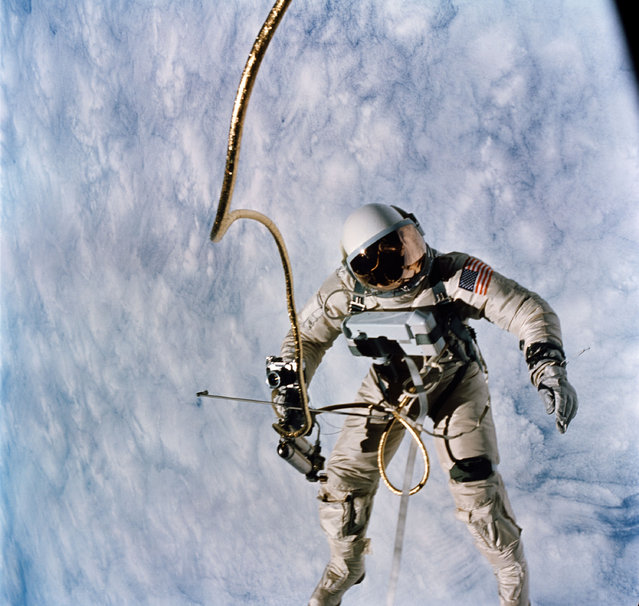
Astronaut Edward H. White II, pilot for the Gemini-Titan 4 (GT-4) spaceflight, floats in the zero-gravity of space during the third revolution of the GT-4 spacecraft on June 3, 1965. White wears a specially designed spacesuit. His face is shaded by a gold-plated visor to protect him from unfiltered rays of the sun. In his right hand he carries a Hand-Held Self-Maneuvering Unit (HHSMU) that gives him control over his movements in space. White also wears an emergency oxygen chest pack; and he carries a camera mounted on the HHSMU for taking pictures of the sky, Earth and the GT-4 spacecraft. He is secured to the spacecraft by a 25-feet umbilical line and a 23-feet tether line. Both lines are wrapped together in gold tape to form one cord. Astronaut James A. McDivitt, command pilot, remained inside the spacecraft during the extravehicular activity (EVA). Astronaut White died in the Apollo/Saturn 204 fire at Cape Kennedy on January 27, 1967. (Photo by NASA)
Details
22 Jul 2014 12:05:00
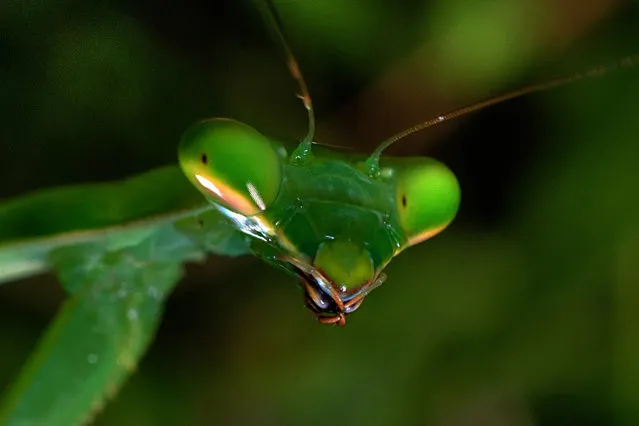
Close Encounter of the Insect Kind: Check out the awesome face on this praying mantis. I can't get over the mouth, it's like something from a science fiction movie. Of all photographic styles macro is definitely my favorite. I am constantly amazed, in every photo that I take, by the intricate level of detail that exists on even the smallest of creatures. It's a stark reminder that a very complex and infinitely beautiful world exists just beyond our human-sized level of perception. Photo taken in Donnybrook, Queensland, Australia. (Photo by Andrew Young/National Geographic Photo Contest

Close Encounter of the Insect Kind: “Check out the awesome face on this praying mantis. I can't get over the mouth, it's like something from a science fiction movie. Of all photographic styles macro is definitely my favorite. I am constantly amazed, in every photo that I take, by the intricate level of detail that exists on even the smallest of creatures. It's a stark reminder that a very complex and infinitely beautiful world exists just beyond our human-sized level of perception. Photo taken in Donnybrook, Queensland, Australia” – Andrew Young. (Photo by Andrew Young/National Geographic Photo Contest via The Atlantic)
Details
24 Sep 2012 09:18:00
Palestinian groom Mohamed abu Daga and his bride Israa wear face masks amid the COVID-19 epidemic, during a photoshoot at a studio before their wedding ceremony in Khan Yunis in the southern Gaza Strip, on March 23, 2020. Authorities in Gaza confirmed on March 22 the first two cases of novel coronavirus, identifying them as Palestinians who had travelled to Pakistan and were being held in quarantine since their return, as the United Nations warned of potential disastrous outcomes to an outbreak given the high poverty rates and weak health system in the coastal strip, under Israeli blockade since 2007. (Photo by Said Khatib/AFP Photo)

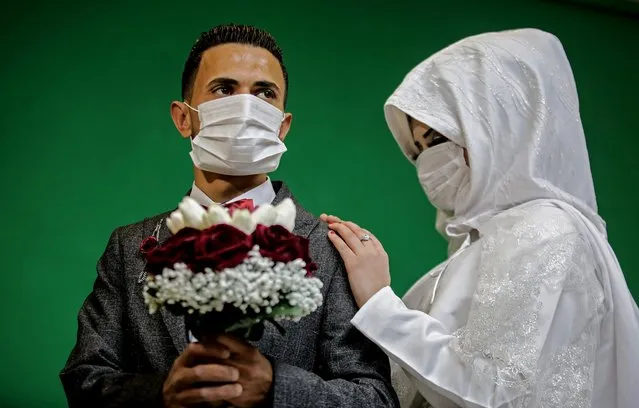
Palestinian groom Mohamed abu Daga and his bride Israa wear face masks amid the COVID-19 epidemic, during a photoshoot at a studio before their wedding ceremony in Khan Yunis in the southern Gaza Strip, on March 23, 2020. Authorities in Gaza confirmed on March 22 the first two cases of novel coronavirus, identifying them as Palestinians who had travelled to Pakistan and were being held in quarantine since their return, as the United Nations warned of potential disastrous outcomes to an outbreak given the high poverty rates and weak health system in the coastal strip, under Israeli blockade since 2007. (Photo by Said Khatib/AFP Photo)
Details
27 Mar 2020 00:07:00