Loading...
Done
Spectacular images offering insight into the lives of the Huaorani people in the Ecuadorian Amazon have been revealed showing how they use traditional methods to hunt monkeys for food. The stunning pictures were taken by conservation photographer Pete Oxford from Torquay, Devon in the Ecuadorian Amazon. “The Huaorani Indians are a forest people highly in tune with their environment. Many are now totally acculturated since the 1950s by missionaries”, said Pete. “Today they face radical change to their culture to the proximity of oil exploration within their territory and the Yasuni National Park and Biosphere Reserve, they are vastly changed. Some still live very traditionally and for this shoot, through my Huaorani friend, a direct relative of those photographed he wanted to depict them as close to their original culture as possible. They still largely hunt with blow pipes and spears eating a lot of monkeys and peccaries”. The Huaorani are also known as the Waorani, Waodani or the Waos and are native Amerindians. Their lands are located between the Curaray and Napo rivers and speak the Huaorani language. Pete says that during his visit he was welcomed into the group and hopes that ancient cultures can be saved. Here: The tribe were seen celebrating after a hunter returned to camp with a wild pig. (Photo by Pete Oxford/Mediadrumworld.com)

Spectacular images offering insight into the lives of the Huaorani people in the Ecuadorian Amazon have been revealed showing how they use traditional methods to hunt monkeys for food. The stunning pictures were taken by conservation photographer Pete Oxford from Torquay, Devon in the Ecuadorian Amazon. Here: The tribe were seen celebrating after a hunter returned to camp with a wild pig. (Photo by Pete Oxford/Mediadrumworld.com)
Details
20 Jan 2017 07:58:00
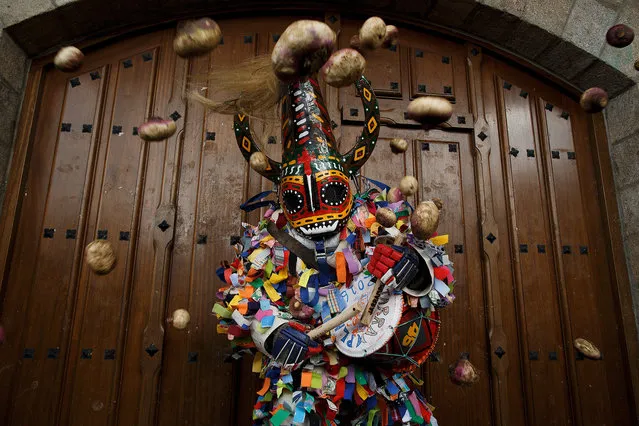
People throw turnips at the Jarramplas as he comes out from the church beating his drum during the Jarramplas Festival on January 20, 2016 in Piornal, Caceres province, Spain. The centuries old Jarramplas festival takes place annually every January 19-20 on Saint Sebastian Day and this year they expect to use more than 20 thousand kilogrames of turnips. Even though the exact origins of the festival are not known, various theories exist including the mythological punishment of Caco by Hercules. (Photo by Pablo Blazquez Dominguez/Getty Images)

People throw turnips at the Jarramplas as he comes out from the church beating his drum during the Jarramplas Festival on January 20, 2016 in Piornal, Caceres province, Spain. The centuries old Jarramplas festival takes place annually every January 19-20 on Saint Sebastian Day and this year they expect to use more than 20 thousand kilogrames of turnips. Even though the exact origins of the festival are not known, various theories exist including the mythological punishment of Caco by Hercules, a relation to ceremonies celebrated by the American Indians that were seen by the first conquerors, to a cattle thief ridiculed and expelled by his village neighbours. It is generally believed to symbolize the expulsion of everything bad. (Photo by Pablo Blazquez Dominguez/Getty Images)
Details
21 Jan 2016 13:21:00
A painter was drawing a lion head body painting on a model during the auto show on March 15, 2015. The local 2015 auto show was held in Xuchang Stadium in Xuchang, Henan Province, China. The exhibitors tried a variety of ways for promotion and attracting people's attention. Some exhibitors were giving gifts to the people scanning their QR codes and add them onto friends list. (Photo by Xu Zhongxin/Sipa Asia)

A painter was drawing a lion head body painting on a model during the auto show on March 15, 2015. The local 2015 auto show was held in Xuchang Stadium in Xuchang, Henan Province, China. The exhibitors tried a variety of ways for promotion and attracting people's attention. Some exhibitors were giving gifts to the people scanning their QR codes and add them onto friends list. An auto company has invited young s*x underwear models and drew body paintings on the girls. (Photo by Xu Zhongxin/Sipa Asia)
Details
21 Mar 2015 13:04:00
Cheng Liping, whose husband Ju was onboard Malaysia Airlines Flight MH370 which disappeared on March 8, 2014, shows a picture of she and her husband together and an old card with a message given by her husband, at a park near her house where she and her husband used to visit during an interview with Reuters in Beijing July 24, 2014. (Photo by Kim Kyung-Hoon/Reuters)

Cheng Liping, whose husband Ju was onboard Malaysia Airlines Flight MH370 which disappeared on March 8, 2014, shows a picture of she and her husband together and an old card with a message given by her husband, at a park near her house where she and her husband used to visit during an interview with Reuters in Beijing July 24, 2014. Cheng said her life has been totally changed since the incident. Their two little sons, who don't know about this incident, keep asking her when their dad is coming back. Six months after Malaysia Airlines Flight MH370, with 239 mostly Chinese people on board, disappeared about an hour into a routine journey from Kuala Lumpur to Beijing March 8, loved ones of missing passengers derive what comfort they can from what's left behind after the world's greatest aviation mystery. More than two dozen countries have been involved in the air, sea and underwater search for the Boeing 777 but months of sorties failed to turn up any trace – even after narrowing the search area to the southern Indian Ocean – long after batteries on the black box voice and data recorders had gone flat. (Photo by Kim Kyung-Hoon/Reuters)
Details
05 Sep 2014 11:27:00
College students take shelter at a traffic point as a man paddles his rickshaw through a flooded road during heavy rain in Guwahati, India, June 13, 2017. (Photo by Anuwar Hazarika/Reuters)

College students take shelter at a traffic point as a man paddles his rickshaw through a flooded road during heavy rain in Guwahati, India, June 13, 2017. (Photo by Anuwar Hazarika/Reuters)
Details
18 Jun 2017 03:31:00
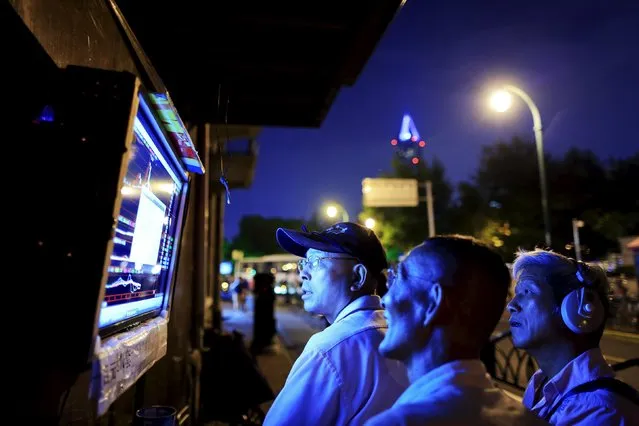
Shen Yuxi (L), introduces analysis software to investors at a “street stock salon” in central Shanghai, China, September 5, 2015. Shen carries a TV screen on his electronic bike to the "salon" every weekends where he sets it up on the wall outside a brokerage house. Shen's been selling analysis software at "the salon" for more than 10 years. (Photo by Aly Song/Reuters)

Some are in it just for the money, others to help buy a meal. Then there are those who trade for fun or to spend time among friends. Millions of investors – pensioners, security guards, high-school students – dominate China's stock markets, conducting about 80 percent of all trades. Retirees gather in brokerage houses dotted around China also to enjoy some company and savour the air conditioning on hot days. Some start as young as 13, trading from home with an eye on future careers in finance. Winning isn't guaranteed. This year, among the most turbulent in China's financial history, its stock markets more than doubled in the six months to May, only to crash amid concerns that growth in the country, which makes everything from cars to steel, is slowing faster than previously thought. (Photo by Aly Song/Reuters)
Details
13 Oct 2015 08:00:00
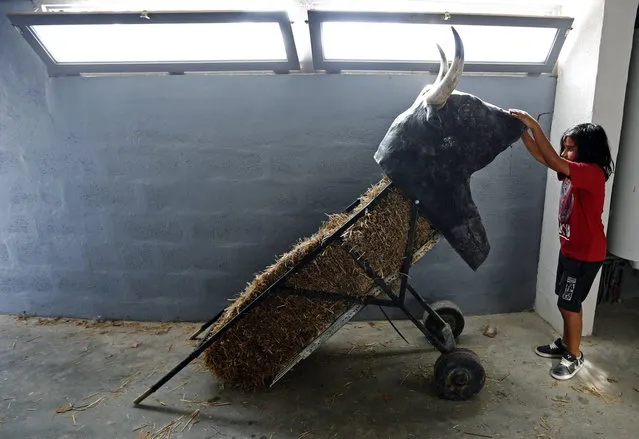
Nino, a ten-year-old toreador apprentice of the French Tauromachy Centre, nicknamed El Nino, touches a practice bull at the bullring of Garons, near Nimes, September 25, 2013. (Photo by Jean-Paul Pelissier/Reuters)

Nino, a ten-year-old toreador apprentice of the French Tauromachy Centre, nicknamed El Nino, touches a practice bull at the bullring of Garons, near Nimes, September 25, 2013. Since 1983, the French Tauromachy Centre in Nimes has trained some 1,000 youths in the art of bullfighting. Twenty of them have gone on to become professional matadors, facing fighting bulls in the arena. Twice a week, students take courses with a matador to learn the movements and gestures of the bullfighter in the ring, but without an animal present. Students train with calves in the surrounding fields during spring, and regularly participate in beginner's bullfights (becerradas) without killing calves. Solal has been taking courses for three years and Nino, for just a year now. Both are normally enrolled in French public schools, but have one thought in mind – bullfighting. They share a passion linked to the city of Nimes, famous for its ferias and bullring. (Photo by Jean-Paul Pelissier/Reuters)

Details
06 Nov 2013 10:12:00
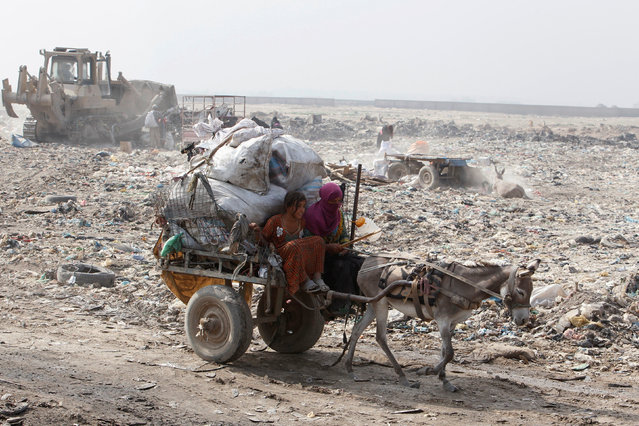
Garbage pickers collect ride on donkey cart while looking for recyclable materials at a rubbish dump in the outskirts of Baghdad, Iraq, August 23, 2016. Despite its huge untapped oil and gas reserves and steadily rising oil output and revenue, 23 percent of the population live below the poverty line, according to the Ministry of Planning. Eg, for 12-year-old Mohammed, life in Sadr City means long days during his school holidays scrabbling through the refuse in the scorching summer heat before selling his daily haul to a middleman. He sells each kilogram (2.2 lb) of plastic bottles or soda cans for 250 Iraqi dinars (around 20 U.S. cents), earning between 2,000 to 4,000 dinars ($1.50–$3) a day. A International Labor Organization report listing dangerous jobs in which children are engaged across the world mentioned collecting garbage as one of the activities in which minors risked suffering violence and injury. (Photo by Khalid al Mousily/Reuters)

Garbage pickers collect ride on donkey cart while looking for recyclable materials at a rubbish dump in the outskirts of Baghdad, Iraq, August 23, 2016. Despite its huge untapped oil and gas reserves and steadily rising oil output and revenue, 23 percent of the population live below the poverty line, according to the Ministry of Planning. (Photo by Khalid al Mousily/Reuters)
Details
24 Aug 2016 11:52:00